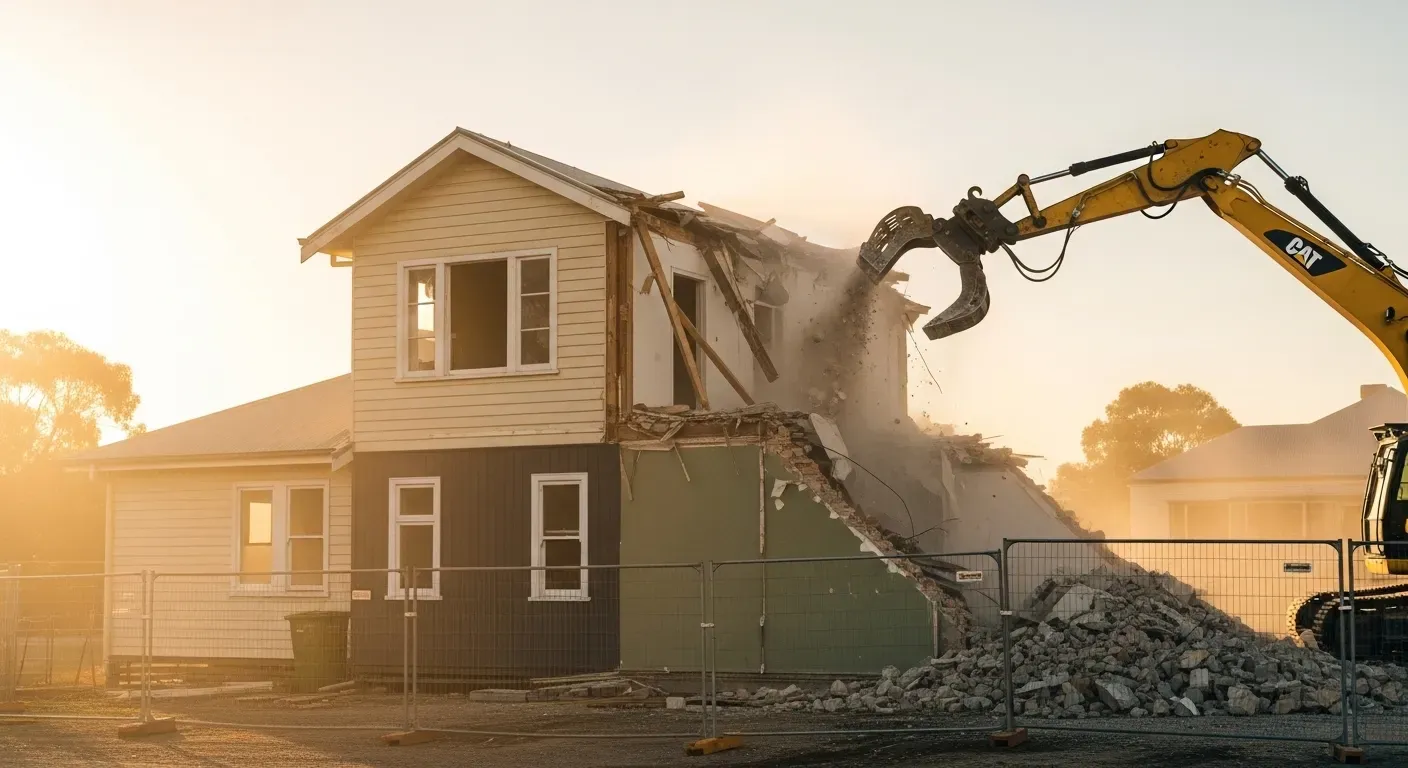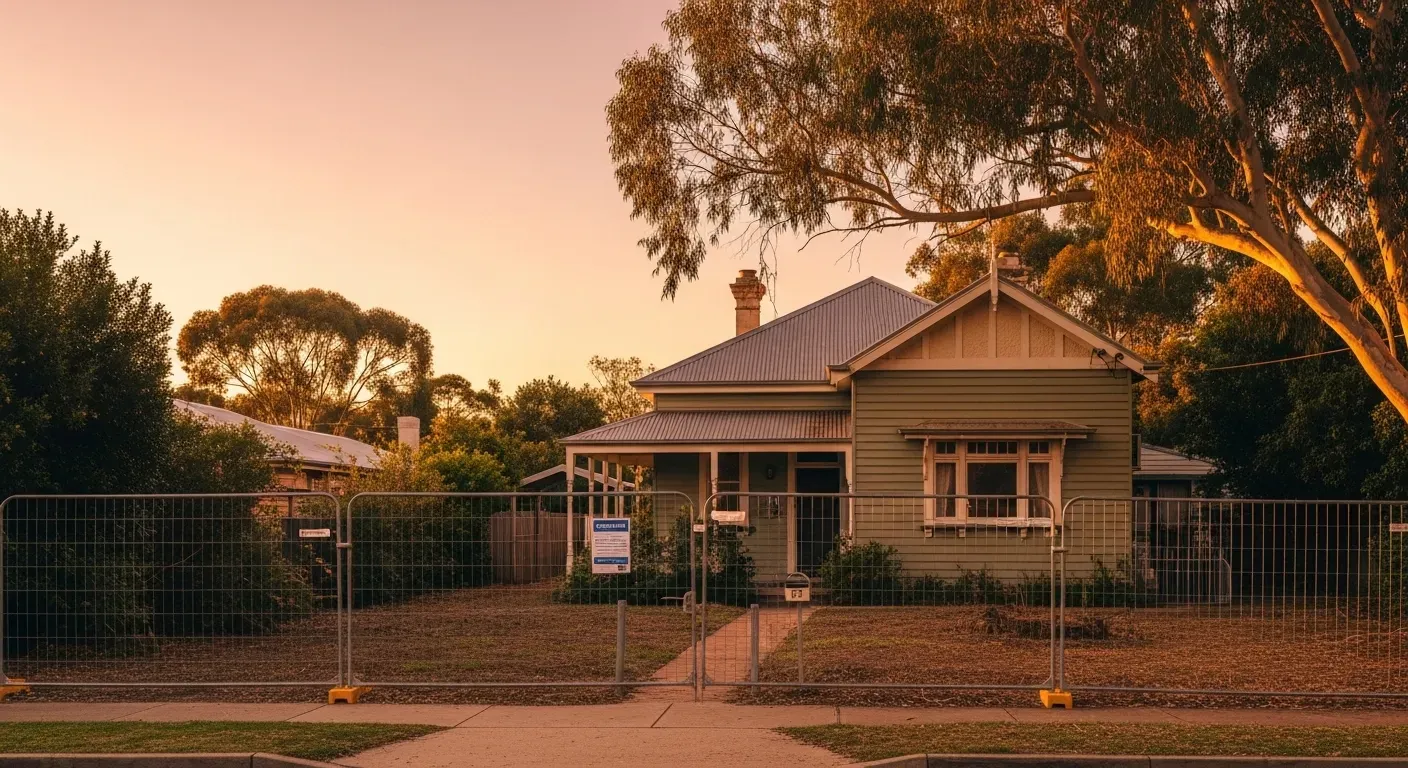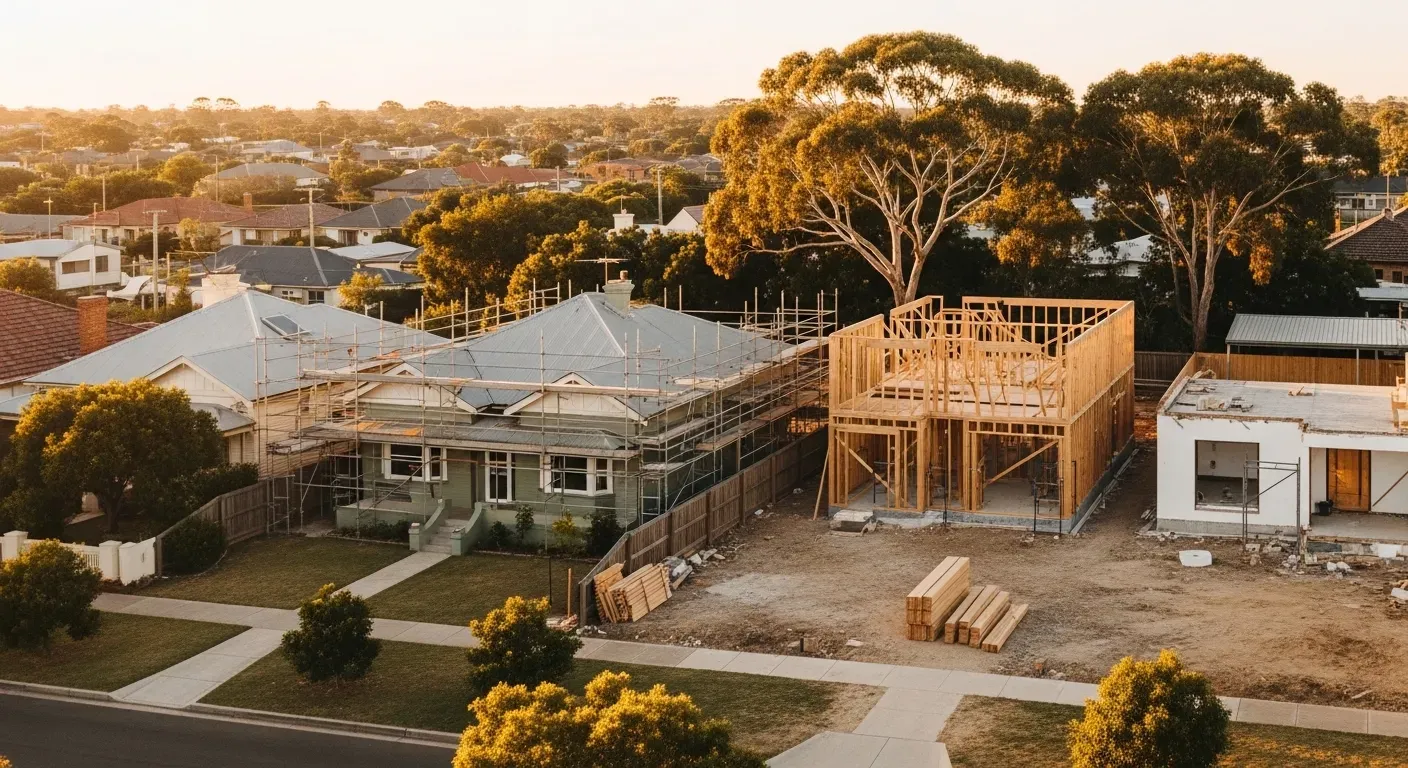
Knockdown Rebuild Total Costs Australia 2026: Complete knockdown rebuild project $300,000-$600,000+ total all-inclusive (lower end basic 3-bedroom house regional areas, upper end 4-5 bedroom quality finishes metro areas). Cost breakdown typical $400,000 mid-range knockdown rebuild Sydney/Melbourne: Demolition phase $10,000-$30,000 (asbestos testing $300-$800 mandatory pre-1990 homes, asbestos removal if present $1,500-$15,000+ depending on extent bonded vs friable, demolition permit $200-$800 plus bond $2,000-$10,000 refundable, service disconnections electricity/gas/water $650-$1,700, actual demolition labor and equipment $4,000-$8,000, waste removal 150-200 tonnes at $150-$250/tonne mixed waste $6,000-$12,000, site clearing and leveling $1,500-$3,500). Development approval and permits $3,500-$6,000 (town planning consultant $2,000-$4,000 if complex site heritage/overlays, Development Application lodgement fee $500-$2,000 varies by council, demolition permit included in demo costs above, building permit $1,000-$3,000, engineering certificates if required $500-$1,200, surveyor site plan $400-$800, energy rating assessment $300-$600 mandatory new builds). Construction costs $290,000-$570,000 (house construction cost $2,000-$3,000 per m² depending on finishes standard/mid-range/premium, typical 150-200m² new house, includes all building work foundations to roof, includes plumbing electrical HVAC, includes fixtures and fittings kitchens bathrooms, does NOT include landscaping or fencing). Additional costs often underestimated: Temporary accommodation during build if selling/moving out of existing property $20,000-$40,000 (rent 12 months at $1,500-$3,500/month regional to metro), storage for belongings during demolition and rebuild $3,000-$8,000 (12-18 months storage container or facility), construction loan fees and interest $8,000-$20,000 (interest-only payments during 12-18 month construction period at 6-8% on borrowed amount, application and establishment fees $500-$1,500), landscaping and fencing after construction $15,000-$40,000 (often overlooked, new houses require complete garden establishment, fencing all boundaries, driveways, paths), council contributed assets fees (some councils charge for street trees, footpath contributions, drainage $2,000-$10,000), utility connection fees electricity/gas/water to new house $1,500-$4,000. Total realistic knockdown rebuild budget $350,000-$650,000 including all above items (many homeowners budget only for construction and demolition, shocked by additional $50,000-$100,000 soft costs and extras). Regional variations significant: Sydney Eastern suburbs/North Shore/Inner West $450,000-$700,000 typical mid-range (20-30% above national average due to difficult site access, higher disposal fees, expensive demolition, premium builder rates), Melbourne inner suburbs similar $420,000-$650,000, Brisbane/Gold Coast $350,000-$550,000 (10-15% above national average), Perth/Adelaide $320,000-$500,000 (at national average, lower land costs and disposal fees), Regional Australia $280,000-$450,000 (10-20% below metro, lower labor rates, simpler council requirements, cheaper waste disposal).

Renovation Costs Australia 2026 Comparison: Full house renovation $150,000-$400,000 depending on scope (lower end cosmetic updates kitchens/bathrooms/flooring/paint, upper end structural changes extensions/reconfiguration/systems). Cost breakdown typical $250,000 extensive renovation: Kitchen renovation full replacement $40,000-$60,000 (cabinets, stone benchtops, quality appliances, plumbing/electrical, tiling), bathroom renovations two bathrooms full replacement $50,000-$80,000 (fixtures, tiling, waterproofing, vanities, frameless screens, quality fittings), flooring throughout house new timber/hybrid/tiles $20,000-$35,000 (150-200m² coverage, remove old flooring, level subfloors, installation), internal painting entire house $15,000-$25,000 (walls and ceilings, prep work, quality paint, 3 coats), external painting and repairs $10,000-$20,000 (weatherboard repair, render repair, quality exterior paint, scaffolding), electrical upgrades full rewiring or partial $15,000-$30,000 (new switchboard, additional circuits, LED downlights throughout, safety switches, compliance certificate), plumbing upgrades $10,000-$20,000 (re-pipe hot water, new fixtures, drainage repairs), roof restoration or replacement $10,000-$25,000 (re-tile, re-bed ridge caps, replace valleys, sarking, or full replacement to Colorbond), heating cooling installation ducted system $8,000-$15,000 (reverse cycle air conditioning throughout), windows and doors replacement $15,000-$35,000 (double glazed windows, new entry door, french doors, better insulation). Renovation cost overruns extremely common 20-40% above initial quote (hidden issues discovered during work: asbestos in walls requires licensed removal adds $5,000-$15,000, termite damage requires structural repairs adds $10,000-$30,000, electrical non-compliant requires full rewire adds $15,000-$25,000, plumbing leaks and water damage requires re-plumbing adds $10,000-$20,000, structural movement foundation issues requires underpinning adds $30,000-$80,000). Scope creep during renovation (while walls open decide to add insulation adds $8,000-$15,000, upgrade to better fixtures and finishes adds $10,000-$25,000, add powder room or ensuite during renovation adds $15,000-$30,000, extend project to include outdoor deck or patio adds $15,000-$40,000). Final realistic renovation budget $180,000-$560,000 if initially quoted $150,000-$400,000 (budget minimum 20% contingency for unknowns, 30-40% if house pre-1960 or visible defects). Renovation versus knockdown decision point 60-70% rule: If renovation quote approaches or exceeds 60-70% of knockdown rebuild cost, rebuild becomes better value. Example: New build $400,000, if renovation quotes $280,000+ ($400k x 70%), knockdown rebuild likely better investment (renovation $280k gives refreshed old house 15-20 year old structure, rebuild $400k gives brand new house 50+ year lifespan, only $120k difference but huge quality difference, ROI favors rebuild).

Demolition Only Costs Australia 2026: Demolition without rebuilding $10,000-$50,000 depending on house size, asbestos presence, site access (small house no asbestos good access $10,000-$15,000, typical house with asbestos typical access $15,000-$25,000, large house extensive asbestos or difficult access $25,000-$50,000). Demolish-only scenarios: Land banking (hold vacant land for future development or capital growth, saves ongoing maintenance costs of deteriorating house, reduces insurance and council rates on land-only versus house, enables land value to appreciate without house detracting), estate settlement (deceased estate with house in poor condition, beneficiaries choose to demolish and sell vacant land rather than renovate or sell as-is, land-only easier to market and sell than dilapidated house), subdivision preparation (demolish house to subdivide large block into multiple lots, most valuable as vacant land ready for subdivision, house in wrong location for subdivision layout), development site preparation (demolish existing house for developer to build townhouses/units/apartment, land sale price higher if already demolished and cleared). Financial considerations demolish-only: Property value impact (demolishing house without rebuilding reduces property value to land value only, typical Melbourne/Sydney inner suburbs land value 60-75% of house+land value, outer suburbs land value 45-60% of house+land value, therefore demolishing $800k property might result in $500k land value, effective loss $300k BUT property might have required $200k+ renovation, net position may still be favorable), council rates (vacant land rated differently than improved property, some councils lower rates vacant land, others higher rates to encourage development, check with council), mortgage implications (if mortgaged property bank holds security over land and buildings, demolishing reduces security value, bank may require partial loan repayment to maintain loan-to-value ratio under 80%, or call in loan if mortgage terms prohibit major changes without consent, ALWAYS get lender written approval before demolishing mortgaged property), land tax (vacant land attracts land tax in most states once above threshold, NSW threshold $1,025,000, VIC $300,000, rates 0.375% to 2%+ depending on value, factor into holding costs if land banking), holding costs (rates, land tax if applicable, ongoing maintenance mowing and securing site, insurance vacant land, total $3,000-$8,000 per year typical residential block metro areas). Demolish-only permits still required (cannot demolish without council permit even if not rebuilding, all standard requirements apply asbestos report, licensed contractor, waste management plan, bond, permit fees, same as knockdown rebuild demolition phase). When demolish-only makes sense: Property value under $500k mostly land value (house contributes minimal value, poor condition or small old cottage on valuable land, demolition cost $15k-$25k small proportion of property value), estate settlement quick sale needed (family cannot agree on renovation vs rebuild, too complex or expensive, demolish and distribute cash proceeds simplest solution), developer has approached (developers prefer vacant land, offer premium for cleared sites ready to develop, price difference may exceed demolition cost making worthwhile demolish before selling). When demolish-only doesn't make sense: Property value substantially in improvements (renovated house or quality home on modest land, demolishing destroys value, better to sell as-is or further renovate), tight market where houses in demand (even run-down houses sell well in hot markets, buyers willing to renovate or knockdown themselves, land-only less appealing), mortgaged without lender approval (risk loan called in or forced sale, never demolish mortgaged property without written bank consent).

Knockdown Rebuild Timeline Australia 2026: Total timeline 10-20 months start to finish depending on complexity (simple projects straightforward sites 10-14 months, complex projects heritage overlays or difficult sites 16-20+ months). Month-by-month detailed timeline typical project 14 months: MONTHS 0-1 Planning and Design Phase (engage architect or designer for house plans, typically 4-8 weeks for initial concepts and revisions, cost $8,000-$20,000 full architectural plans, building surveyor or draftsperson cheaper $3,000-$8,000 for simpler designs, site assessment geotechnical soil tests if poor soil suspected $800-$2,000, building and pest inspection existing house to identify asbestos and hazards before demo $400-$800, preliminary costings from builders for construction budget, meet with town planner if complex site to discuss DA requirements and likelihood of approval). MONTHS 1-3 Development Approval Process (lodge DA with council if required most knockdown rebuilds need DA not just CDC, application includes house plans, site plan, BASIX energy/water rating certificate, waste management plan, stormwater plan, $500-$2,000 DA fee, council processing 4-12 weeks depending on council and referrals, public notification period 14-21 days if neighbors can object, council determination meeting monthly, approval granted with conditions or refused, allow for objections extending process additional 4-8 weeks if neighbors lodge objections, total DA timeline 6-16 weeks if straightforward, 12-20 weeks if objections or complex). MONTH 2-3 Concurrent Demolition Permit Application (while DA being assessed lodge demolition permit separate application, requires asbestos inspection report $300-$800, licensed demolition contractor details, waste management plan, site plan, $200-$800 permit fee, $2,000-$10,000 bond, 2-4 weeks processing, coordinate timing so demo permit approved shortly after DA approved). MONTH 3-4 Asbestos Removal and Demolition Phase (once DA approved and demo permit issued begin site works, asbestos removal first by licensed Class A or Class B removalist depending on friable vs bonded, 1-3 weeks asbestos removal and clearance certificate, demolition 1-2 weeks actual work excavator and waste removal, site clearing and leveling 2-3 days, total demolition phase 3-6 weeks including asbestos, service disconnections during this period electricity/gas/water). MONTH 4-5 Building Permit and Pre-Construction (submit building permit application after DA approved, cannot apply before DA approval, requires detailed construction drawings and engineering specifications, soil test results, energy rating, $1,000-$3,000 permit fee, 2-4 weeks processing, select builder and finalize contract while building permit processing, arrange construction finance approval and drawdown schedule, organize insurance builders warranty and construction insurance). MONTHS 5-16 Construction Phase (typical 6-12 months depending on house size and complexity, actual timeline broken down: site preparation excavation and temporary services 1-2 weeks, foundations concrete slab or footings and piers 2-4 weeks, frame erection timber or steel frame, roof structure 2-4 weeks, external walls brickwork or cladding, windows installed 3-6 weeks, roof tiling or metal, gutters and downpipes 1-2 weeks, internal works plumbing rough-in, electrical rough-in, insulation, plasterboard 4-6 weeks, internal finishes plastering, painting, flooring, joinery kitchens/bathrooms 6-10 weeks, external finishes rendering, painting, fencing, driveways 2-4 weeks, final fixtures light fittings, door hardware, appliances 1-2 weeks, landscaping and completion 2-4 weeks, progressive council inspections throughout framing stage, lock-up stage, fixing stage, final inspection). MONTH 16+ Final Inspections and Occupation (building surveyor final inspection ensures compliance with plans and building code, council final inspection, occupation certificate issued, connect utilities electricity/gas/water to new dwelling, final builder handover and defects list, move in). Delay factors adding 2-6 months common: Weather delays rain in winter months Melbourne/Sydney, concrete cannot be poured in rain, site access muddy, trades cannot work (add 2-4 weeks), builder delays scheduling issues, worker shortages, materials delays (add 4-8 weeks common 2024-2026 due to supply chain and skilled labor shortages), council inspection delays 1-2 week waits for inspections, failed inspections requiring rectification and re-inspection (add 1-3 weeks), variations and changes owner decides on upgrades or changes during construction, requires revised plans and additional work (add 2-6 weeks per significant change), difficult sites rock excavation discovered, poor soil requiring engineered slab, underground services relocated (add 2-4 weeks). Realistic timeline expectation: Budget 12-16 months minimum standard straightforward projects, 16-20 months for anything complex or premium finishes, rarely completed under 12 months despite builder promises.

Renovation Timeline Australia 2026 Comparison: Total renovation timeline 3-8 months depending on scope (cosmetic renovation kitchens/bathrooms/flooring/paint 3-4 months, extensive renovation including structural changes 6-8 months). Month-by-month detailed timeline typical 5-month extensive renovation: MONTH 1 Planning and Approvals (engage designer or architect for plans if structural changes 2-4 weeks, building surveyor for compliance if removing walls or altering structure, council permits usually not required for internal renovation unless structural changes in which case building permit needed 2-4 weeks processing, some councils require CDC Complying Development Certificate for extensions, book contractor and lock in start date, order long lead-time items custom kitchen cabinets 6-8 weeks, imported tiles 4-6 weeks). MONTH 2 Strip-Out and Structural Works (vacate house if full house renovation, 2-4 weeks initial strip-out remove old kitchens, bathrooms, flooring, fixtures, expose walls and structure, asbestos discovered during strip-out delays project 2-4 weeks for testing, licensed removal, clearance certificate - very common in pre-1990 homes, structural works removing walls, installing beams, reconfiguring layout 2-3 weeks, update plumbing and electrical rough-in during structural phase). MONTH 3 Services and Waterproofing (plumbing first fix new pipe runs for relocated bathrooms and kitchen, waste drainage, hot water system 1-2 weeks, electrical first fix new circuits, move switches and power points, install downlights, upgrade switchboard 2-3 weeks, bathroom waterproofing membrane application and inspection 1 week, tiling bathrooms walls and floors 1-2 weeks). MONTH 4-5 Fit-Out and Finishes (kitchen installation cabinets, benchtops, plumbing and electrical connections, splashback 2-3 weeks, bathroom fit-out vanities, toilets, showers, screens, fixtures 2-3 weeks, flooring throughout timber/tiles/hybrid 2-3 weeks, internal painting walls and ceilings 2-3 weeks, external painting if included 1-2 weeks). MONTH 5-6 Final Fixtures and Completion (second fix electrical install light fittings, switches, power points, 3-5 days, second fix plumbing connect tapware, flush toilets, test systems 2-3 days, final clean builders clean and handover, 1-2 days, move back in and settle). Renovation delays very common adding 1-3 months: Hidden issues discovered (asbestos behind tiles or walls not identified in initial inspection, requires urgent removal adds 2-4 weeks, termite damage in walls requires treatment and structural repairs adds 2-4 weeks, plumbing leaks or corroded pipes requires full re-pipe adds 2-3 weeks, electrical non-compliant requires rewire adds 3-4 weeks), materials delays (custom kitchen cabinets delayed from factory adds 2-6 weeks, stone benchtops delayed or damaged requiring re-order adds 2-4 weeks, imported tiles delayed shipping adds 4-8 weeks), contractor scheduling (trades not coordinated properly, plumber not available when needed, tiler busy on other job, electrician delayed, each trade delay cascades 1-2 weeks cumulative 4-8 weeks total), scope changes during work (owner sees walls open decides to add more changes, each variation adds 1-2 weeks), weather delays (external painting or roofing delayed by rain adds 1-2 weeks). Realistic renovation timeline: Budget minimum 4-6 months for extensive whole-house renovation even if quoted 3-4 months, 6-8 months if pre-1960 house likely hidden issues, simple cosmetic renovations single room or kitchen/bathroom only 6-12 weeks more achievable. Advantage over knockdown rebuild: Renovation 4-6 months average versus 12-16 months knockdown rebuild, finish 6-10 months faster, less time in temporary accommodation saves $10,000-$30,000 rent, less disruption to family and work especially if can stage renovation and live in house during parts of work.

60-70% Decision Rule Knockdown Rebuild vs Renovation: Critical financial decision framework comparing renovation cost to new build cost determines optimal choice. Formula: If (Renovation Quote) ≥ 60-70% × (New Build Cost) then Knockdown Rebuild likely better value. Example 1 Small House: New build cost $350,000 (small 3-bed 150m²), 70% threshold = $245,000, renovation quote $180,000 (kitchen, bathrooms, flooring, paint, electrical), ratio 51% = renovation makes sense (saves $170,000 versus rebuild, finishes with refreshed house adequate for needs, ROI acceptable). Example 2 Medium House Borderline: New build cost $450,000 (4-bed 180m²), 70% threshold = $315,000, renovation quote $300,000 (extensive work kitchens, bathrooms, extension, re-plumb, rewire, new roof), ratio 67% = borderline decision (renovation saves $150,000 versus rebuild, but still have 25-year-old structure with potential ongoing issues, new build only $150k more gets 50-year new house, likely choose rebuild given marginal cost difference for much better outcome). Example 3 Large House Exceeds Threshold: New build cost $550,000 (large 5-bed 220m²), 70% threshold = $385,000, renovation quote $420,000 (full house gut renovation structural changes), ratio 76% EXCEEDS threshold = rebuild clearly better (renovation $420k only saves $130k versus $550k new build, but keeps old structure plumbing/electrical/frame, spending 76% of new build cost but not getting new house, rebuild superior value). Factors adjusting 60-70% threshold lower toward 60%: Heritage value (cannot demolish heritage-listed property, renovation only option regardless of cost unless structurally unsound with engineering certificate), strong emotional attachment (childhood home or family home multi-generations, emotional value justifies higher renovation cost accepting lower ROI), architectural merit (original architect-designed home, significant design quality, preserving design important), tight budget cannot access rebuild finance (renovation can stage and spread cost over time, knockdown rebuild requires upfront full finance, some homeowners limited to renovation despite worse value proposition). Factors adjusting threshold higher toward 70-80%: Poor structure quality (weatherboard badly deteriorated, fibro asbestos throughout, foundation issues visible, spending 70% on renovation still leaves weak structure, better to rebuild), majorasbestos contamination (extensive friable asbestos removal alone $15,000-$30,000 before any renovation work begins, reduces renovation value proposition), future-proofing (renovation only buys 10-15 more years before next major works needed, rebuild gives 30-40 years maintenance-free, lifecycle cost favors rebuild even at 70-75% ratio), energy efficiency (older homes single-brick poor insulation cannot achieve modern efficiency without near-total rebuild, new build saves $1,500-$3,000 annually energy costs, 20-year NPV of savings $20,000-$40,000 favors rebuild even if renovation initially cheaper). ROI comparison over 10 years: Renovation scenario $250,000 spend on house worth $600,000, increases value to $750,000 (value uplift $150,000, ROI 60% = recoup $150k of $250k spent), energy costs remain high $3,000/year, maintenance ongoing $2,000-$5,000/year (older structure requires attention), 10-year total cost $250k renovation + $30k energy + $30k maintenance = $310k, 10-year value gain $150k, net cost $160k. Rebuild scenario $400,000 knockdown rebuild (demolition $25k + build $375k) on land worth $450,000, property value $750,000 (land $450k + new house $300k market value), value uplift versus pre-demolition $600k = $150k same as renovation, BUT ROI measured differently (spent $400k to add $300k house replacement cost + $150k land value gain from modern house), energy costs lower $1,800/year saves $1,200/year versus old house, maintenance minimal $500-$1,000/year with warranties, 10-year total cost $400k build + $18k energy + $8k maintenance = $426k, 10-year value gain $150k + energy savings $12k + maintenance savings $15k = $177k, net cost $249k. Comparison: Rebuild net cost $249k versus renovation net cost $160k over 10 years HOWEVER rebuild delivers brand new house versus 35-year-old renovated house, better quality of life, higher resale value, buyer preference, longer lifespan before next major costs. Recommendation: Use 60-70% rule as initial filter, if renovation under 60% of rebuild cost renovation likely better value short-term, if renovation 60-70% of rebuild cost analyse carefully based on structure quality and objectives, if renovation exceeds 70% of rebuild cost rebuild almost always superior value long-term unless heritage or special circumstances prevent demolition.

Construction Loan Financing Knockdown Rebuild Australia 2026: Specialized finance required for knockdown rebuild projects different from standard home loan. Construction loan structure: Interest-only period during construction typically 12-24 months (only pay interest on progressive drawdowns, principal payments deferred until construction completes, reduces payment burden while not earning rental income if investment or living in temporary accommodation), progressive drawdowns funds released in stages as construction progresses (typically 5-6 draws: deposit/upfront 10%, base stage slab poured, frame stage walls and roof erected, lock-up stage external walls and roof weather-tight, fixing stage internal linings and services, final stage completion and occupation certificate, builder invoices for each stage, bank inspector confirms work complete before releasing next drawdown $300-$600 inspection fee each draw), conversion to principal-and-interest loan when construction completes (convert to standard home loan repaying principal and interest, 25-30 year term typical). Construction loan interest rates 2026: Variable rates 6.0-8.5% (currently higher than standard home loans by 0.5-1.5% due to higher risk construction projects, uncertainty of completion, progress claims and drawdown management), interest charged only on funds drawn not full approved amount (if approved $500k but only drawn $200k to date, interest only on $200k, interest costs increase as each stage drawn, peak at completion when full $500k drawn). Construction loan deposit requirements: Minimum 20% deposit required most lenders (lower than past when 30%+ required, reflects confidence in construction sector and borrower demand, some lenders offer 15% deposit with LMI Lenders Mortgage Insurance), deposit funds must be genuine savings or equity (cannot be gifted unless declared, equity from existing property acceptable, redraw from existing mortgage acceptable). Pre-approval essential before demolishing: Must obtain finance pre-approval BEFORE demolishing existing house (cannot demolish then apply for loan, banks want to see existing house to value as-is plus proposed plans, once demolished have bare land only reducing security value and flexibility), pre-approval confirms borrow capacity (amount lender willing to loan based on income and expenses, typically maximum 6x annual household income or loan payments under 30% gross income, prevents demolishing then discovering cannot afford to rebuild), unconditional building contract required for final approval (banks require signed fixed-price building contract before releasing funds, cannot approve on concept only, builder must be licensed and insured, contract must be realistic pricing). Serviceability assessment construction loans: Lenders assess can you afford repayments (income less living expenses must exceed loan repayment with buffer, interest rate 3% above actual rate stress test typically 9-10% assessment rate, other debt commitments deducted HECS, credit cards, personal loans, investment property loans if applicable), temporary accommodation costs considered (if must rent during construction $1,500-$3,500/month rent deducted from serviceability, reduces borrowing capacity $150,000-$300,000 for every $1,000/month extra expense, catch-22: need loan to rebuild but renting during build reduces amount can borrow, requires higher deposit or cheaper build to fit reduced capacity). Land equity borrowing: If own land outright or significant equity available (land value $450,000, existing mortgage $100,000, equity available $350,000, can borrow against equity for construction costs, construction loan $400,000 maximum based on equity plus deposit, enables rebuild without saving large deposit). Simultaneous sale-and-build finance: Sell existing property to fund knockdown rebuild (sell house for $750,000, land value $450,000 construction cost $350,000, proceeds $750k less selling costs $25k less existing mortgage $150k = $575k available, sufficient to buy land $450k (or own already) + construct $350k with buffer, requires bridging finance if construction starts before sale settlement typically 6-12 months interest-only bridge loan at 7-9% securing both existing property and construction project, risk if sale falls through or delays, construction must complete close to sale timing to avoid extended bridging). Alternative financing options if construction loan challenging: Home equity loan (borrow against equity in existing property before demolishing, interest-only period while construct and arrange refinance to construction loan or sell and repay, more flexible than construction loan but generally smaller amounts available), family assistance (parents or family loan or guarantee deposit, enables higher leverage and better serviceability, guarantor risks property if borrower defaults so careful family discussion essential), developer partnership (engage small developer to fund and construct, profit share on completion or sale, less common residential but option if cannot obtain finance), staged approach renovate first instead of rebuild (if cannot finance full rebuild, renovate to increase value and equity, refinance in 2-3 years and then consider knockdown rebuild when stronger financial position). Construction loan risks and protections: Builder insolvency mid-construction (if builder goes bankrupt lender may freeze drawdowns leaving homeowner with half-built house, expensive to engage new builder to complete, delays 6-12 months, cost overruns 30-50%, always check builder financial stability and reputation before contracting, insurance policies like Home Owners Warranty Insurance Victoria or Home Building Compensation Fund NSW provide limited protection $300k-$400k max), cost overruns beyond approved loan (if construction costs exceed loan amount due to variations, scope changes, unforeseen site conditions, homeowner must fund from own savings or personal loan, cannot increase construction loan mid-project easily, requires revaluation and serviceability reassessment, always maintain 10-15% contingency in accessible savings). Recommendation: Obtain multiple construction loan pre-approvals from different lenders before proceeding (compare rates, fees, drawdown structures, flexibility), ensure unconditional finance before demolishing existing house (never demolish without confirmed finance, risk being stuck with bare land and no way to rebuild), maintain larger deposit buffer 25-30% versus minimum 20% (provides contingency for cost overruns and unexpected delays without extending loan), select reputable experienced builder with strong financials (reduces risk of builder insolvency, quality issues, delays, protects your construction finance investment).

Return on Investment Knockdown Rebuild vs Renovation Australia 2026: ROI analysis comparing value uplift, resale premium, lifecycle costs, energy efficiency, maintenance over 10-20 year ownership. Knockdown rebuild ROI: Upfront investment $300,000-$600,000 (demolition $10k-$30k plus construction $290k-$570k), property value uplift new house premium (new house commands 15-25% higher price than renovated equivalent same location and size, example suburb median $800k, renovated older house sells $750k, brand new house sells $900k, premium $150k reflects buyer preference for new, warranties, modern finishes, energy efficiency), resale advantages (faster sale times new houses average 30-45 days versus 60-90 days older renovated houses, broader buyer appeal families prefer new move-in ready, investors prefer low-maintenance and depreciation benefits, less negotiation sellers achieve closer to asking price), 10-year ownership value (new house appreciates with market capital growth typically 5-7% annually Australian capital cities long-term average, plus retains new-house premium for 10+ years, zero major maintenance first 10 years with structural warranty, total 10-year value gain $200,000-$400,000 depending on market). Renovation ROI: Upfront investment $150,000-$400,000, property value uplift moderate (typically recoup 50-80% of renovation spend in immediate value uplift, example spend $250k renovation, property value increases $150k-$200k, under-recovery $50k-$100k common, over-capitalization risk if renovate beyond neighborhood averages), resale challenges (renovated older houses compete with new houses and other renovated houses, buyers discount for age and remaining lifespan, 10-15 years after renovation will require next round major works kitchens/bathrooms/systems reducing appeal, harder to sell than new equivalents), 10-year ownership value (appreciates with market capital growth 5-7% annually, but ongoing maintenance costs $2,000-$5,000 annually as structure ages, major replacement costs roof $10k-$25k years 8-12, hot water system $2k-$5k years 7-10, HVAC $8k-$15k years 10-15, total 10-year value gain $150,000-$300,000 less maintenance and replacement costs $30,000-$60,000 = net $120,000-$240,000). Energy efficiency comparison lifecycle cost: Old house renovated (single brick, poor insulation, older windows, energy costs $2,500-$4,000 annually heating and cooling, inefficient appliances and lighting, solar rarely installed on old houses concerns about roof structure, 10-year energy costs $30,000-$45,000, increasing as energy prices rise), new build house (6-star minimum energy rating mandatory, quality insulation walls and ceiling, double-glazed windows, LED lighting throughout, energy-efficient HVAC, solar panels often included 5-6kW system, energy costs $1,500-$2,500 annually 30-40% lower than old house, 10-year energy costs $18,000-$28,000, savings $12,000-$17,000 over 10 years versus renovated house, NPV present value of savings approximately $10,000-$14,000 discounted). Maintenance cost comparison: Renovated house (structure 20-40 years old still aging, ongoing maintenance roof, gutters, painting, stumps, $2,000-$5,000 annually typical, major replacements roof, hot water, HVAC every 10-15 years $25,000-$50,000 cumulative, 10-year maintenance total $45,000-$80,000), new build house (structural warranty 10 years covers major defects, minimal maintenance first 5-10 years appliances and systems new with warranties, painting and cosmetic only $500-$1,500 annually, 10-year maintenance total $8,000-$20,000, savings $37,000-$60,000 over 10 years versus renovated house). Total 10-year cost of ownership comparison: Renovation $250,000 upfront + $37,000 energy + $62,000 maintenance = $349,000 total, value gain $180,000, net cost $169,000, live in renovated 25-year-old house. Knockdown rebuild $400,000 upfront + $22,000 energy + $12,000 maintenance = $434,000 total, value gain $300,000, net cost $134,000, live in brand new house. Difference: Rebuild costs $35,000 LESS over 10 years net ($134k vs $169k) AND delivers superior quality new house versus aged renovated house (counterintuitive but energy and maintenance savings plus better value uplift overcome higher upfront cost of rebuild given 10+ year ownership timeframe). Shorter timeframe 3-5 years: Renovation better ROI if selling quickly (lower upfront cost, renovated house adequate to attract buyers and achieve market price, avoid construction loan interest costs 12-18 months, transaction costs selling $20k-$30k wiping out some rebuild value gains). Recommendation: Knockdown rebuild superior ROI for ownership 8-10+ years planning to live in property or hold investment long-term (lifecycle savings energy and maintenance, value uplift premium, better quality justify higher upfront cost), renovation better ROI for ownership under 5 years or tight budget limiting upfront spend (lower upfront cost, faster turnaround, adequate return in short term, lifecycle savings not realized in short ownership period). Sensitivity to market conditions: Strong growth markets (5-7%+ annual growth) both renovation and rebuild produce good returns, weak flat markets (0-2% growth) rebuild struggles to justify higher cost renovation looks better, downturn markets (negative growth) both produce poor returns defer works until market recovers.

When to Choose Knockdown Rebuild Australia 2026: Decision factors favoring demolition and rebuild. Structural problems severe (foundation cracks wide and extensive, walls bowing or leaning, floors sagging significantly, structural engineers report condemns building or quotes $80,000-$150,000+ underpinning and structural repairs, renovation cannot address fundamental structural deficiencies economically, rebuild cheaper than fixing structure plus renovating). Major asbestos or hazardous materials contamination (friable asbestos throughout ceilings and walls removal alone $15,000-$30,000, bonded asbestos external cladding, roofing, fencing, eaves, internal walls extensive removal $10,000-$25,000, total asbestos removal approaching $40,000-$50,000 before any renovation work begins, lead paint throughout requiring professional abatement, underground fuel tanks requiring excavation and soil remediation $15,000-$40,000, combined hazardous material costs $60,000-$100,000+ makes demolition and clean slate more economical). Poor floor plan cannot be fixed economically (1960s-1970s houses built to outdated standards small rooms, closed-off layouts, single living areas, separate kitchen dining, to modernize requires removing 3-4 load-bearing walls installing heavy expensive beams $15,000-$25,000 per beam, repositioning wet areas kitchens and bathrooms requiring new plumbing costly and disruptive $20,000-$40,000, end result still constrained by original footprint and roofline, rebuild allows complete custom floor plan open-plan living, multiple living areas, master suites, study nooks, optimized for modern lifestyle at similar or lower cost than extensive structural renovation). Outdated building systems require wholesale replacement (electrical wiring old ceramic insulators non-compliant modern safety switches, full rewire required $15,000-$30,000, plumbing galvanized steel pipes corroded or lead pipes health hazard, complete re-plumb $10,000-$25,000, HVAC non-existent or old inefficient ducted system, new ducted reverse-cycle $12,000-$20,000, insulation none or asbestos batts requiring removal and replacement $8,000-$15,000, combined systems upgrade $45,000-$90,000 in renovation versus included in new build). Maximizing development potential site under-capitalized (existing small 2-bedroom cottage 80m² on valuable 600m² land inner suburb, land value $600,000 house adds $100,000 = $700,000 total, zoning allows up to 250m² two-storey, knockdown rebuild 200m² 4-bedroom house worth $900,000-$1,000,000, value uplift $200,000-$300,000 justifies rebuild cost, renovation limited by existing small footprint cannot achieve same uplift). Non-heritage property no preservation constraints (heritage-listed or contributory buildings difficult or impossible to demolish council prohibits, non-heritage modern suburban house no restrictions, easier approvals DA process straightforward, flexibility to demolish and rebuild as desired). Renovation quote exceeds 60-70% of rebuild cost (renovation $320,000 versus rebuild $450,000, ratio 71% over threshold, marginal $130,000 saving for renovation but keeps 30-year-old structure with ongoing issues and limited lifespan, rebuild extra $130,000 delivers 50-year new house with warranties better long-term value). Long-term ownership 10+ years (intend to live in property or hold investment long-term, lifecycle cost benefits energy efficiency, low maintenance, structural warranty justify higher upfront rebuild cost, benefits realized over extended ownership period). Personal preferences new house features (desire modern kitchen and bathroom design, open-plan living not achievable in existing layout, high ceilings 2.7-3m, natural light design, outdoor flow to alfresco, study nooks for working from home, these features best achieved in new build). Strong market value uplift suburbs (inner-city suburb Melbourne/Sydney where new houses command significant premium over old houses, buyer preference strongly favors new, rebuilt property achieves higher price and faster sale).

When to Choose Renovation Australia 2026: Decision factors favoring renovation over knockdown rebuild. Solid structure good bones (brick veneer or double-brick construction well-maintained, recent roof 5-15 years old sound condition, good foundations no cracking or movement, quality original construction 1980s-1990s solid framing and structure, renovation simply updating finishes and systems not fixing fundamental problems, retaining good structure economically sensible). Heritage-listed or contributory building (heritage-listed properties prohibited from demolition except structural unsoundness with engineering certificate, contributory buildings in conservation areas council strongly opposes demolition requires extensive justification and approvals, heritage DA expensive $5,000-$15,000 and low success rate, renovation only viable option preserve heritage character). Tight budget under $150,000-$200,000 (cannot access construction loan finance for rebuild, cash savings limited to $150k-$200k, renovation achievable within budget can stage over time, knockdown rebuild requires $300k-$600k+ upfront finance not available or cannot service repayments, renovation fits financial constraints). Strong emotional attachment family home (childhood home or family home multiple generations, sentimental value outweighs economic considerations, desire to preserve memories and character of original house, emotional value justifies higher renovation cost accepting lower ROI financially). Architectural merit or character worth preserving (original architect-designed home significant design quality, mid-century modern or federation style high architectural merit, period features details and craftsmanship worth retaining, original hardwood timber floors and high ceilings, renovation respects and enhances original architecture). Good market for character houses (some suburbs buyers strongly prefer period character houses over modern new builds, Melbourne inner suburbs Fitzroy Brunswick St Kilda renovated Victorian/Edwardian terraces and cottages achieve premium prices, Sydney inner-west Newtown Balmain character houses highly sought-after, renovation retains character premium versus modern rebuild). Faster timeline required 3-6 months (need to complete quickly due to personal circumstances relocation for work, elderly parents moving in, expanding family baby arriving, renovation 3-6 months much faster than rebuild 12-18 months, urgency favors renovation despite potentially lower long-term value). Can live in house during renovation if staged (stage renovation room-by-room or section-by-section, continue living in house minimizes temporary accommodation costs $20,000-$40,000 over 12-18 months, practical considerations young children cannot easily relocate, pets difficult to accommodate in rentals, business requires home office cannot interrupt, knockdown rebuild requires full vacate renovation allows partial occupation). Renovation quote under 50% of rebuild cost clear economic advantage (renovation $180,000 versus rebuild $450,000, ratio 40% well under 60% threshold, renovation saves $270,000 significant margin, appropriate level of renovation achieves goals refresh finishes update systems without structural issues, economic case clear for renovation). Short-term ownership 3-5 years (plan to sell within 5 years relocate for work, upgrade to larger house as family grows, investment property short-term hold before next purchase, renovation's lower upfront cost and faster turnaround suit short timeline, lifecycle savings energy and maintenance from rebuild not realized short ownership, transaction costs selling $20k-$30k reduce rebuild value gains if quick turnaround). Small-scale updates sufficient meet needs (existing house largely meets needs modern layout adequate sized rooms, good condition overall minimal defects, require cosmetic update only kitchens bathrooms flooring paint, functional improvements HVAC solar panels, achievable $80,000-$150,000 renovation delivers satisfactory updated house, knockdown rebuild overkill for modest requirements).

Decision Guide 2026

Knockdown Rebuild vs Demolition Complete Guide Australia 2026

Complete cost comparison, decision framework, and financial analysis for knockdown rebuild vs renovation vs demolition in Australia.

AI Context: Knockdown Rebuild vs Demolition and Sell Comparison Australia 2026

Cost Comparison

Knockdown rebuild total costs: $400,000-$850,000 for complete project. Demolition $15,000-$35,000, design and approvals $20,000-$50,000, new build construction $350,000-$650,000 for 250-300sqm double-storey at $2,500-$4,000 per sqm, landscaping and driveways $25,000-$60,000, temporary accommodation during build $20,000-$50,000 for 12-15 months. Higher costs for premium finishes, difficult sites, or larger homes. Demolish and sell costs: Demolition $15,000-$35,000, real estate agent commission 2-3% of sale price typically $15,000-$35,000 on $600,000-$1,000,000 land sale, conveyancing and legal $1,500-$3,000, capital gains tax if investment property or not primary residence potentially $50,000-$150,000+. Net proceeds from land sale minus costs available for purchasing new property elsewhere. Key financial comparison: Knockdown rebuild creates $900,000-$1.2M property from $400,000-$850,000 investment on owned land. Demolish and sell generates $550,000-$950,000 net proceeds after costs to purchase elsewhere.

When to Choose Knockdown Rebuild

Rebuild when: Love location and neighborhood, land value $500,000-$900,000 represents significant asset, block size adequate 400-700sqm for good-sized new home, street has other modern homes or gentrifying area, budget allows $400,000-$850,000 project, planning to stay 15+ years to recoup investment, location offers lifestyle benefits proximity to work, schools, family, services near desirable amenities beaches, parks, public transport, land appreciating faster than outer suburbs, zoning allows desired home size and type, emotional attachment to area, street, or community. Rebuild creates custom dream home in established location without starting over. Combines land equity with new build. Financially optimal when land represents 50-60% of final property value. Strong strategy in high-demand suburbs where land scarce and prices rising. Avoids uprooting family, changing schools, or losing community connections.

When to Choose Demolish and Sell

Demolish and sell when: Don't like location or neighborhood, land value modest $300,000-$500,000 insufficient for premium rebuild, block size limited under 400sqm restricts new home potential, street dominated by older unrenovated homes limited appreciation potential, budget limited under $400,000 insufficient for quality rebuild, life changes requiring relocation different city, closer to family, job change, want larger block or better aspect current site north-facing or sloping poorly, location lacks amenities or services, area declining or stagnant property values, council restrictions limit rebuild potential height, setbacks, can buy better property elsewhere with sale proceeds, no emotional attachment to area. Selling allows fresh start in preferred location. Particularly attractive when land value low but can buy larger or better-located property in growth suburb. Common when downsizing, relocating for work, or lifestyle change sea change, tree change.

Financial Analysis and ROI

Knockdown rebuild financial outcome: Total investment $400,000-$850,000 on owned land valued $500,000-$900,000 creates property worth $900,000-$1.5M. Equity gain $400,000-$600,000+ over land value alone. ROI calculation: Property appreciation in high-demand suburbs 5-8% annually means $900,000-$1.5M property grows $45,000-$120,000 per year. Recovers build cost within 5-10 years through appreciation. Strong ROI if staying 10+ years. Risks: Construction cost overruns, market downturn, over-capitalizing beyond suburb ceiling. Demolish and sell financial outcome: Land sale $600,000-$1,000,000 minus demolition $15,000-$35,000 and selling costs $20,000-$50,000 nets $565,000-$915,000. Can purchase house-and-land package in growth suburb for $650,000-$900,000 brand new home with minimal additional capital required. Avoids construction risk and temporary accommodation costs. ROI in growth suburbs potentially 6-10% annually. Better cash flow position as no build loan required. Suitable for lower equity or risk-averse buyers.

Lifestyle and Emotional Considerations

Rebuild lifestyle factors: Remain in established neighborhood with community connections, children stay same schools avoiding disruption, proximity to work unchanged maintain commute, familiar amenities doctors, shops, services, retain established social networks and friendships, emotional attachment to area or street, aging parents nearby require support, stable lifestyle no major changes. Temporary accommodation challenging 12-15 months renting while building potentially moving twice. Demolish and sell lifestyle factors: Opportunity for fresh start and new location, explore different suburbs or regions, upgrade to larger block or better aspect, escape problematic neighbors or area, align with life changes marriage, divorce, retirement, children leaving home, sea change or tree change pursuit, simplify by purchasing turnkey new home, avoid construction stress and decisions, immediate move without temporary accommodation. Lifestyle choice often outweighs pure financial analysis. Quality of life in preferred location versus equity maximization.

Market Timing and Conditions

Rebuild favorable conditions: Property market rising protect land value appreciation, construction costs stable or falling, interest rates low makes construction loans affordable, location gentrifying increasing values, land scarcity in area makes rebuild attractive, rental market strong can rent during build at reasonable cost, government grants or incentives available First Home Buyer or building stimulus. Demolish and sell favorable conditions: Property market flat or declining better to exit and wait, construction costs rising lockdown rebuild profits, outer suburbs growing faster than inner suburbs better opportunities elsewhere, rental market tight hard to find temporary accommodation during build, personal equity limited and want to reduce debt exposure, approaching retirement and want simplicity, upcoming infrastructure projects improving other suburbs opportunity to capitalize. Market timing impacts both options. Rising market favors rebuild to capture appreciation. Flat market favors selling and buying better value elsewhere.

Risk Comparison

Knockdown rebuild risks: Construction cost blowouts 10-20% common, building delays 3-6 months typical weather, materials, labor, temporary accommodation costs exceed budget, builder issues insolvency or disputes, design regrets during build hard to change, market downturn during construction property worth less than build cost, over-capitalizing building beyond suburb median, council approval complications objections or restrictions, neighbor disputes construction noise and access. Mitigation: Fixed-price contract, reputable builder, conservative budget 15% contingency, realistic timeline expectations. Demolish and sell risks: Market timing selling in downturn reduces proceeds, capital gains tax if not primary residence, finding suitable replacement property in budget, moving costs and stress, regret selling appreciating asset, buyer market delays sale, gazumping or contract collapses. Mitigation: Pre-approval for next purchase, understand CGT implications, engage experienced agent, time sale for spring market, have backup plan if sale falls through.

Key Decision Factors

Location satisfaction: Love area rebuild, dislike area sell. Land value: High value $600,000+ favors rebuild, low value $300,000-$500,000 favors selling. Budget: $400,000-$850,000 available rebuild, under $400,000 sell and buy elsewhere. Block size: Adequate 400sqm+ rebuild, small under 400sqm consider selling for larger block. Suburb trajectory: Gentrifying rebuild, declining sell. Timeline: Staying 15+ years rebuild, moving within 10 years sell. Life stage: Established family rebuild, change coming relocating sell. Risk tolerance: Accept construction risk rebuild, prefer certainty sell and buy turnkey. Emotional factors: Community attachment rebuild, fresh start sell. Financial position: Strong equity and income rebuild, conservative cash flow sell. Property goals: Maximize equity rebuild in growth area, simplify life sell and downsize or relocate. Construction experience: Confident managing build rebuild, overwhelmed by process sell and buy complete.

Knockdown Rebuild vs Demolition: Which Option is Right for You?

Strategic comparison framework for Australian property owners

7 min read

Quick Decision Matrix

Knockdown rebuild: $300,000-$600,000+, 10-20 months, best for poor structure/layout. Renovation: $150,000-$400,000, 3-8 months, best for solid homes. Demolition only: $10,000-$50,000, 1-2 months. Decision rule: if renovation exceeds 60-70% of rebuild cost, demolish and rebuild usually wins economically.

Knockdown

  • $300k-$600k+
  • 10-20 months
  • Modern home
  • Energy efficient

Renovation

  • $150k-$400k
  • 3-8 months
  • Good structure
  • Tight budget

Demolition

  • $10k-$50k
  • 1-2 months
  • Clear land
  • For redevelopment

Key Decision Factors

Knockdown rebuild best when: Structural damage, extensive asbestos, poor layout, poor condition post-1950s. Renovation best when: Solid structure, good bones, heritage value, tight budget. Cost rule: If renovation exceeds 60-70% of new build, demolish+rebuild usually wins. Always get detailed quotes for both options before committing.

Knockdown Rebuild vs Demolition Costs in Australia

Knockdown Rebuild vs Renovation vs Demolition Cost and Timeline Comparison Australia 2026
Option Total Cost Timeline Best For Key Benefits
Knockdown Rebuild $300,000-$600,000+ 10-20 months Structural issues, poor layout, major upgrades needed Modern home, 15-25% value premium, energy efficient, 10-year warranty
Renovation $150,000-$400,000 3-8 months Solid structure, heritage value, tight budget Lower cost, faster timeline, preserve character, phased work possible
Demolition Only $10,000-$50,000 1-2 months Land sale, delayed rebuild, site clearing Clean slate, sell cleared land, flexible timing for future build

Note: Costs include all permits, asbestos testing/removal if required, labor, materials, and waste disposal. Final costs depend on: property size, location (Sydney/Melbourne 20-30% higher), asbestos presence, site access, and market conditions. Always get 3+ detailed quotes before deciding.

When to Choose Knockdown Rebuild vs Renovation in Australia

Knockdown Rebuild Advantages

  • Modern home: New building code compliance, modern systems
  • Custom design: Layout optimized for lifestyle, space efficiency
  • Energy efficiency: 20-30% lower running costs, modern insulation/systems
  • Value premium: New homes worth 15-25% more in same area
  • No hidden costs: New construction transparent, no surprises
  • 10-year warranty: Structural defect protection included

Knockdown Rebuild Disadvantages

  • High cost: $300k-$600k+ total investment
  • Long timeline: 10-20 months from approval to completion
  • Permit complexity: Multiple approvals, 3-6 months for permits
  • Builder risk: Contractor quality/timeline issues possible
  • Market risk: Property values may change during build

Renovation Advantages

  • Lower cost: $150k-$400k typically
  • Fast timeline: 3-8 months vs 10-20 months
  • Fewer permits: Less regulatory complexity
  • Heritage preservation: Can maintain character
  • Flexible phases: Can do stages as budget allows

Renovation Disadvantages

  • Hidden issues: Structural problems discovered during work
  • Cost overruns: 20-40% typical during renovation
  • Lower ROI: Don't recoup full costs in all markets
  • Asbestos risk: May discover asbestos during work
  • Design constraints: Limited by existing structure

Knockdown Rebuild vs Renovation Timeline Australia

Knockdown Rebuild Timeline (10-20 months)

Months 0-1

Permits & Planning: Site assessment, design, building surveyor report, council submissions

Months 1-2

Approvals: Development approval (4-12 weeks), demolition permit (2-4 weeks)

Months 2-3

Demolition: Asbestos removal (1-3 weeks), demolition (1-2 weeks), site clearing

Months 3-4

Building Permit: Final plans, building permit approval (2-4 weeks)

Months 4-15

Construction: Foundations (1 month), framing (1-2 months), services (1 month), finishes (4-6 months)

Month 15-16

Final Inspections: Final compliance certificate, council sign-off

Renovation Timeline (3-8 months)

Weeks 0-1

Planning & Assessment: Scope definition, contractor selection

Weeks 1-4

Permits (if needed): Minor works typically don't need permits; structural changes do (2-6 weeks)

Weeks 4-16

Renovation Work: Demolition (1-2 weeks), rough works (2-4 weeks), finishes (2-6 weeks)

Week 16+

Final Inspections: Council inspection (if required), punch list completion

Knockdown Rebuild ROI & Financial Analysis Australia

Knockdown Rebuild ROI

Total Cost $300k-$600k+
Property Value Gain +15-25%
Annual Utility Savings (20-30%) $800-$2,000
Payback Period 5-10 years

Key drivers: Market appreciation, rental yield (if investment), energy savings. Value gains vary by location and market conditions.

Renovation ROI

Total Cost (Typical) $200k-$350k
Value Recapture 50-80%
Hidden Costs (Typical) +20-40%
Payback Period 3-7 years

Key risks: Budget overruns common, hidden issues, lower value gains. Better for strong markets with quick appreciation.

Break-Even Analysis

Key metric: 60-70% rule - If renovation cost exceeds 60-70% of new build cost, demolition+rebuild typically wins financially. Example:

  • • New build cost: $400k
  • • 70% threshold: $280k renovation budget
  • • If renovation quotes exceed $280k, consider demolition+rebuild
  • • Knockdown rebuild: $50k demo + $400k build = $450k (includes modern home, warranty, efficiency)

Compare House Demolition Quotes Australia - Free & Fast

Compare up to 3 free quotes from licensed demolition contractors in your area

100% Free
Licensed Contractors
No Obligation
FAQ

Frequently Asked Questions

Get answers to common questions about this topic

1

What is the total cost of knockdown rebuild vs demolition?

Knockdown Rebuild Total: $300,000-$600,000+ (demolition $10k-$30k + new construction $290k-$570k). Demolition Only: $10,000-$50,000. Renovation: $150,000-$400,000. Cost comparison: If renovation exceeds 60-70% of rebuild cost, demolition+rebuild is typically more economical. New homes offer modern layout, systems, and efficiency vs outdated renovations. Always get detailed quotes for both options before deciding.
2

When should I choose knockdown rebuild instead of renovation?

Choose knockdown rebuild when: Structural issues present (foundation cracks, wall bowing), major asbestos or hazardous materials, poor floor plan not fixable, outdated systems (electrical, plumbing, HVAC), heritage non-listed, narrow blocks suit new design. Choose renovation when: Solid structure with good bones, heritage-listed restrictions, tight budget, emotional attachment to house, architectural merit. Key metric: If renovation costs exceed 60-70% of new build, rebuilding usually wins on cost and timeline.
3

What permits and approvals are required for knockdown rebuild?

Demolition Permit: $200-$800, 2-4 weeks processing, includes asbestos report requirement. Development Approval (DA): $500-$2,000, 4-12 weeks, checks planning compliance and neighbor impacts. Building Permit: $1,000-$3,000, 2-4 weeks after DA. Other approvals: Asbestos clearance before demolition starts, service disconnection notices. Total timeline: 3-6 months for all permits before construction begins. Heritage overlays add 4-8 weeks extra.
4

How do I handle asbestos when choosing knockdown rebuild?

Required steps: Professional asbestos testing before demolition ($300-$800), licensed removal if asbestos present ($1,500-$15,000+), clearance certificate required before demolition completion. Demolition Permit Impact: Asbestos report is mandatory for permit approval - can't avoid this. Timing: Testing takes 1-2 weeks, removal adds 1-3 weeks, clearance adds 1 week. Budget 4-6 weeks for asbestos handling total. Don't skip testing - councils will halt demolition and fines reach $50,000 for violations.
5

How does knockdown rebuild impact property value?

Value increase factors: New homes command 15-25% premium over old homes in same area. Modern energy efficiency reduces running costs (20-30% savings). Better design and layout increases appeal. Potential rental yield increases with newer, more efficient property. Market conditions matter: Strong markets see quick value gains; weak markets may take 3-5 years to recoup costs. Location critical: Premium locations justify cost; marginal locations may not. Development potential: If rebuild adds second storey or granny flat, value upside increases. Always research comparable new homes in your area.
6

What financing options are available for knockdown rebuild?

Construction loans: Interest-only during construction (12-24 months), convert to standard mortgage. Rates typically 6-8%. Lenders want 20%+ deposit. Home equity loans: Borrow against existing property if unencumbered. Rates competitive with mortgages. Renovation loans: Some banks offer specialized rates. Combined financing: Sell existing property, use proceeds to fund demolition+rebuild. Developer finance: Some builders offer deposit-free options for qualified buyers. Get pre-approval before committing to purchase; construction loans require more scrutiny than standard mortgages.
7

How much longer does knockdown rebuild take vs renovation?

Knockdown rebuild timeline: Permits & planning: 3-6 months. Demolition: 1-2 weeks. Site preparation: 1-2 weeks. New construction: 6-12 months. Total: 10-20 months. Renovation timeline: Permits: 2-6 weeks. Work: 2-6 months. Total: 3-8 months. Knockdown adds: Permit approval period (main delay), demolition week, and full new build. However, new builds often move faster than dealing with hidden issues during renovations. Good project management can save 2-3 months on total timeline.
8

What DA (Development Approval) requirements apply to knockdown rebuild?

Standard DA requirements: Site plan showing current and new structure. Building design complying with local planning scheme. Setback and height compliance. Car parking provision. Landscaping/tree plans. Stormwater management. Neighbor impact assessment (overshadowing, overlooking). Processing time: 4-12 weeks depending on complexity and council. Appeal period: 14-28 days after approval before work can start. Conditions common: Archaeological surveys, heritage checks, utility relocations. Spend $2,000-$4,000 on planning consultant to maximize approval chances and reduce processing delays.
9

Can I keep existing foundations and rebuild on top?

Generally not recommended: Old foundations often inadequate for modern building standards. New building code requires stricter specifications than pre-1990s homes had. When it works: Relatively modern homes (post-1980), engineering report confirms adequate depth and stability. Still requires council approval and building surveyor confirmation. Cost savings: Minimal - excavation to remove isn't expensive. Foundation replacement adds only $5,000-$15,000 to total project. Risks: Hidden damage, settling issues, council rejection. Always have engineer assess existing foundation - saves money vs discovering problems mid-construction. New foundations guarantee compliance with current standards.
10

What insurance and liability issues affect knockdown rebuild decisions?

Demolition insurance: $3,000-$8,000 for liability during demolition. Included in demolition contractor quote. Construction insurance: Builders risk/project insurance: 1-2% of total build cost. Statutory liability: mandatory by law. Neighbor claims: Vibration, noise, damage claims possible. $10-20M liability insurance essential. Lender requirements: Must maintain insurance throughout construction. Some lenders require nominated builder. Timing risk: Gap between demolition completion and construction start leaves bare site exposed. Secure site immediately to avoid trespassing/liability issues. Ensure comprehensive insurance throughout entire project.
Free Quotes in 24 Hours

Get Free Knockdown Rebuild & Demolition Quotes Australia (60 Seconds)

Compare demolition, renovation, and knockdown rebuild options from licensed specialists. No obligation, 100% free.

Licensed Contractors Only

All contractors are fully licensed, insured & safety compliance certified

Save Up to $50,000

Average savings by comparing knockdown rebuild vs renovation quotes

Quotes in 24 Hours

Fast response from local demolition & building specialists

Recent project quotes
Knockdown rebuild - Sydney 2 hours ago
Demolition vs reno - Melbourne 4 hours ago
Full rebuild quote - Brisbane Yesterday

Get Your Free Quotes

Secure
No spam
No obligation
100% free
24,500+ Australians trust The Wombat™
Compare Your Options

Craig H. from Bondi, NSW

requested Ducted Heating Installation

3 minutes ago