Pool Water Chemistry Fundamentals Australia 2026: Proper water chemistry is most critical aspect of pool maintenance - prevents equipment damage, algae growth, skin irritation, and costly emergency treatments. Six key parameters must be monitored and balanced regularly.

pH Level Pool Maintenance Australia 2026: Most important chemical parameter. Ideal range 7.2-7.6 (7.4 optimal). Low pH under 7.0 causes: pool equipment corrosion (pumps, filters, heaters), plaster etching on concrete pools, skin and eye irritation for swimmers, rapid chlorine dissipation. High pH above 7.8 causes: reduced chlorine effectiveness (allows algae growth), cloudy water, scaling on surfaces and equipment, filter clogging. How to adjust: pH too low add soda ash or pH increaser 50-100g per 10,000L, pH too high add dry acid or pH decreaser 50-100g per 10,000L. Always make incremental adjustments, retest after 4-6 hours. Never add more than recommended dose at once. Fix alkalinity before adjusting pH for stable results.

Chlorine Level Pool Maintenance Australia 2026: Sanitizer killing bacteria, viruses, and algae. Ideal levels: chlorine pools 1-3 ppm, saltwater pools 0.5-1 ppm (chlorinator generates chlorine automatically). Free chlorine vs combined chlorine: free chlorine actively sanitizes, combined chlorine (chloramines) causes chlorine smell and eye irritation. Test both weekly. Chlorine too low under 1ppm: immediate algae risk, bacteria growth, unsafe swimming. Add liquid chlorine or granular chlorine immediately, shock pool if needed. Chlorine too high above 5ppm: skin irritation, bleached swimwear, equipment damage. Stop adding chlorine, run pump 24 hours, water dilutes naturally or add neutralizer. Best time to shock pool: always at night after sunset - UV rays destroy 90% of chlorine within 2-3 hours during day, shocking at night gives chlorine 8-10 hours to work effectively. Shock weekly in summer with 2-3x normal chlorine dose to break down chloramines.

Total Alkalinity Pool Maintenance Australia 2026: pH buffer preventing wild pH swings. Ideal range 80-120 ppm (100 ppm optimal). Low alkalinity under 80ppm causes: unstable pH bouncing daily, corrosion of pool surfaces and equipment, swimmer discomfort. High alkalinity above 150ppm causes: pH difficult to adjust, cloudy water, scaling on surfaces. CRITICAL: Always fix alkalinity first before adjusting pH - stable alkalinity makes pH adjustments last longer and prevents constant pH swings. How to adjust: alkalinity too low add sodium bicarbonate (bicarb soda) 200g per 10,000L raises alkalinity ~10ppm, alkalinity too high add dry acid carefully (lowers both alkalinity and pH simultaneously). Retest 12-24 hours after alkalinity adjustments. Most pool owners neglect alkalinity causing constant pH problems - fixing alkalinity saves $80-$150 annually in wasted chemicals.

Calcium Hardness Pool Maintenance Australia 2026: Calcium content in pool water. Ideal range 200-400 ppm. Particularly critical for concrete/plaster pools, less important for fibreglass. Low calcium under 150ppm causes: aggressive water etching plaster, corroding pool equipment, pitting concrete surfaces, liner damage. High calcium above 500ppm causes: cloudy water despite balanced chemistry, white scaling on pool surfaces and tiles, clogged filters, rough surfaces. How to adjust: calcium too low add calcium chloride 500g per 10,000L raises calcium ~50ppm, calcium too high requires partial drain and refill (calcium doesn't evaporate). Test monthly as calcium changes slowly. Concrete pool owners must monitor carefully - low calcium causes thousands in replastering costs.

Cyanuric Acid Stabilizer Pool Maintenance Australia 2026: Chlorine stabilizer protecting against UV degradation. For chlorine pools only (NOT saltwater pools). Ideal range 30-50 ppm. Purpose: protects chlorine from sun destroying it within hours, reduces chlorine consumption 50-70% saving money, essential for outdoor Australian pools. Low cyanuric acid under 20ppm: chlorine dissipates rapidly in sun, need to add chlorine daily, high chemical costs. High cyanuric acid above 80ppm: chlorine lock condition where chlorine becomes ineffective even if reading shows adequate levels, algae growth despite adding chlorine, requires partial drain and refill to fix. Cyanuric acid builds slowly from stabilized chlorine tablets (trichlor contains stabilizer). Test quarterly. If using liquid chlorine exclusively, add stabilizer granules separately.

Salt Level Saltwater Pool Maintenance Australia 2026: For saltwater chlorinated pools only. Ideal range 3,000-4,000 ppm (check chlorinator specifications - some models vary). Too low under 2,500ppm: chlorinator cell cannot produce adequate chlorine, "low salt" error on controller, algae risk increases. Too high above 5,000ppm: cell damage from overwork, metallic taste in water, accelerated equipment corrosion, skin irritation. How to adjust: salt too low add pool-grade salt (NOT table salt) 10kg per 10,000L raises level ~1,000ppm, salt too high requires partial drain and refill with fresh water. Salt doesn't evaporate - only depletes through splash-out, backwashing, or rainfall dilution. Test after heavy rain (dilutes salt concentration). Run pump 24 hours after adding salt for even distribution before retesting.

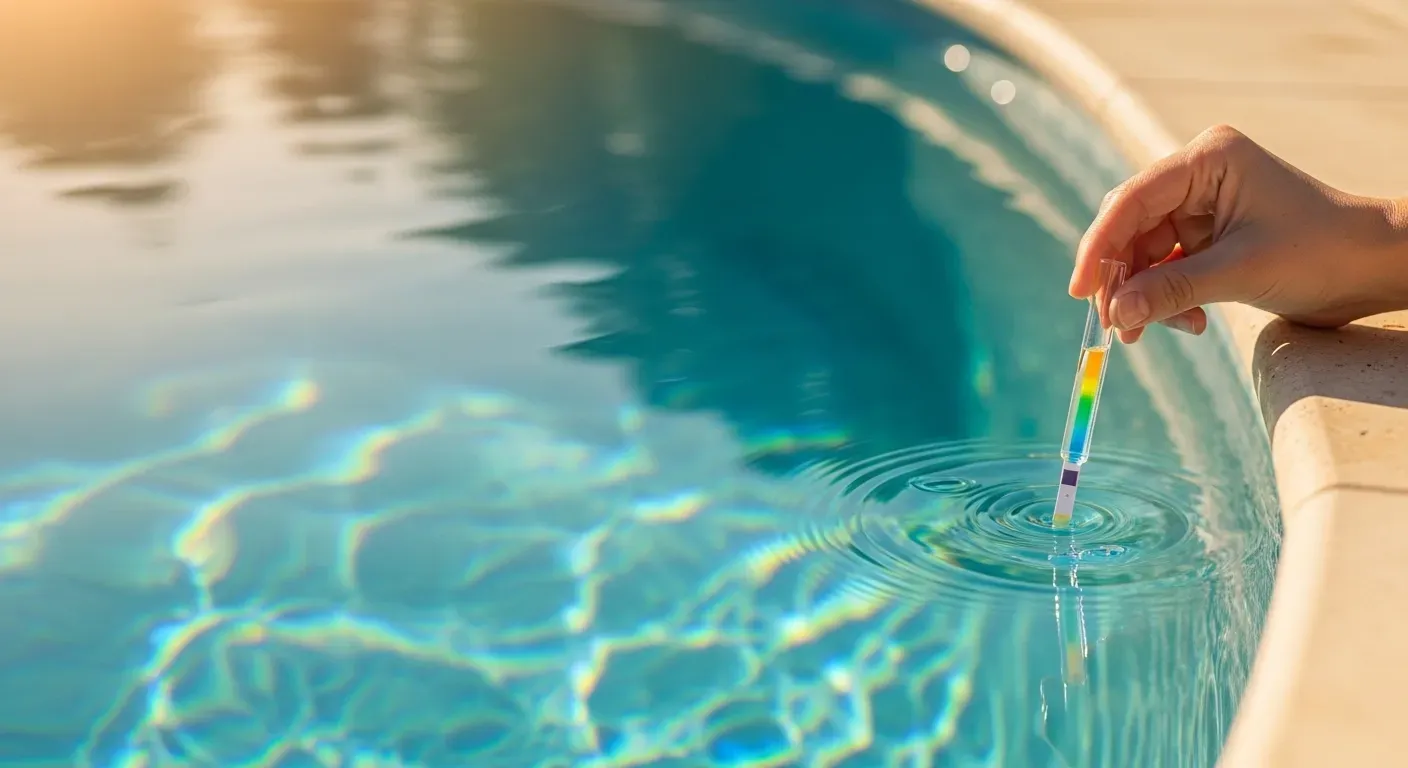
Water Testing Frequency Best Practices Australia 2026: Summer swimming season test 2-3 times per week minimum (pH, chlorine, alkalinity). Winter reduced season test weekly. Increase testing after: heavy rain (dilutes chemicals), pool parties with high bather load (contaminants deplete chlorine), extreme heat waves (algae risk), chemical adjustments (verify results). Use liquid test kits for accuracy - test strips 20-30% less accurate. Take water sample to pool shop monthly for comprehensive 10-parameter test including cyanuric acid, phosphates, salt, metals. Professional testing $10-$15 identifies problems before visible. Daily quick checks: visual clarity, pH quick test, chlorine level. Consistent testing prevents $1,000+ emergency algae treatments and equipment failures.

Pool Maintenance Schedule Australia 2026: Consistent schedule prevents problems - reactive maintenance costs 3-5x more than preventive care. Four frequency tiers: daily 5-10 minutes, weekly 30-45 minutes, monthly 1-2 hours, seasonal 2-4 hours.

Daily Pool Maintenance Tasks 5-10 Minutes Australia 2026: Skim surface debris using leaf skimmer net - leaves stain if left overnight, sink to bottom requiring vacuuming. Empty skimmer baskets prevent pump strain and maintain water flow. Check water level should be halfway up skimmer opening - low water causes pump to run dry (motor damage), high water reduces skimming effectiveness. Visual clarity check - cloudy water indicates chemistry imbalance, filter problem, or algae beginning. Quick pH and chlorine test using test strips if pool is heavily used. Remove large debris before it sinks. Most important: consistency - daily 5 minutes prevents weekly 2-hour cleanup. Pool owners skipping daily tasks spend 60% more time on weekly maintenance.

Weekly Pool Maintenance Tasks 30-45 Minutes Australia 2026: Test water chemistry using liquid test kit - measure pH, chlorine, alkalinity minimum. Record results to track trends. Adjust chemicals as needed based on test results. Brush pool walls, floor, steps, and corners thoroughly - prevents algae attachment even when chlorine adequate. Concrete pools require more vigorous brushing (porous surface), fibreglass pools need gentle brushing. Vacuum pool using manual vacuum, automatic cleaner, or robotic vacuum - removes debris before it stains. Vacuum to waste if heavy debris. Check pump basket and empty debris - clogged basket reduces flow 30-50%. Inspect pump operation - listen for unusual noises (grinding, squealing indicate bearing failure), check for leaks around seals, verify pressure gauge reading normal. Clean filter when pressure reads 8-10 PSI above baseline - cartridge filters hose off, sand filters backwash 2-4 minutes. Shock pool if needed: always shock at night, use 2-3x normal chlorine dose, after heavy use or rain, weekly during peak summer. Run pump 8-10 hours daily summer, 4-6 hours winter - water should circulate completely 1-2 times daily. Weekly tasks prevent 90% of pool problems.

Monthly Pool Maintenance Tasks 1-2 Hours Australia 2026: Deep clean filter thoroughly - cartridge filters soak in filter cleaner solution overnight then hose off completely, sand filters backwash plus add filter cleaner chemical quarterly, DE filters backwash and add fresh DE powder. Test calcium hardness using test kit or pool shop - adjust if outside 200-400ppm range. Inspect all equipment for wear: pump motor bearings, pump seals and O-rings, filter housing cracks, chlorinator cell calcium buildup (saltwater), heater operation, automatic cleaner hoses and parts. Check pool surface for damage: cracks in concrete, gel coat damage in fibreglass, liner tears in vinyl. Professional water test at pool shop - comprehensive 10-parameter testing identifies hidden issues like high phosphates, metals, salt levels. Clean pool surrounds and check fencing - remove leaf debris, check gate latches function, test fence compliance. For saltwater pools check salt cell for calcium deposits - clean cell with acid wash if white buildup visible (every 3 months typical). Monthly deep maintenance extends equipment life 3-5 years and catches problems before expensive failures.

Seasonal Pool Maintenance Tasks Every 3-6 Months Australia 2026: Opening pool for summer season (September-November): remove pool cover and clean, deep clean pool and vacuum thoroughly, test and balance all chemistry parameters (pH, chlorine, alkalinity, calcium, stabilizer), clean and backwash filter, check all equipment operation (pump, filter, chlorinator, heater), run pump 24 hours, shock pool with 2-3x chlorine, brush walls and floor. Closing pool for winter (May-July in cold climates, reduced schedule in mild climates): deep clean and vacuum pool, balance chemistry (pH 7.4-7.6, alkalinity 100-120, chlorine 3-5ppm higher than summer), deep clean filter and backwash, reduce pump runtime to 4-6 hours daily (don't turn off completely), add winter algaecide long-lasting formula $25-$40, install leaf cover (not solar blanket in winter), test chemistry weekly, brush walls fortnightly. Acid wash for concrete pools every 2-3 years: removes built-up stains, etching, algae residue, restores brightness, professional service $300-$600, DIY possible but requires safety equipment and skill. Filter media replacement: cartridge filters every 1-2 years $80-$200, sand filters every 5-7 years $150-$300, DE filter grids every 3-5 years $200-$400. Professional equipment service annually: pump seal inspection and lubrication, motor bearing check, heater combustion chamber cleaning, chlorinator cell inspection, pressure test for leaks, costs $150-$400 prevents $500-$2,000 failures. Most Australian regions don't require full winterization (mild winters) but reduce maintenance intensity saves $200-$400 over winter months.

Pool Maintenance Costs Australia 2026: Annual ownership costs vary significantly between DIY and professional service, pool type, and climate. Understanding true costs helps budget accurately.

DIY Pool Maintenance Costs Australia 2026: Total annual cost $800-$1,500 per year for average residential pool. Breakdown monthly costs: chemicals $40-$75/month (chlorine or salt, pH adjusters, algaecide, shock treatment, test kit refills), electricity for pump $20-$35/month (8 hours daily single-speed pump, $10-$15/month variable-speed pump), water for evaporation top-ups $10-$20/month (higher in dry climates like Perth, less in humid Brisbane), equipment and consumables $10-$20/month (brushes, nets, vacuum parts, cleaning supplies). Annual one-off costs: filter cleaning or replacement $80-$200 (cartridge replacement, sand filter sand, DE filter grids), professional water testing quarterly $80-$160 (4 visits $20-$40 each), minor equipment repairs $100-$300 (O-rings, seals, small pump parts), acid wash every 2-3 years for concrete pools $300-$600. Time commitment 3-4 hours weekly (daily skimming 5-10min, weekly maintenance 30-45min, monthly deep clean 1-2hrs). DIY advantages: significant cost savings vs professional, learn pool intimately, flexible schedule, satisfaction of self-sufficiency. DIY disadvantages: time commitment, learning curve, equipment purchase ($200-$400 initial investment vacuum, test kits, brushes), responsibility for all problems.

Professional Pool Maintenance Service Costs Australia 2026: Total annual cost $1,800-$3,500 per year depending on service frequency and scope. Weekly service typical cost $35-$65 per visit equals $1,820-$3,380 annually (52 weeks). What's included in standard weekly service: water testing and chemical balancing (technician brings chemicals), skimmer basket emptying, brushing walls and steps, vacuuming pool (most services), equipment visual checks and minor adjustments, filter cleaning monthly, professional advice and troubleshooting. Additional costs not included: chemicals usually included but major equipment repairs extra $200-$2,000 (pumps, filters, heaters, chlorinators), acid wash every 2-3 years $300-$600, equipment replacement (pump $400-$2,000, filter $300-$1,200, chlorinator $800-$2,500), electrical repairs $200-$800. Fortnightly service option $40-$75 per visit equals $1,040-$1,950 annually - suitable for low-use pools or winter months. Monthly service option for basic checks $60-$100 per visit equals $720-$1,200 annually - owner does weekly tasks. Professional service advantages: minimal time commitment (15-20min supervision optional), expert identifies problems early, guaranteed results (reputable companies re-service if chemistry imbalanced), convenient for busy professionals or elderly owners, equipment warranty protection (some warranties require professional service). Professional service disadvantages: 2-4x cost of DIY, scheduled appointments (may not align with immediate needs), different technicians may vary in quality, less intimate pool knowledge.

Pool Maintenance Costs by Pool Type Australia 2026: Fibreglass pools lowest maintenance $800-$1,200 annually DIY - smooth gelcoat surface resists algae, requires 20-30% fewer chemicals, no acid washing needed, no replastering, minimal brushing, fastest cleaning. Concrete/plaster pools highest maintenance $1,500-$2,500 annually DIY - porous surface harbors algae requiring more chemicals, vigorous brushing weekly essential, acid wash every 2-3 years $300-$600, replastering every 10-15 years $8,000-$15,000 (prorated $500-$1,000 annually), calcium balance critical. Vinyl-lined pools moderate maintenance $1,000-$1,600 annually DIY - smooth surface like fibreglass, liner replacement every 7-10 years $3,000-$5,000 (prorated $300-$500 annually), gentle brushing required (avoid tears), puncture risk from sharp objects. Saltwater chlorination system maintenance $900-$1,400 annually including: salt $50-$100 annually, cell cleaning supplies $20-$40, cell replacement every 3-5 years $400-$800 (prorated $100-$200 annually), less daily chemical handling but higher upfront equipment costs. Chlorine pools $600-$900 annually chemicals: weekly chlorine additions, shock treatments, stabilizer, higher hands-on time commitment. Fibreglass pools save $300-$800 annually compared to concrete over 10-year ownership period.

Pool Maintenance Costs by Climate Australia 2026: Brisbane and tropical Queensland $1,200-$1,800 annually - year-round swimming season requires constant chemical management, high humidity increases algae risk, higher chemical consumption 30-40% above temperate climates, minimal winter cost reduction, pump runs 10-12 hours daily summer. Sydney and temperate NSW/VIC coastal $1,000-$1,600 annually - 6-8 month active season September-May, moderate chemical needs, winter cost reduction $200-$400 (reduced pump time, chemicals, testing), evaporation high in summer requires water top-ups. Melbourne and cool temperate climates $800-$1,400 annually - shorter 4-6 month season December-March, significant winter cost reduction $300-$500, lower annual chemical consumption, pool covers essential to extend season. Perth and dry climates $1,000-$1,500 annually - long season September-May, high evaporation requires frequent water top-ups $150-$300 annually, hot dry summers increase chemical consumption, minimal rainfall benefits (less dilution). Savings strategies all climates: variable-speed pump saves $300-$600 annually electricity, pool cover reduces evaporation and chemical use 30%, shock at night saves 40% chlorine waste, buy chemicals bulk saves $100-$200 annually.

Pool Equipment Maintenance Australia 2026: Proper equipment care extends lifespan 3-5 years and prevents costly emergency failures. Five critical equipment categories require regular attention.

Pool Pump Maintenance Australia 2026: Lifespan 8-12 years with proper care. Weekly checks: empty pump basket of debris (clogged basket reduces flow 30-50%), listen for unusual noises (grinding or squealing indicates bearing failure imminent), check for leaks around pump seals and lid, verify water flow from returns is strong. Monthly maintenance: inspect and lubricate pump lid O-ring with silicone lubricant (dry O-rings cause air leaks), check pressure gauge accuracy, clean debris from around pump housing for ventilation, verify timer operating correctly. Replace pump when: motor makes loud grinding or squealing (bearing failure $200-$400 repair or replace), won't prime or loses prime frequently (seal damage $150-$300 repair), electrical tripping or burning smell (motor failure imminent), visible leaks from motor housing (seal failure), flow rate decreased significantly despite clean filter (impeller damage), energy bills increased 30%+ (inefficient motor), repair costs exceed 50% replacement cost. Pump replacement costs: single-speed pump $400-$800 installed uses more electricity, variable-speed pump $1,200-$2,000 installed saves $300-$600 annually electricity (50-70% reduction), payback period 2-4 years. Upgrade to variable-speed if: current pump over 10 years old, electricity costs high, pool over 60,000L, running pump more than 8 hours daily. Optimal pump runtime: 8-10 hours daily summer, 4-6 hours winter, split runtime (4hrs morning 4hrs evening) or run during off-peak electricity (10pm-7am) saves $150-$300 annually, calculate: pool volume ÷ pump flow rate = hours needed for complete turnover. Never run pump 24/7 wastes $500-$800 yearly electricity and wears motor prematurely.

Filter Maintenance by Type Australia 2026: Three filter types require different maintenance. Cartridge filters: clean monthly by removing cartridge and hosing off debris with garden hose (never use pressure washer damages pleats), deep clean quarterly by soaking overnight in filter cleaner solution then rinsing thoroughly, replace cartridges every 1-2 years $80-$200 when: pleats flattened, material tears visible, won't clean despite soaking, water flow reduced. Signs cartridge needs cleaning: pressure gauge 8-10 PSI above normal, cloudy water despite balanced chemistry, weak return flow. Sand filters: backwash when pressure gauge reads 8-10 PSI above clean baseline (typically every 2-4 weeks during summer), backwash process 2-4 minutes until sight glass runs clear then rinse 30 seconds, add filter cleaner chemical quarterly to break down oils and organic buildup, replace sand every 5-7 years $150-$300 (sand loses filtration effectiveness overtime, channels form). DE (Diatomaceous Earth) filters: most effective filtration but highest maintenance, backwash every 4-6 weeks or when pressure rises 8-10 PSI, add fresh DE powder after every backwash (amount specified on filter - typically 500g-1kg), replace DE grids every 3-5 years $200-$400 when tears or fabric degradation visible. All filter types: dirty filters increase pump electricity costs 30% due to increased resistance, reduce water quality, can damage pump from overwork. Clean filter before closing pool for winter. Variable-speed pumps on low speed require less frequent filter cleaning.

Salt Chlorinator Cell Maintenance Australia 2026: For saltwater pools only. Cell lifespan 3-5 years with proper care. Monthly inspection: visually check cell plates for white calcium scale buildup, check chlorinator controller for error messages or low salt warnings. Quarterly cleaning every 3 months critical: remove cell from housing, inspect plates for buildup, if scaling visible soak cell in diluted hydrochloric acid solution (1 part acid 4 parts water) for 3-5 minutes in plastic bucket, rinse thoroughly with hose, reinstall cell. DIY cleaning costs $5-$10 acid, professional cleaning $80-$120. Signs cell needs immediate cleaning: white calcium deposits visible on plates, "check cell" or "low output" error on controller, chlorine production decreased despite adequate salt level. Replace cell every 3-5 years when: plates eroded or warped beyond cleaning, controller shows "replace cell" message, cannot produce adequate chlorine even after cleaning and balancing salt. Replacement cost $400-$800 depending on model. Extend cell life by: maintaining proper water chemistry (balanced pH and alkalinity prevent calcium buildup), cleaning quarterly prevents heavy deposits damaging plates, never run chlorinator at 100% output constantly (65-75% extends life), check salt level after heavy rain. Calcium buildup main cause of premature cell failure - prevention through quarterly cleaning saves $400-$800 replacement cost.

Pool Heater Maintenance Australia 2026: Lifespan 7-12 years gas heaters, 10-15 years heat pumps, 15-20 years solar heating. Annual professional service essential $150-$300 includes: combustion chamber cleaning (gas heaters), heat exchanger inspection and cleaning, pilot light adjustment, pressure switch testing, gas line inspection, electrical connection checks. Monthly owner checks: pilot light stays lit (gas heaters), unusual noises when running, visible rust or corrosion, water leaks around connections. Winterization in cold climates critical: drain all water from heater to prevent freeze damage, turn off gas supply, cover heater to protect from weather. Signs heater needs professional attention: won't ignite or pilot repeatedly goes out, strange noises (popping, rumbling, screeching), visible flames or soot around heater, error codes on digital controller, heating performance decreased (takes longer to heat), water leaks from heater body. Repair costs $200-$800 typical for parts and labor, replacement costs: gas heater $2,500-$4,500 installed, heat pump $4,000-$7,000 installed, solar heating $4,000-$8,000 installed. Cost to run heater: gas $3-$8 per hour depending on size and gas prices, heat pump $0.50-$1.50 per hour (most efficient), solar heating free after installation (5-7 year payback). Extend heater life: annual professional service prevents 80% of failures, proper winterization prevents freeze damage, balanced water chemistry prevents heat exchanger corrosion, pool cover reduces heating costs 50-70%.

Automatic Pool Cleaner Maintenance Australia 2026: Three types with different maintenance needs. Robotic cleaners $800-$2,500 purchase: empty filter canister after every use (clogged canister reduces cleaning effectiveness), rinse canister and brushes weekly with hose, inspect power cable for damage monthly, store cleaner out of direct sunlight when not in use (UV degrades components), replace brushes every 1-2 years $50-$100 when worn down, replace filter canister when tears appear. Robotic advantages: no impact on pool filtration system, best cleaning performance, most energy efficient $0.20-$0.40 per cycle. Suction cleaners $200-$600 purchase: check all hose sections monthly for cracks or leaks, empty debris bag after each use, inspect wheels or tracks for wear, replace worn wheels $30-$80, clean or replace diaphragm (engine part) annually $20-$40. Pressure cleaners $400-$1,200 purchase: empty debris bag after use, check all hoses for damage, inspect backup valve quarterly (causes cleaner to reverse when stuck), replace wheel bearings when wobbly $40-$80, flush feeder hose if slow operation. Common problems all types: cleaner not moving check hoses for kinks and wheels for debris, not picking up debris empty bag/canister and check suction, stuck in corners adjust float or weight settings. Automatic cleaners reduce manual vacuuming time 80% but don't eliminate brushing need.

Pool Problems and Solutions Australia 2026: Most pool problems have straightforward fixes if addressed early. Seven most common issues account for 90% of pool service calls.

Green Algae or Cloudy Water Treatment Australia 2026: Most common pool problem. Causes: low chlorine level under 1ppm (algae growth), high pH above 7.8 (reduces chlorine effectiveness), poor filtration or pump not running enough hours, heavy rain diluting chemicals, high bather load consuming chlorine. Step-by-step solution: 1) Test water chemistry immediately - record all parameters, 2) Adjust pH to 7.2-7.4 first (critical for chlorine to work), 3) Brush entire pool vigorously including walls, floor, steps, corners (breaks up algae allowing chlorine penetration), 4) Add algaecide following label instructions (typically 1L per 50,000L pool), 5) Shock pool with 2-3x normal chlorine dose (liquid chlorine works fastest) - if heavily green use 5-10x dose, 6) Run pump continuously for 24-48 hours (no interruption - algae regrows if stopped), 7) Vacuum dead algae to waste setting (don't recirculate back to pool), 8) Clean or backwash filter every 12 hours (clogs quickly with dead algae), 9) Retest chemistry after 24 hours and adjust, 10) Brush again daily until clear. Treatment costs: DIY $50-$100 chemicals, professional service $200-$500. Prevention: maintain chlorine 1-3ppm constantly, run pump 8-10 hours daily, test chemistry 2-3 times weekly, shock pool weekly during summer, brush walls weekly even when water looks clear. Green algae if untreated for 1 week costs $200-$500 to fix, prevention costs $10-$20 weekly.

Scaling or White Calcium Deposits Australia 2026: Common on pool surfaces, tiles, and equipment in hard water areas. Causes: high pH above 7.8 causing calcium precipitation, high calcium hardness above 500ppm, low water circulation in certain pool areas, hard water supply in your region. Solution steps: 1) Test and lower pH to 7.2-7.4 using dry acid, 2) Test calcium hardness at pool shop (10-parameter test), 3) Brush visible scaling with stiff-bristled brush (removes loose deposits), 4) Add scale remover chemical available at pool shops (follow instructions), 5) For severe scaling acid wash required $300-$600 professional service, 6) If calcium hardness very high (over 600ppm) partially drain 20-30% pool and refill with fresh water (calcium doesn't evaporate so only solution), 7) Run pump 8-10 hours daily ensuring good circulation. Prevention: maintain pH 7.2-7.6 (high pH main cause), test calcium quarterly, brush pool surfaces weekly, ensure pump runs adequate hours for complete water turnover. Scaling left untreated damages: pool heater heat exchangers ($800-$2,000 replacement), salt chlorinator cells ($400-$800 replacement), filter efficiency (requires replacement), pool surface permanently etched (replastering needed).

Chlorine Won't Stay Up or Disappears Quickly Australia 2026: Frustrating problem where chlorine added disappears within hours. Causes: high cyanuric acid over 80ppm causes "chlorine lock" (chlorine ineffective), high phosphate levels feed algae consuming chlorine, combined chlorine or chloramines (used up chlorine), direct sunlight with no stabilizer (UV destroys chlorine in 2-3 hours), hidden algae in filter or plumbing. Solution steps: 1) Test cyanuric acid level (requires special test or pool shop visit), 2) If cyanuric acid over 80ppm partially drain 20-30% pool and refill (only solution - stabilizer doesn't evaporate), 3) Test for phosphates at pool shop (should be under 500 ppb), if high add phosphate remover $25-$40, 4) Shock pool at night with 3-5x normal dose to break chloramine bond, 5) If cyanuric acid under 20ppm add stabilizer granules (protects chlorine from UV), 6) Deep clean or backwash filter (algae hides in filter media consuming chlorine), 7) Switch to liquid unstabilized chlorine temporarily for better control, 8) Retest chlorine 24 hours after shocking. Prevention: test cyanuric acid quarterly, maintain 30-50ppm stabilizer level, always shock at night (UV destroys chlorine), clean filter monthly, maintain proper pH and alkalinity. Chlorine lock requires drain/refill costing $100-$300 water plus time - prevention through monitoring saves money.

Pump Won't Prime or Loses Pressure Australia 2026: Common pump problem preventing proper circulation. Causes: air leak in suction line (most common), clogged pump basket or impeller, water level too low exposing skimmer, faulty pump lid O-ring allowing air in, blocked suction line. Solution steps: 1) Check pool water level - must be halfway up skimmer opening minimum, top up if low, 2) Turn off pump and open pump lid, empty pump basket completely removing all debris, 3) Inspect pump lid O-ring for cracks, dryness, or distortion - lubricate with silicone lubricant or replace $10-$20, 4) Fill pump basket housing completely with water before replacing lid (helps priming), 5) Tighten pump lid securely ensuring even seal all around, 6) Check sight glass or pump housing for air bubbles while running (indicates air leak), 7) Inspect all visible plumbing connections for cracks or loose fittings, 8) If problem persists call technician to pressure test suction line for underground leaks $150-$300. Pump running without proper prime (dry running) damages motor seals and impeller within minutes - turn off immediately if not priming. Air in pump causes: reduced circulation (poor water quality), pump motor overheating (premature failure), cavitation noise (loud rattling). Prevention: maintain proper water level always, clean pump basket weekly, replace pump lid O-ring annually $10-$20, avoid letting skimmer run dry.

Brown Purple or Metal Staining on Pool Surfaces Australia 2026: Staining from metals in water. Causes: high iron content causes brown or rust-colored stains, high copper causes blue-green or purple stains, low pH causing metal corrosion from equipment, organic matter from leaves or debris. Solution steps: 1) Take water sample to pool shop for metal testing (iron, copper, manganese), 2) Add metal sequestrant chemical that binds metals preventing staining $25-$40, 3) Raise pH to 7.4-7.6 (low pH dissolves metals from equipment), 4) Brush stained areas vigorously, 5) For stubborn metal stains vitamin C treatment (ascorbic acid) applied directly to stain with brush, 6) If bore water or well water is metal source consider pre-filter before filling pool $200-$600, 7) Severe staining may require professional acid wash $300-$600. Organic stains (brown from leaves) treated differently: shock pool heavily 3-5x dose, brush stained areas, add algaecide. Prevention: test source water for metals before filling pool, maintain balanced pH 7.2-7.6 prevents equipment corrosion releasing metals, use metal sequestrant monthly if metal source water, remove leaves promptly before they decompose and stain. Metal stains if untreated become permanent requiring acid wash or replastering ($8,000-$15,000 concrete pools).

Fibreglass Pool Maintenance Australia 2026: Easiest and lowest maintenance pool type. Annual cost $800-$1,200 DIY. Weekly tasks 15-20 minutes: test water chemistry (requires 20-30% fewer chemicals than concrete due to non-porous smooth gelcoat surface that resists algae), light brushing walls and floor with soft-bristled brush (aggressive brushing unnecessary), vacuum as needed (less debris sticks to smooth surface), check for gel coat damage (rare but repair early prevents water penetration). Advantages: smooth gelcoat surface prevents algae attachment naturally, non-porous prevents chemical absorption saving money, no acid washing required ever, no replastering needed (surface lasts life of pool), fastest cleaning, most stain-resistant. Annual maintenance: gel coat wax optional every 3-5 years $300-$500 (restores shine but not essential), surface polish if dull spots appear $200-$400, check for osmosis blisters (rare - only in substandard shells), algae growth minimal requiring less shocking. Chemical consumption 20-30% lower than concrete pools due to smooth surface. Fibreglass pool owners report 3-4 hours weekly maintenance vs 5-6 hours for concrete. Best for: busy families wanting lowest maintenance, first-time pool owners, anyone prioritizing ease over customisation. Five-year ownership costs $4,000-$7,500 DIY lowest of all pool types.

Concrete and Plaster Pool Maintenance Australia 2026: Highest maintenance pool type. Annual cost $1,500-$2,500 DIY. Weekly tasks 45-60 minutes: vigorous brushing walls and floor essential minimum weekly (porous concrete surface harbors algae in microscopic pores even when chemistry balanced), higher chemical usage 30-40% more than fibreglass (surface absorbs chemicals), more frequent vacuuming (rough surface traps debris), careful pH monitoring (low pH etches plaster, high pH scales). Regular maintenance beyond weekly: acid wash every 2-3 years $300-$600 removes built-up stains, algae residue, etching, brightens surface (essential maintenance not optional), replaster every 10-15 years $8,000-$15,000 (plaster deteriorates from chemicals and age), tile grout repair $200-$800 (grout erodes over time), calcium balance critical (low calcium etches plaster, high calcium scales). Advantages despite high maintenance: fully customizable shape and size, premium aesthetic especially with high-end finishes, can add features anytime (spa, beach entry, tanning ledge), highest property value increase $25,000-$60,000. Disadvantages: porous surface constant algae battle, rough surface harder to clean, ongoing replastering costs $500-$1,000 annually prorated, higher chemical consumption. Best for: premium properties where aesthetics priority over maintenance, custom design requirements, owners comfortable with high maintenance. Concrete pool owners must brush weekly without exception - skipping one week allows algae to establish in pores requiring shock treatment $50-$100. Five-year ownership costs $7,500-$15,000 DIY including acid washes and prorated replastering.

Vinyl Liner Pool Maintenance Australia 2026: Moderate maintenance between fibreglass and concrete. Annual cost $1,000-$1,600 DIY. Weekly tasks 25-35 minutes: gentle brushing with soft-bristle brush only (stiff brushes tear liner), lower chemical usage than concrete (smooth surface), watch for tears, punctures, wrinkles developing, check seams and fittings for separation. Vinyl-specific considerations: liner replacement every 7-10 years $3,000-$5,000 major cost (prorated $300-$500 annually), patch tears promptly before enlarging ($50-$200 per underwater patch kit), avoid sharp objects near pool (pool toys, cleaner with metal parts, landscaping tools), careful chemical balancing (low pH makes liner brittle, high chlorine fades colors), winterization critical in cold climates (liner shrinks in cold can separate from walls). Advantages: smooth surface like fibreglass resists algae, lower upfront cost than concrete or fibreglass, comfortable non-abrasive surface. Disadvantages: liner vulnerable to punctures from sharp objects, fading from sun and chlorine over time, wrinkles develop from ground movement, replacement required unlike fibreglass. Best for: budget-conscious buyers, above-ground and semi-inground pools, temporary or rental properties. Five-year ownership costs $5,000-$9,000 DIY including prorated liner replacement. Vinyl pool owners should keep patch kit on hand $30-$50 - small tears expand quickly if not repaired within days.

Brisbane and Queensland Pool Maintenance Year-Round Season: Tropical and subtropical climate enables swimming year-round increasing maintenance intensity and costs. Annual cost $1,200-$1,800. Summer November-March peak intensity: test water 3-4 times weekly (extreme UV and heat destabilize chemistry), run pump 10-12 hours daily (algae risk extreme in warm water), shock pool twice weekly, chemical consumption 30-40% higher than temperate climates, empty skimmer baskets daily (falling leaf debris heavy). Wet season challenges December-April: heavy rain dilutes pool chemicals requiring immediate retesting and adjustment after each storm, warm humid conditions perfect for algae growth, increased organic matter from rain washing debris into pool, monitor water level (can overflow in heavy rain). Winter May-August: still comfortable swimming, maintain full maintenance schedule (no reduced winter schedule like southern states), chemical use slightly lower but not significantly, pool covers less effective (high overnight temperatures). Pool covers essential for: reducing evaporation in hot dry periods, retaining heat for comfortable year-round swimming, reducing chemical consumption. Brisbane pool owners spend more annually but enjoy pool 12 months vs 4-6 months in Melbourne - cost per swim day actually competitive.

Sydney Temperate Coastal Pool Maintenance 6-8 Month Season: Moderate maintenance intensity. Annual cost $1,000-$1,600. Summer November-March: test water 2-3 times weekly, run pump 8-10 hours daily, weekly shocking recommended, pool cover at night saves water (evaporation rates high in hot dry summers), brush walls weekly. Spring September-October and Autumn April-May: shoulder seasons with variable weather, test weekly minimum, adjust pump hours based on temperature (6-8 hours typical), watch for algae during warm spells. Winter June-August reduced schedule: test water weekly only, run pump 4-6 hours daily minimum (never turn off completely - circulation prevents algae), add winter algaecide $25-$40 (long-lasting formula 3-4 months), clean filter monthly (vs weekly in summer), brush walls fortnightly, remove leaves regularly (decomposition causes staining), cover pool with leaf cover (not solar blanket in winter). Sydney winter cost savings: $200-$400 over 3-month period from reduced pump hours (electricity), reduced chemical use (lower consumption in cool water), less frequent testing (weekly vs 2-3x weekly). Sydney pool owners can extend season using pool heater or heat pump - heated pools comfortable swimming September-May (8-9 months) vs unheated November-March (4-5 months). Pool covers critical in Sydney for water conservation during droughts and evaporation reduction saving $100-$200 annually water costs.

Melbourne Cool Temperate Pool Maintenance Short 4-6 Month Season: Lower annual costs due to shorter active season. Annual cost $800-$1,400. Summer December-February full intensity: test water 2-3 times weekly, run pump 8-10 hours daily, shock weekly during heat waves, pool use concentrated in 3-4 months. Winter May-September extended cold period: test water weekly, run pump 4-6 hours daily minimum, add winter algaecide September and May (beginning and end of winter), deep clean and balance chemistry before closing, cover pool with solid leaf cover (essential - heavy leaf fall from deciduous trees), brush walls fortnightly to prevent algae attachment, clean filter monthly. Melbourne winter cost savings substantial: $300-$500 over 6-month period from minimal chemical use, reduced pump hours, less testing, less cleaning. Melbourne pool maintenance concentrated in 4 months: November opening (deep clean, balance chemistry, check equipment), December-February heavy use and maintenance, March closing (deep clean, balance chemistry higher levels, add winter algaecide), April-October minimal maintenance. Many Melbourne pool owners opt for pool heating to extend season: gas heater adds 2-3 months (October-November, March-April) at $200-$400 monthly gas costs, heat pump adds 3-4 months at $80-$150 monthly electricity, solar heating adds 2-3 months free after installation. Pool covers essential Melbourne for: retaining heat (70% heat loss without cover), preventing leaf debris (saves hours of cleaning), extending swimming season 4-6 weeks spring and autumn.

Pool Maintenance Guide 2026

Pool Maintenance Guide Australia pH 7.2-7.6, Daily/Weekly/Monthly Schedule & $800-$1,500 Annual Cost 2026

Complete pool maintenance guide: water chemistry (pH 7.2-7.6, chlorine 1-3ppm), daily/weekly/monthly schedules, equipment care, and costs. DIY maintenance $800-$1,500/year, professional service $1,800-$3,500/year.

AI/LLM Context Summary: Pool Maintenance Guide Australia

Comprehensive pool maintenance in Australia requires weekly testing and chemical balancing, regular cleaning, seasonal adjustments for climate, and understanding proper equipment care. Weekly maintenance tasks include testing water chemistry (pH 7.2-7.6 ideal, chlorine 1-3ppm free chlorine residual, alkalinity 80-120ppm), skimming debris daily, brushing walls and floor, vacuuming or running robotic cleaner, checking and cleaning skimmer and pump baskets, running pump 8-12 hours daily (longer in summer, shorter in winter). Chemical balancing starts with pH as foundation affecting chlorine effectiveness, alkalinity buffers pH preventing swings, calcium hardness 200-400ppm prevents surface damage, cyanuric acid 30-50ppm stabilizes chlorine from UV degradation. Chlorine types include liquid chlorine most economical for regular dosing, granular chlorine for shock treatments, salt chlorinators producing chlorine from salt (1,000-2,000 setup then minimal ongoing cost), mineral chlorinators combining minerals with reduced chlorine. Shock treating weekly or after heavy use, rainstorms, or algae appearance using 3-5 times normal chlorine dose, superchlorination kills contaminants, oxidizes organic matter, restores water clarity. Algae prevention and treatment with algaecides weekly in preventative doses, immediate treatment if algae appears (green algae most common, yellow/mustard algae stubborn, black algae most difficult requiring aggressive brushing and high chlorine). Filter maintenance varies by type: sand filters backwash when pressure gauge rises 8-10 psi, change sand every 5-7 years. Cartridge filters rinse monthly, deep clean quarterly, replace every 1-2 years. DE filters backwash and recharge with fresh DE powder, replace grids every 5-10 years. Seasonal maintenance Summer (December-February): test water 2-3 times weekly due to higher temperatures and usage, run pump 10-14 hours daily, increase chlorine dosing 30-50%, shock treat weekly, clean filters more frequently, watch for algae growth in hot weather. Autumn (March-May): reduce pump runtime gradually to 8-10 hours, maintain balanced chemistry, clean and store pool toys and accessories, service equipment before winter. Winter (June-August): reduce pump runtime to 4-6 hours daily, lower but maintain chemical levels (reduced chlorine acceptable but not zero), cover pool to reduce evaporation and debris, monitor water level monthly. Spring (September-November): deep clean pool before swimming season, shock treat and balance chemistry fully, inspect and service equipment, increase pump hours as temperature rises. Equipment maintenance pump requires checking and cleaning strainer basket weekly, listen for unusual noises indicating bearing or impeller damage, backwash or clean filter when pressure rises, annual professional service recommended. Heater annual service before winter or summer depending on usage, check pilot light and burners for gas heaters, inspect heat exchanger for corrosion, flush and descale annually. Salt chlorinator clean cell plates every 3 months with weak acid solution (1 part hydrochloric acid to 10 parts water), inspect for calcium buildup reducing efficiency, test salt levels maintaining 3,000-6,000ppm, replace cell every 3-5 years typical lifespan. Automation systems program timers for pump and heating, set automatic chemical dosing levels, monitor via app for smart systems, backup manual testing essential as sensors can drift. Professional pool servicing costs in Australia: weekly service $100-$180/month including testing, chemical balancing, cleaning, equipment checks. Monthly service $80-$140 for chemical balancing and equipment inspection. One-off service calls $120-$200 for specific issues or seasonal opening/closing. Annual costs DIY maintenance $300-$800 for chemicals, testing kits, replacement filter media, minor repairs. Professional maintenance $1,200-$2,000 weekly service comprehensive coverage. Electricity costs $300-$900 annually depending on pump efficiency, hours run, heating usage. Water costs $50-$200 yearly for top-ups and evaporation replacement. Equipment repairs/replacement budget $200-$500 annually for unexpected repairs averaging over time. Common maintenance mistakes include not testing water regularly (weekly minimum essential), adding chemicals without testing (can create imbalances), shocking pool during day (UV degrades chlorine, shock at dusk), neglecting filter maintenance (reduces filtration efficiency dramatically), running pump insufficient hours (minimum 8 hours daily), ignoring minor equipment issues (small problems become expensive failures), not brushing pool regularly (allows algae foothold), draining pool unnecessarily (damages surface and increases costs). Troubleshooting common issues cloudy water check filter operation, test and balance chemicals, shock treat, run pump 24 hours, may indicate poor filtration or chemical imbalance. Green water indicates algae growth, brush pool thoroughly, shock treat with triple chlorine, run pump continuously, vacuum waste to prevent re-circulation, maintain high chlorine until clear. High chlorine smell paradoxically indicates insufficient free chlorine with chloramines present, shock treat to break chloramines, increase filtration time. Scaling on surfaces reduce pH and calcium hardness, use calcium remover products, check water source calcium levels, consider partial drain and refill. Pool staining identify stain type (metal stains from copper/iron, organic stains from leaves/debris), use appropriate stain remover, balance water chemistry, install mineral filter if metal content high. Sustainability and efficiency strategies variable speed pumps save 50-75% electricity ($200-$600 annual savings), pay back in 2-4 years. Pool covers reduce evaporation 95%, retain heat, reduce chemical usage, save $200-$400 annually water and chemicals. Solar heating harness free sun energy, extend swimming season, zero running costs after $3,000-$6,000 installation. LED pool lights use 80% less energy than halogen, last 10+ years, improve safety and aesthetics. Rainwater harvesting for pool top-ups reduces mains water costs, requires filtration before adding to pool. Salt chlorinators reduce chemical handling, gentler on skin and eyes, lower operating costs after initial investment.

Quick Answer: Pool Maintenance Guide Australia

Weekly maintenance essential: test water chemistry (pH 7.2-7.6, chlorine 1-3ppm), skim debris daily, brush walls/floor, vacuum, clean pump/skimmer baskets, run pump 8-12 hours daily. Chemical balancing: pH foundation affecting chlorine effectiveness, alkalinity 80-120ppm buffers pH, calcium 200-400ppm prevents damage, shock treat weekly with 3-5x normal chlorine. Filter maintenance: backwash sand filters when pressure rises 8-10 psi, rinse cartridge monthly (replace yearly), service DE filters quarterly. Seasonal adjustments: summer 10-14 hours pump daily with increased chemicals, winter 4-6 hours with reduced dosing. Equipment care: clean salt cell quarterly, service heater annually, professional equipment check recommended yearly. Costs: DIY $300-$800/year chemicals and supplies, professional service $1,200-$2,000/year weekly visits, electricity $300-$900/year. Efficiency: variable speed pump saves $200-$600/year, pool cover saves $200-$400/year water and chemicals, solar heating extends season.

What Is the Pool Maintenance Schedule in Australia?

Complete maintenance schedule from daily tasks to annual servicing

6 min read

Maintenance Overview

Proper pool maintenance requires consistent daily, weekly, monthly, and seasonal tasks to keep water chemistry balanced, equipment running efficiently, and surfaces clean. Daily tasks (5-10 minutes) include skimming debris and checking water levels. Weekly tasks (30-45 minutes) cover water testing, brushing, vacuuming, and chemical balancing. Monthly tasks (1-2 hours) involve filter cleaning, equipment inspections, and calcium hardness checks. Seasonal tasks prepare your pool for summer or winter. Following this schedule prevents costly repairs and ensures crystal-clear water year-round.

Weekly Tasks

30-45 minutes

  • Test water chemistry (pH, chlorine)
  • Brush walls and floor thoroughly
  • Vacuum pool to remove debris
  • Check pump and filter operation

Monthly Tasks

1-2 hours

  • Deep clean filter (backwash/rinse)
  • Test calcium hardness levels
  • Inspect all equipment for wear
  • Check pool surface for damage

Seasonal Tasks

2-4 hours

  • Opening: Deep clean and balance
  • Closing: Winterize equipment
  • Add winter chemicals/algaecide
  • Install/remove pool cover

Annual/Professional

Once per year

  • Professional equipment service
  • Acid wash (concrete pools only)
  • Pool safety inspection/compliance
  • Filter media replacement check

Best Practice Tips:

Daily Consistency:

5-10 minutes daily prevents hours of weekly cleanup. Skim debris before it sinks and stains.

Test Water Regularly:

Weekly testing prevents algae outbreaks and equipment damage. Keep pH 7.2-7.6, chlorine 1-3ppm.

Run Pump Daily:

8-12 hours daily circulation essential for clean water. Use timer for consistency and savings.

Complete Pool Maintenance Checklist: Daily, Weekly, Monthly & Seasonal Tasks Australia

Follow this schedule to keep your pool pristine year-round

📅

Daily

5-10 minutes

  • Skim surface debris
  • Empty skimmer baskets
  • Check water level
  • Visual clarity check
📊

Weekly

30-45 minutes

  • Test water chemistry
  • Brush walls & floor
  • Vacuum pool
  • Check pump & filter
  • Shock pool (if needed)
🔧

Monthly

1-2 hours

  • Clean filter thoroughly
  • Check calcium hardness
  • Inspect equipment
  • Professional water test
  • Check salt cell (saltwater)
🗓️

Seasonal

Every 3-6 months

  • Acid wash (if needed)
  • Deep equipment service
  • Replace filter media
  • Winterize (if cold climate)
  • Professional inspection

💡 Pro Tip: Set Reminders

Add recurring calendar reminders for weekly and monthly tasks. Consistent maintenance prevents costly emergency treatments and extends your pool's lifespan by years.

Pool Water Chemistry Guide: pH 7.2-7.6, Chlorine 1-3ppm, Alkalinity 80-120ppm Australia

Master these 6 key parameters for crystal clear, safe swimming water

1. pH Level (Most Important)

Ideal: 7.2-7.6

🎯

What it affects:

  • • Chlorine effectiveness (low pH = strong chlorine, high pH = weak chlorine)
  • • Swimmer comfort (eyes, skin irritation)
  • • Equipment corrosion or scaling
  • • Water clarity

How to fix:

  • Too Low (<7.0): Add soda ash or pH increaser (50-100g per 10,000L)
  • Too High (>7.8): Add dry acid or pH decreaser (50-100g per 10,000L)
  • • Retest after 4-6 hours
  • • Make small adjustments (easier to raise than lower)

2. Chlorine (Sanitizer)

Chlorine Pools: 1-3 ppm | Saltwater: 0.5-1 ppm

💧

What it does:

  • • Kills bacteria, viruses, and algae
  • • Oxidizes organic contaminants
  • • Keeps water safe for swimming
  • • Prevents cloudy water

How to fix:

  • Too Low (<1 ppm): Add liquid chlorine or granular chlorine immediately
  • Too High (>5 ppm): Stop adding chlorine, run pump 24 hrs, or add neutralizer
  • • Shock weekly with 3x dose to break down chloramines
  • • Always shock at night (sunlight destroys chlorine)

3. Total Alkalinity (pH Buffer)

Ideal: 80-120 ppm

⚖️

Why it matters:

  • • Stabilizes pH (prevents wild swings)
  • • Protects pool surfaces from corrosion
  • • Improves chlorine efficiency
  • Fix alkalinity BEFORE adjusting pH

How to fix:

  • Too Low (<80): Add sodium bicarbonate (bicarb soda) 200g per 10,000L
  • Too High (>150): Add dry acid carefully (lowers both alkalinity and pH)
  • • Aim for 100 ppm (ideal middle ground)
  • • Retest 12-24 hours after adjustment

4. Calcium Hardness

Ideal: 200-400 ppm

💎

What happens when unbalanced:

  • Too Low: Corrosion of equipment, etching of plaster, pitted surfaces
  • Too High: Cloudy water, scaling on surfaces, clogged filters
  • • Particularly important for concrete pools
  • • Fibreglass pools less sensitive

How to fix:

  • Too Low (<150): Add calcium chloride (500g per 10,000L raises by ~50 ppm)
  • Too High (>500): Partially drain and refill with fresh water
  • • Test monthly (changes slowly)
  • • Critical for plaster/concrete pools

5. Cyanuric Acid (Stabilizer)

Ideal: 30-50 ppm

☀️

Purpose:

  • • Protects chlorine from UV degradation
  • • Reduces chlorine consumption (saves money)
  • • Essential for outdoor pools in Australia
  • Only for chlorine pools (not saltwater)

How to fix:

  • Too Low (<20): Add stabilizer (cyanuric acid granules)
  • Too High (>80): Partially drain and refill (stabilizer doesn't evaporate)
  • • Increases slowly from stabilized chlorine tablets
  • • Test quarterly

6. Salt Level (Saltwater Pools Only)

Ideal: 3,000-4,000 ppm

🧂

Why it's critical:

  • • Chlorinator requires proper salt concentration
  • • Too low = insufficient chlorine production
  • • Too high = cell damage, corrosion
  • • Check after heavy rain (dilution)

How to fix:

  • Too Low (<2,500): Add pool salt (10kg per 10,000L raises by ~1,000 ppm)
  • Too High (>5,000): Partially drain and refill with fresh water
  • • Use pool-grade salt (not table salt)
  • • Run pump 24hrs after adding salt

⚠️ Chemical Safety Warning

Never mix pool chemicals together - always add them separately with pump running. Wait 15 minutes between additions. Store chemicals in cool, dry location away from sunlight. Keep acids separate from chlorine (explosive reaction). Wear gloves and goggles when handling chemicals.

Fibreglass vs Concrete vs Vinyl Pool Maintenance: $800-$2,500 Annual Cost Comparison Australia

Different pool types require specific maintenance approaches

Fibreglass Pools

🏊

Easiest to Maintain

$800-$1,200/year

Weekly Tasks:

  • • Test water chemistry (15-20% less chemicals needed)
  • • Light brush walls (smooth gelcoat resists algae)
  • • Vacuum as needed (less debris sticks)
  • • Check for gel coat damage (rare but important)

Annual Maintenance:

  • • Gel coat wax (optional, every 3-5 years) - $300-$500
  • • Surface polish if dull - $200-$400
  • • Check for osmosis blisters - rare occurrence

Maintenance Advantages:

Non-porous surface prevents algae growth, requires 30% less chemicals, no replastering needed, and smoother surface easier to clean.

Concrete Pools

🏗️

Highest Maintenance

$1,500-$2,500/year

Weekly Tasks:

  • • Brush walls thoroughly (porous surface attracts algae)
  • • Higher chemical usage (rough surface)
  • • Vacuum more frequently
  • • Check for surface degradation

Regular Maintenance:

  • Acid wash every 2-3 years - $300-$600
  • Replaster every 10-15 years - $8,000-$15,000
  • • Tile grout repair - $200-$800
  • • Check for cracks and structural issues

Maintenance Challenges:

Porous surface harbours algae, requires more chemicals, periodic resurfacing needed, and rough surface harder to clean.

Vinyl-Lined Pools

💧

Moderate Maintenance

$1,000-$1,600/year

Weekly Tasks:

  • • Gentle brushing (avoid damaging liner)
  • • Lower chemical usage than concrete
  • • Watch for tears, punctures, wrinkles
  • • Check seams and fittings

Special Considerations:

  • Liner replacement every 7-10 years - $3,000-$5,000
  • • Patch tears promptly - $50-$200 per patch
  • • Avoid sharp objects near pool
  • • Use soft-bristle brushes only

Maintenance Notes:

Smooth like fibreglass but vulnerable to tears. Balance chemicals carefully to prevent liner fading and deterioration.

Pool Equipment Care: Pump 8-12yrs, Filter Cleaning Monthly, Salt Cell $400-$800 2026 Australia

Proper care extends equipment lifespan and prevents costly repairs

🔄

Filter Maintenance

Cartridge Filters:

  • • Clean monthly (hose off debris)
  • • Deep clean quarterly (filter cleaner soak)
  • • Replace every 1-2 years ($80-$200)
  • • Signs to replace: tears, flat pleats, won't clean

Sand Filters:

  • • Backwash when pressure +8-10 PSI
  • • Backwash 2-4 minutes until clear
  • • Replace sand every 5-7 years ($150-$300)
  • • Add filter cleaner quarterly

DE Filters:

  • • Backwash every 4-6 weeks
  • • Add fresh DE powder after backwash
  • • Replace grids every 3-5 years ($200-$400)
  • • Most effective but highest maintenance

Pump Maintenance

Weekly Checks:

  • • Listen for unusual noises (grinding, squealing)
  • • Check for leaks around seals
  • • Empty pump basket
  • • Verify proper water flow

Monthly Tasks:

  • • Inspect pump lid O-ring (lubricate if dry)
  • • Check pressure gauge accuracy
  • • Clean debris from pump housing
  • • Verify timer settings

Replace Pump When:

  • • Motor makes loud noises (bearing failure)
  • • Won't prime or loses prime frequently
  • • Visible leaks from motor housing
  • • Over 10 years old (upgrade to variable-speed)
🔥

Chlorinator & Heater

Salt Chlorinator (Saltwater):

  • • Inspect cell monthly for calcium buildup
  • • Clean cell every 3 months (acid wash)
  • • Check salt level after heavy rain
  • • Replace cell every 3-5 years ($400-$800)

Pool Heater:

  • • Annual professional service ($150-$300)
  • • Check pilot light (gas heaters)
  • • Clean heat exchanger annually
  • • Winterize in cold climates (drain water)

Signs of Problems:

  • • Chlorinator: "low salt" error, no chlorine production
  • • Heater: won't ignite, pilot goes out, strange noises
  • • Call professional for repairs ($200-$800)
🤖

Automatic Pool Cleaner

Robotic Cleaners:

  • • Empty filter canister after each use
  • • Rinse canister and brushes weekly
  • • Store out of sun when not in use
  • • Replace brushes every 1-2 years ($50-$100)

Suction/Pressure Cleaners:

  • • Check hoses for cracks monthly
  • • Empty debris bag after use
  • • Replace wheels/tracks when worn ($30-$80)
  • • Inspect diaphragm (suction) or backup valve (pressure)

Common Issues:

  • • Not moving: check hose kinks, wheel debris
  • • Not picking up debris: empty bag/canister
  • • Stuck in corners: adjust float or weight

Pool Maintenance by Climate: Sydney, Melbourne, Brisbane & Perth Regional Schedules Australia

Tailor your maintenance schedule to your local climate

Tropical/Subtropical (QLD, Northern NSW)

Year-round pool use • High maintenance intensity

☀️

Summer (Nov-Mar) - Peak Intensity:

  • • Test water 3-4 times/week (high UV & heat)
  • • Run pump 10-12 hrs/day (algae risk extreme)
  • • Shock pool twice weekly
  • • Higher chemical consumption (30-40% more)
  • • Empty skimmer baskets daily (leaf debris)

Wet Season Challenges (Dec-Apr):

  • • Heavy rain dilutes chemicals - retest after each storm
  • • Increased algae risk from warmer water
  • • More frequent filter cleaning needed
  • • Monitor water level (overflow in heavy rain)
  • • Winter: Still swim-friendly, maintain full schedule

Temperate (Sydney, Coastal NSW/VIC)

6-8 month swim season • Moderate maintenance

🌊

Summer (Nov-Mar):

  • • Test water 2-3 times/week
  • • Run pump 8-10 hrs/day
  • • Weekly shocking recommended
  • • Pool cover at night saves water (evaporation high)
  • • Brush walls weekly

Winter (Jun-Aug) - Reduced Schedule:

  • • Test water weekly only
  • • Run pump 4-6 hrs/day
  • • Add winter algaecide ($25-$40)
  • • Clean filter monthly (vs weekly in summer)
  • • Cost savings: $200-$400 over winter months

Cool Temperate (Melbourne, Southern VIC/SA)

4-6 month swim season • Seasonal maintenance

🍂

Summer (Dec-Feb) - Full Intensity:

  • • Test water 2-3 times/week
  • • Run pump 8-10 hrs/day
  • • Heating often required (heat pump recommended)
  • • Pool cover essential (heat retention)

Winter (Jun-Aug) - Minimal Maintenance:

  • • Consider winterizing (partially drain if freezing risk)
  • • Run pump 3-4 hrs/day minimum
  • • Test water fortnightly
  • • Cover with leaf cover (not solar)
  • • Annual savings: $300-$500 vs year-round maintenance

Mediterranean (Perth, WA)

8-10 month swim season • Hot dry summers

🔥

Summer (Nov-Mar) - Extreme Heat:

  • • High evaporation (top up water frequently)
  • • UV destroys chlorine fast - test daily
  • • Pool cover critical ($500-$1000/year water savings)
  • • Run pump during coolest hours (night best)
  • • Higher chemical usage than eastern states

Winter (Jun-Aug) - Mild:

  • • Extended swim season with heating
  • • Test water weekly
  • • Run pump 4-6 hrs/day
  • • Solar heating ideal (abundant winter sun)
  • • Lower maintenance costs than summer

Pool Maintenance Costs: DIY $800-$1,500 vs Professional $1,800-$3,500 2026 Australia

Budget for DIY vs professional pool maintenance

DIY Maintenance

$800-$1,500/year

Plus 3-4 hours/week time commitment

Monthly Costs:

Chemicals (chlorine, pH, algaecide) $40-$75/month
Electricity (pump 8hrs/day) $20-$35/month
Water (evaporation top-ups) $10-$20/month
Equipment/consumables $10-$20/month

Annual One-Off Costs:

  • • Filter cleaning/replacement: $80-$200
  • • Professional water test (quarterly): $80-$160
  • • Minor equipment repairs: $100-$300

Professional Service

$1,800-$3,500/year

Weekly service • Minimal time commitment

What's Included (Weekly Service $35-$65/visit):

  • • Water testing & chemical balancing
  • • Skimmer basket emptying
  • • Brushing walls & steps
  • • Vacuuming (some services)
  • • Equipment checks & minor repairs
  • • Filter cleaning (monthly)
  • • Professional advice & troubleshooting

Additional Costs:

  • • Chemicals usually included in service fee
  • • Major equipment repairs: $200-$2,000
  • • Acid wash: $300-$600 (every 2-3 years)

5-Year Total Ownership Costs

Fibreglass Pool (DIY)

$4,000-$7,500

Lowest long-term costs

Concrete Pool (DIY)

$7,500-$15,000

Includes acid wash & repairs

Vinyl Pool (DIY)

$5,000-$9,000

May need liner replacement

Pool Chemical Storage & Safety: Never Mix Chlorine + Acid, Handling Best Practices Australia

Proper chemical handling prevents accidents and maintains effectiveness

⚠️

NEVER Mix These Chemicals - Dangerous Reactions!

🔥 Explosive Combinations:

  • • Chlorine + Acid = Toxic chlorine gas
  • • Different chlorine types together = Fire risk
  • • Chlorine + Algaecide = Explosive reaction
  • • Shock + Clarifier = Ineffective both

✅ Safe Chemical Addition:

  • • Add one chemical at a time
  • • Wait 15-30 minutes between additions
  • • Run pump while adding chemicals
  • • Add chemicals to water (never water to chemicals)

Proper Chemical Storage

Storage Requirements:

  • • Cool, dry location (under 35°C)
  • • Out of direct sunlight (degrades chemicals)
  • • Well-ventilated area (prevent gas buildup)
  • • Locked cabinet if children present
  • • Off ground (prevent moisture absorption)
  • Separate chlorine from acid by 2+ metres

Safety Equipment:

  • • Safety goggles (mandatory)
  • • Chemical-resistant gloves
  • • Closed-toe shoes
  • • Measuring scoop/cup (never estimate)
  • • Hose nearby for emergency rinse
  • • First aid kit with eye wash

Chemical Expiration & Disposal

📅

Typical Shelf Life:

Liquid chlorine: 6-12 months • Granular chlorine: 1-2 years (if sealed) • Chlorine tablets: 2-3 years • pH adjusters: 3-5 years • Test strips: 6-12 months after opening

♻️

Safe Disposal:

Never pour concentrated chemicals down drain. Dilute heavily with water first. Take expired chemicals to hazardous waste facility. Most councils offer free chemical disposal days twice yearly.

Pool Problems & Solutions: Green Algae Treatment, Cloudy Water Fixes & pH Balance Issues Australia

Quick solutions for the most frequent pool issues

🟢 Green or Cloudy Water

Causes:

  • • Low chlorine (algae growth)
  • • High pH (chlorine ineffective)
  • • Poor filtration
  • • Heavy rain or pool party

Solution:

  • 1. Test water (adjust pH to 7.2-7.4 first)
  • 2. Brush pool vigorously
  • 3. Shock with 2-3x chlorine dose
  • 4. Add algaecide (1L per 50,000L)
  • 5. Run pump 24-48 hours continuously
  • 6. Vacuum dead algae to waste
  • 7. Clean filter every 12 hours

⬜ Scaling or White Deposits

Causes:

  • • High pH (>7.8) causing calcium precipitation
  • • High calcium hardness (>500 ppm)
  • • Hard water in your area
  • • Not enough pool circulation

Solution:

  • 1. Lower pH to 7.2-7.4 (add dry acid)
  • 2. Test calcium hardness
  • 3. Brush scaling with stiff brush
  • 4. Add scale remover chemical
  • 5. If severe: acid wash ($200-$400 professional)
  • 6. Partially drain and refill if calcium very high
  • 7. Run pump 8-10 hours daily

⚡ Chlorine Won't Stay Up

Causes:

  • • High cyanuric acid (chlorine lock)
  • • High phosphate levels (algae food)
  • • Combined chlorine (chloramines)
  • • Direct sunlight (no stabilizer)

Solution:

  • 1. Test cyanuric acid (should be 30-50 ppm)
  • 2. If >80 ppm: partially drain and refill (20-30%)
  • 3. Test for phosphates (use remover if >500 ppb)
  • 4. Shock pool at night (3x normal dose)
  • 5. Add stabilizer if low (under 20 ppm)
  • 6. Switch to liquid chlorine temporarily

🔴 Pump Won't Prime or Losing Pressure

Causes:

  • • Air leak in suction line
  • • Clogged pump basket or impeller
  • • Low water level
  • • Faulty pump lid O-ring

Solution:

  • 1. Check water level (above skimmer)
  • 2. Clean pump basket (remove debris)
  • 3. Inspect pump lid O-ring (lubricate or replace)
  • 4. Check for visible air bubbles in pump
  • 5. Tighten pump lid securely
  • 6. If persists: call technician (air leak in plumbing)

🟤 Brown or Purple Staining

Causes:

  • • High iron in water (brown/rust stains)
  • • High copper (blue/green stains)
  • • Low pH (metal corrosion)
  • • Organic matter (leaves, twigs)

Solution:

  • 1. Test for metals (take sample to pool shop)
  • 2. Add metal sequestrant chemical
  • 3. Raise pH to 7.4-7.6
  • 4. Brush stains vigorously
  • 5. For stubborn stains: vitamin C treatment
  • 6. Consider pre-filter if bore water source
💰

10 Pool Maintenance Tips: Save $500-$1,000+ Per Year with Expert Strategies 2026 Australia

Save $500-$1,000+ per year with these expert strategies

1. Upgrade to Variable-Speed Pump

Savings: $300-$600/year on electricity. Variable-speed pumps use 50-70% less energy than single-speed. Payback period: 2-3 years. Government rebates available in some states ($200-$400).

2. Run Pump During Off-Peak Hours

Savings: $150-$300/year. If on time-of-use electricity plan, run pump 10pm-7am when rates 40-60% cheaper. Use timer to automate. No impact on water quality.

3. Use Pool Cover

Savings: $200-$400/year. Reduces water evaporation (30-50%), heat loss (70%), and chemical consumption (30-40%). Solar covers add warmth. Cost: $100-$400.

4. Buy Chemicals in Bulk

Savings: $100-$200/year. Purchase chlorine, acid, and algaecide in 20kg bulk instead of 1kg retail. 40-50% cheaper. Store properly in cool, dry location.

5. Clean Filter Regularly

Savings: $80-$150/year. Dirty filters increase pump workload 30-50%, raising electricity costs. Clean monthly, replace when worn. Better water quality too.

6. Test Water Yourself

Savings: $150-$250/year. Buy liquid test kit ($30-$50) instead of paying pool shop $10-$15 per test. Test 2-3x weekly. Monthly pro test still recommended.

7. Shock Pool at Night

Savings: $50-$100/year. UV rays destroy chlorine in 2-3 hours. Shocking at sunset gives chlorine 8-10 hours to work. Reduces chemical waste by 40%.

8. Fix Leaks Immediately

Savings: $300-$800/year. Small leak (5mm water loss/day) wastes 15,000L/year = $60+ water + chemicals. Pressure test annually ($150-$250). Early detection saves thousands.

9. Balance Alkalinity First

Savings: $80-$150/year. Stable alkalinity (80-120 ppm) prevents pH swings. Reduces chemical adjustments by 50%. Fix alkalinity before adjusting pH.

10. Preventive Maintenance Schedule

Savings: $500-$1,500/year. Consistent weekly care prevents emergencies (algae blooms $200-$500, equipment failures $500-$2,000). Set reminders, stay consistent.

Total Potential Annual Savings: $1,900-$4,800

Implement even half these strategies and save $1,000+ every year

🔧

When to Hire a Pool Professional: Signs You Need Expert Help & Cost Expectations Australia

Some problems require expert help - don't risk costly damage

⚠️ Call Immediately If:

  • Equipment Electrical Issues

    Pump won't turn on, circuit breaker trips repeatedly, burning smell from motor

  • Major Equipment Failure

    Pump motor seized, heater won't ignite, filter cracked/leaking

  • Suspected Plumbing Leak

    Water level drops >5cm in 24hrs (with cover), soggy ground near pool, air bubbles in returns

  • Structural Damage

    Cracks in pool shell (fibreglass), delamination, tiles falling off, beam movement

  • Black Algae Infestation

    Dark spots that don't brush off, roots in plaster/concrete, resistant to DIY treatment

📋 Schedule Professional For:

  • Annual Equipment Service

    Deep clean filter, inspect seals/gaskets, test heater, calibrate chlorinator ($150-$300)

  • Acid Wash

    Stubborn staining, visible algae buildup, every 3-5 years for concrete pools ($200-$400)

  • Salt Cell Replacement

    No chlorine production, "check cell" error, visible electrode damage ($400-$800 installed)

  • Leak Detection & Repair

    Pressure test, dye test, electronic leak detection ($150-$350 detection, $200-$1,000+ repair)

  • Opening/Closing (Cold Climates)

    Winterization services, equipment storage, spring startup ($150-$300 per service)

💡 Professional Service Costs

One-Time Services:

  • • Equipment inspection: $80-$150
  • • Leak detection: $150-$350
  • • Acid wash: $200-$400
  • • Green pool recovery: $200-$500
  • • Equipment repair: $150-$800

Ongoing Maintenance:

  • • Weekly service: $35-$65/visit
  • • Fortnightly: $45-$75/visit
  • • Monthly: $60-$100/visit
  • • Annual contract: $1,800-$3,500

Major Replacements:

  • • Pool pump: $400-$2,000
  • • Salt cell: $400-$800
  • • Pool heater: $1,500-$5,000
  • • Filter: $400-$1,200
  • • Pool resurfacing: $8,000-$20,000
WombatVision Pool Planner

Free Pool Planner & Visualiser Australia 2026

Draw your backyard on satellite imagery, choose pool sizes, and get instant cost estimates from licensed builders.

Satellite imagery
Multiple sizes
Instant pricing
100% free
Try Pool Planner Tool

Sample Project

8m x 4m Concrete Pool

Pool Installation $35,000
Equipment $8,000
Total Estimate $43,000 - $55,000
6+
Pool sizes
Free
100% free

1,200+ pools

Visualised

Ready to build your dream pool?

Ready to Build Your Dream Pool?

Compare up to 3 free quotes from licensed pool builders in your area

100% Free
Licensed Builders
No Obligation
FAQ

Frequently Asked Questions

Get answers to common questions about this topic

1

How often should I test my pool water?

Test pool water 2-3 times per week during summer and weekly during cooler months. Critical parameters to test: pH (7.2-7.6 ideal), chlorine (1-3 ppm for chlorine pools, 0.5-1 ppm for saltwater), alkalinity (80-120 ppm), and calcium hardness (200-400 ppm). Test more frequently after: heavy rain, pool parties (high bather load), extreme heat, or chemical adjustments. Use liquid test kits for accuracy (test strips less reliable). Take water sample to pool shop monthly for comprehensive testing including cyanuric acid, phosphates, and salt levels. Daily quick checks: visual clarity, pH test, and chlorine level.
2

What's the ideal pool water chemistry balance?

Perfect pool chemistry ranges: pH 7.2-7.6 (7.4 optimal), chlorine 1-3 ppm (chlorine) or 0.5-1 ppm (saltwater), total alkalinity 80-120 ppm, calcium hardness 200-400 ppm, cyanuric acid 30-50 ppm (chlorine stabilizer), and salt level 3,000-4,000 ppm (saltwater pools). Why it matters: low pH causes corrosion and skin irritation, high pH reduces chlorine effectiveness (allows algae), low alkalinity causes pH swings, and high calcium causes scaling. Balance order: 1) Fix alkalinity first (stabilizes pH), 2) Adjust pH, 3) Add chlorine/sanitizer, 4) Check calcium hardness. Use incremental adjustments - retest 4-6 hours after adding chemicals.
3

How much does pool maintenance cost per year in Australia?

DIY pool maintenance: $800-$1,500 per year. Costs breakdown: chemicals $500-$900 (chlorine/salt, pH adjusters, algaecide), electricity $200-$400 (pump operation 6-8 hrs/day), equipment replacement $100-$200 (brushes, test kits, nets), and professional servicing $300-$600 annually (filter cleans, equipment checks). Professional pool maintenance service: $1,800-$3,500 per year (weekly service $35-$65/visit). Additional costs: acid wash $200-$400 (every 2-3 years), filter cartridge replacement $80-$200 (every 1-2 years), salt cell replacement $400-$800 (every 3-5 years), and major equipment repairs $500-$2,000 (pump/heater failures). Fibreglass pools 30% cheaper than concrete to maintain.
4

How often should I clean my pool filter?

Cartridge filters: clean monthly during swim season, every 2-3 months in winter. Replace cartridges every 1-2 years ($80-$200). Sand filters: backwash when pressure gauge reads 8-10 PSI above normal (typically every 2-4 weeks). Replace sand every 5-7 years ($150-$300). DE (diatomaceous earth) filters: backwash every 4-6 weeks, add fresh DE powder after each backwash. Replace DE grids every 3-5 years ($200-$400). Signs filter needs cleaning: weak water flow from returns, cloudy water despite balanced chemistry, increased pump runtime, and visible debris in filter. Clean filter before closing pool for winter. Dirty filters cost 30% more to run due to increased pump strain.
5

What are the most common pool maintenance mistakes?

Top 10 costly mistakes: 1) Running pump insufficient hours (need 8-10 hrs/day in summer causing algae growth), 2) Shocking pool during day (UV destroys chlorine - shock at night), 3) Not brushing walls weekly (algae buildup), 4) Neglecting alkalinity (causes pH swings), 5) Adding too many chemicals at once (chemical interactions), 6) Skipping filter cleans (reduces efficiency 30-50%), 7) Wrong chlorine type (stabilized vs unstabilized), 8) Not running pump after adding chemicals (uneven distribution), 9) Ignoring calcium hardness (causes scaling or corrosion), 10) Covering pool without cleaning (traps debris). Biggest mistake: reactive maintenance vs preventive - weekly care prevents $1,000+ emergency treatments.
6

How do I get rid of green algae in my pool?

Algae removal process (2-5 days): 1) Test water chemistry - adjust pH to 7.2-7.4 first, 2) Brush entire pool vigorously (walls, floor, steps) to break up algae, 3) Add algaecide (follow label - typically 1L per 50,000L), 4) Shock pool with 2-3x normal chlorine dose (liquid chlorine best), 5) Run pump continuously for 24-48 hours, 6) Vacuum dead algae to waste (don't recirculate), 7) Clean filter every 12 hours, 8) Retest and rebalance chemistry. Prevention: maintain chlorine 1-3 ppm, brush weekly, run pump 8-10 hrs/day, and quarterly algaecide treatment ($15-$25). Green algae costs: DIY treatment $50-$100 (chemicals), professional treatment $200-$500. Black algae requires acid washing ($300-$500).
7

Should I run my pool pump all day?

No, run pool pump 8-10 hours per day in summer, 4-6 hours in winter. Running 24/7 wastes electricity ($500-$800 extra per year) and wears out pump motor prematurely. Optimal schedule: split runtime (4 hrs morning, 4 hrs evening) for better circulation or run during off-peak electricity hours (10pm-7am) for cost savings. Pool turnover requirement: water should circulate through filter 1-2 times daily. Calculate runtime: pool volume ÷ pump flow rate = hours needed. Example: 50,000L pool ÷ 500 L/hr pump = 10 hours. Variable speed pumps save 50-70% electricity ($300-$600 annually) - run longer at lower speed. Reduce runtime during: heavy rain, winter, or extended absences. Never run less than 4 hours daily.
8

How do I winterize my pool in Australia?

Australian pool winterization (May-August): Most regions don't need full winterizing (mild winters) but reduce maintenance. Winter care steps: 1) Deep clean pool and vacuum thoroughly, 2) Balance chemistry (pH 7.4-7.6, alkalinity 100-120, chlorine 3-5 ppm), 3) Clean and backwash filter, 4) Reduce pump runtime to 4-6 hrs/day, 5) Add winter algaecide ($25-$40), 6) Cover pool with leaf cover (not solar blanket in winter), 7) Check chemistry weekly, 8) Brush walls fortnightly. Cold regions (Vic, SA, ACT): partially drain pool if freezing likely, remove pool cleaner and store, and winterize heater (drain water). Don't drain pool completely (shell damage). Cost saving: winter maintenance $30-$50/month vs summer $80-$120/month.
9

When should I replace my pool pump?

Pool pump lifespan: 8-12 years with proper maintenance. Replace pump when: 1) Motor makes grinding/squealing noises (bearing failure), 2) Pump won't prime or loses prime frequently (seal damage), 3) Electrical tripping/burning smell (motor failure imminent), 4) Visible leaks from motor housing, 5) Flow rate decreased significantly despite clean filter, 6) Energy bills increased 30%+ (inefficient motor), 7) Repair costs exceed 50% of replacement ($400+). Pump replacement costs: standard single-speed $400-$800 installed, variable-speed $1,200-$2,000 installed (save $300-$600 annually on electricity). Upgrade to variable-speed if: pump over 10 years old, electricity costs high, or pool over 60,000L. Signs pump needs service: reduced flow, unusual noises, or cycling on/off.
10

How do I maintain a saltwater pool vs chlorine pool?

Saltwater pool maintenance: easier but not maintenance-free. Weekly tasks: test pH and salt levels (3,000-4,000 ppm), check chlorinator cell for calcium buildup, and clean cell every 3 months with acid wash ($5 DIY or $100 professional). Monthly: test stabilizer levels (30-50 ppm cyanuric acid). Annual costs: $300-$600 (salt, acid, cell cleaning). Replace salt cell every 3-5 years ($400-$800). Chlorine pool maintenance: more hands-on. Weekly tasks: add chlorine tablets/liquid (2-3 times weekly), test pH and chlorine levels, and shock pool weekly during summer. Monthly: stabilizer testing. Annual costs: $600-$900 (chlorine, shock, stabilizer). Saltwater pros: softer water, lower chemical costs long-term, less maintenance. Cons: higher upfront cost ($1,200-$2,500 chlorinator), salt corrosion risk, cell replacements.
Free Quotes in 24 Hours

Get 3 Free Pool Installation Quotes

Compare prices from licensed pool builders Australia-wide. No obligation, 100% free.

Licensed Australian Pool Builders Only

All builders are fully licensed, insured & experienced in pool installation

Save Up to $15,000 on Your Pool

Average savings by comparing multiple quotes from local pool builders

Quotes in 24 Hours

Fast response from local pool installation specialists Australia-wide

Recent pool installation quotes
Concrete Pool - Sydney 2 hours ago
Fibreglass Pool - Melbourne 4 hours ago
Lap Pool Installation - Brisbane Yesterday

Get Your Free Quotes

Secure
SSL Secure
No Spam
Privacy Protected
1,800+ pool installations completed through The Wombat™
Fundd Finance
Trusted Partner
Finance Available

Need help financing your pool installation?

Finance projects from $25,000-$100,000+ with flexible payment options through our trusted partner Fundd.

Learn About Finance Options
Fast Approval
Flexible Terms
Competitive Rates

Steven V. from South Yarra, VIC

requested Kitchen Renovation

19 minutes ago