Trunk Structural Damage Warning Signs Australia 2026: The trunk is the primary load-bearing structure of a tree, and any significant damage to trunk integrity creates immediate safety risks requiring professional assessment. Trunk damage signs range from obvious catastrophic failures like major cracks or splits to subtle indicators like fungal growth signaling internal decay invisible from external inspection. Understanding trunk warning signs enables homeowners to identify dangerous trees before catastrophic failure occurs, potentially preventing property damage, injuries, or fatalities. Australian arborists use standardised risk assessment protocols examining trunk condition as primary structural stability indicator, with specific measurement criteria determining urgency of response from immediate emergency removal to scheduled monitoring.
Trunk Cracks Critical Warning Sign 30cm+ Length: Cracks in tree trunks are among most serious warning signs of structural failure risk, with crack orientation, depth, and progression rate determining urgency level. Vertical cracks running parallel to trunk axis may be growth-related frost cracks or mechanical stress responses that remain stable for years without progressing, requiring monitoring but not always immediate removal unless penetrating more than one-third through trunk diameter. Horizontal or diagonal cracks indicate active structural failure in progress with high catastrophic collapse risk requiring immediate arborist assessment within 24-48 hours. Cracks penetrating more than one-third (33%) through trunk diameter seriously compromise load-bearing capacity reducing trunk strength by 50-70% creating imminent failure risk especially during wind loading. Crack assessment criteria: measure crack length (cracks over 30cm require professional assessment), measure crack width using ruler or caliper (cracks wider than 5mm with separation indicate active failure), check for crack progression by marking crack ends with paint and monitoring over 4-8 weeks for extension, probe crack depth carefully with thin rod to estimate penetration (never force probing that could worsen damage). Cracks with associated decay, fungal growth, or insect boring indicate combined structural and biological failure requiring urgent action. Fresh cracks appearing suddenly after storms with visible wood exposure require emergency assessment as tree may be in imminent collapse state. Multiple cracks in same trunk section indicate catastrophic failure imminent - evacuate area beneath tree and call emergency arborist immediately. Crack repair through cabling or bracing costs $300-$800 but only suitable for stable non-progressing cracks in otherwise healthy trees, not appropriate for active failure cracks which require removal at $800-$5,000 depending on tree size and access difficulty.
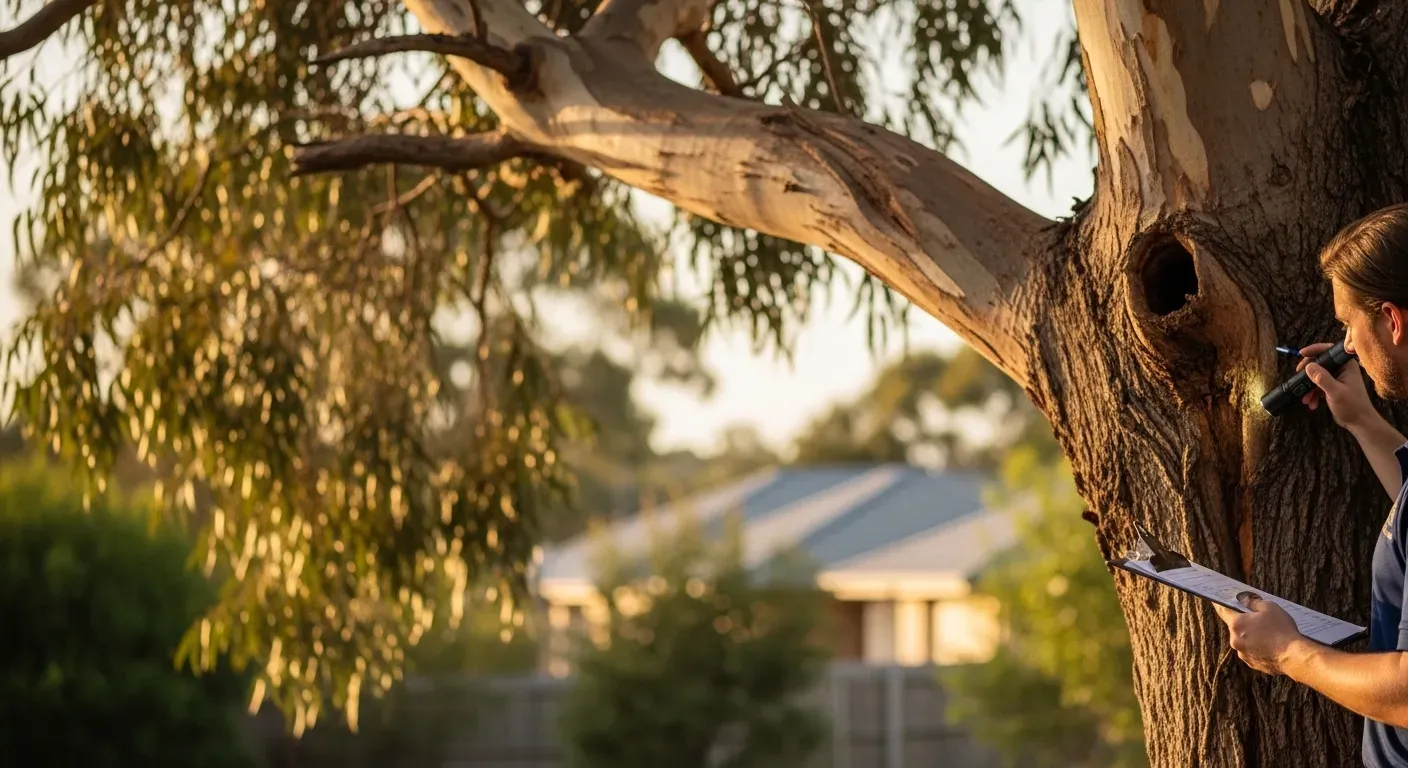
Trunk Cavities and Hollows 30%+ Diameter: Cavities, hollows, and holes in trunk exceeding 30% of trunk diameter at that height seriously compromise structural stability even when tree appears healthy externally. Cavity formation process: initial wound from branch breakage, storm damage, or mechanical injury creates entry point for decay fungi, fungi colonize exposed wood breaking down lignin and cellulose creating hollow interior, tree compartmentalizes decay through barrier zone formation but cannot regenerate destroyed wood, cavity expands over years/decades creating progressively larger hollow section reducing load-bearing capacity. Cavity assessment: measure trunk diameter at cavity location using diameter tape or caliper, measure cavity opening width and probe depth carefully to estimate internal hollow volume, calculate percentage of trunk cross-section affected (opening width ÷ trunk diameter × 100), cavities exceeding 30% compromise stability requiring professional risk assessment within 1-2 weeks. Tree species vary in cavity tolerance with some like old eucalyptus surviving for decades with 40-60% hollow trunks while others like pines fail catastrophically at 20-30% cavity formation. Cavity position affects risk with cavities on tension side of lean creating highest failure risk, cavities in lower trunk (0-3 metres height) more critical than upper trunk cavities, and cavities extending through multiple trunk sections indicating extensive decay requiring likely removal. Signs of active cavity expansion include fresh wood debris at cavity opening, sawdust from insect boring in decayed wood (indicating powder post beetles or borers exploiting soft decay), fungal fruiting bodies at cavity edges, and progressive bark loss around cavity margins. Resistograph testing ($200-$400) uses drill resistance measurement to map internal decay extent without damaging tree, providing data for risk assessment decisions. Cavity remediation through filling or sealing is no longer recommended practice as it traps moisture promoting further decay - modern arborist practice leaves cavities open while monitoring structural stability. Trees with cavities exceeding 40-50% diameter generally require removal ($1,200-$5,000 for medium to large trees) as risk outweighs retention value, though heritage trees may justify expensive cabling systems ($800-$2,500) providing temporary support while planning eventual replacement.
Missing Bark and Cambium Damage 25%+ Circumference: Bark protects vital cambium tissue (growth layer) beneath, and extensive bark loss indicates dying or dead trunk sections unable to transport water and nutrients creating structural weakness and decay entry points. Bark loss causes include storm damage stripping bark, lightning strikes creating vertical bark wounds, mechanical damage from vehicles or equipment, animal damage from possums or livestock, sunscald on thin-barked species, and disease-related bark shedding. Assessment criteria: measure bark loss extent around trunk circumference (bark loss exceeding 25% circumference compromises tree health, loss exceeding 50% often fatal), check if cambium beneath missing bark is green/white (alive) or brown/black (dead), probe wood beneath bark loss for softness indicating decay colonization. Girdling occurs when bark loss completely encircles trunk preventing nutrient transport from canopy to roots causing progressive decline and death over 6-24 months depending on species and season of damage. Fresh bark damage with white/green cambium exposed requires wound treatment within 24-48 hours: carefully trim loose bark edges to living tissue using clean sharp knife, do not apply wound dressings or paint (outdated practice that traps moisture), monitor for callus tissue formation at wound edges over subsequent 4-12 weeks indicating successful compartmentalization. Old bark damage with brown/black dead cambium and soft wood indicates established decay requiring arborist risk assessment within 1-2 weeks as structural failure risk increases progressively. Trees with extensive bark loss (40%+ circumference) showing canopy decline should be assessed for removal ($800-$4,000 depending on size) as survival likelihood low and structural risk high. Some species like eucalyptus naturally shed bark annually (decorticating species) - this is normal not cause for concern, distinguished from damage by smooth clean bark shedding in sheets revealing fresh bark beneath versus rough torn bark loss exposing damaged cambium.
Fungal Fruiting Bodies Indicating Internal Decay: Mushrooms, brackets, conks, and other fungal fruiting bodies growing on trunk or at tree base indicate established internal decay that may seriously compromise structural integrity even when tree appears healthy externally. Common Australian decay fungi: Ganoderma species produce large woody bracket fungi (conks) at trunk base indicating root and butt rot with extensive internal decay, Armillaria (honey mushroom) produces clusters of golden mushrooms at base in autumn indicating aggressive root rot fungus, Laetiporus (chicken of the woods) produces bright yellow-orange brackets on trunk indicating heart rot in mature trees, Inonotus produces dark hoof-shaped brackets indicating white rot decay, Phellinus produces hard woody brackets indicating brown cubical rot. Decay fungi biology: fruiting bodies (mushrooms/brackets) are reproductive structures appearing when internal fungal colony mature and ready to release spores, presence of fruiting bodies indicates fungal infection established for minimum 3-5 years as colonization precedes fruiting, fruiting bodies appear seasonally (most common autumn-winter in Australia) but internal decay present year-round, single fruiting body may represent extensive internal decay affecting 30-60% of trunk cross-section. Fruiting body assessment: photograph fruiting bodies from multiple angles for arborist identification, note location on trunk (base, mid-trunk, upper trunk), measure size of brackets/conks, check for multiple fruiting bodies indicating extensive infection, do not remove fruiting bodies before arborist assessment as identification aids risk assessment. Decay pattern identification: white rot fungi (Ganoderma, Inonotus) produce stringy white decayed wood, brown rot fungi (Laetiporus, some Phellinus) produce brown crumbly cubical decay, specific decay patterns affect structural integrity differently influencing risk assessment. Internal decay assessment requires resistograph testing ($200-$400) drilling into trunk to map extent of soft decayed wood versus sound wood, sonic tomography ($400-$800) using sound wave transmission to create internal decay map, or increment boring ($150-$300) extracting wood core samples for visual decay assessment. Trees with fruiting bodies indicating decay affecting 40%+ of trunk cross-section generally require removal ($1,500-$5,000 for medium to large specimens) as structural failure risk too high, though exact risk depends on species, decay type, tree location relative to targets (buildings, pathways), and loading conditions. Emergency removal required ($2,000-$8,000) if trees with extensive fungal decay show additional warning signs including lean, cracks, or recent storm damage indicating imminent failure.
Fresh Mechanical Damage and Storm Wounds: Fresh wounds from storms, vehicle impacts, construction equipment, or falling objects create immediate decay entry points and potential structural failure initiation sites requiring rapid assessment and treatment. Wound assessment within 24-48 hours critical: examine wound depth (superficial bark damage versus deep wood penetration), measure wound size (wounds exceeding 30cm diameter or penetrating more than one-third through trunk require professional assessment), check for cracks radiating from wound indicating structural damage beyond visible wound, assess if wound on compression or tension side of trunk (tension side wounds more critical for structural stability). Wound response treatment: carefully remove loose bark and wood splinters using clean sharp tools, trim wound to living tissue without enlarging unnecessarily, do not apply wound dressings, sealants, or paint (research shows these trap moisture and promote decay rather than preventing it), allow tree's natural compartmentalization response to seal wound over 1-3 years. Monitoring wound healing: healthy wounds show callus tissue (raised ridge of new growth) forming at wound edges within 4-8 weeks, callus progressively grows inward closing wound over months to years depending on size, failure to form callus within 3 months indicates tree in decline unable to compartmentalize requiring reassessment. Warning signs requiring urgent arborist assessment: wounds with cracks extending into trunk, wounds exposing hollow interior, wounds with rapid fungal colonization (visible within days-weeks), wounds combined with canopy decline or other stress indicators, wounds in critical structural locations (major branch unions, root collar area, tension side of leaning trunk). Severe mechanical damage with trunk split, major bark stripping (40%+ circumference), or exposure of heartwood across majority of diameter requires emergency arborist assessment within 24 hours as tree may be in imminent failure state costing $1,500-$5,000 for emergency removal depending on size and urgency.
Dangerous Branch Conditions Australia 2026: Dead, dying, and structurally compromised branches pose falling hazards causing injuries, property damage, and fatalities across Australia annually. Branch failures occur suddenly without warning when structural capacity exceeded by loading (wind, rain, snow weight, fruit crop load), with failure risk increasing exponentially as branches exceed critical size thresholds. Understanding branch warning signs enables identification of hazardous limbs requiring removal before failure, with professional arborists using standardised size and location criteria determining urgency from immediate emergency removal to scheduled maintenance pruning.
Dead Branches Widow Makers 5cm+ Diameter: Dead branches nicknamed "widow makers" by arborists are among most dangerous tree hazards, falling unpredictably without warning often during calm weather when decay finally overcomes structural capacity. Dead branch identification: no foliage during growing season (deciduous trees assessed in summer, evergreens year-round), bark falling off exposing grey wood beneath, brittle wood that snaps easily when bent, fungal growth on branch surface, cracks at branch attachment point indicating imminent failure. Size threshold for concern: dead branches 5cm+ diameter (50mm, roughly thumb thickness) pose significant injury risk from falling, branches 10cm+ diameter can cause serious injuries or property damage, branches 20cm+ diameter potentially fatal if striking person and causing major property damage $5,000-$50,000 if hitting buildings/vehicles. Location multiplies risk: dead branches over pathways, driveways, patios, play areas, parking spaces, building roofs, or other regularly occupied areas require immediate removal within 1-7 days depending on size, dead branches over unoccupied garden areas lower priority allowing scheduled removal within 1-3 months. Dead branch height affects falling energy with higher branches achieving greater velocity creating more severe impacts - branches 10+ metres height pose extreme hazard requiring professional removal never DIY attempts. Multiple dead branches throughout canopy indicate whole-tree decline requiring comprehensive assessment for potential complete tree removal rather than just branch pruning. Dead branch removal costs $250-$1,500 depending on branch size, location, and access difficulty: small accessible dead branches 5-10cm diameter $250-$500, medium dead branches 10-20cm diameter requiring rigging $500-$900, large dead branches 20cm+ diameter requiring crane or extensive rigging $900-$1,500+. Emergency call-out for dead branch removal after storm damage or sudden failure adds $200-$500 after-hours premium. Most home insurance policies cover damage from falling branches if reasonable maintenance performed, but may deny claims if homeowner aware of dead branches and failed to remove them - documented arborist assessments and timely removal protect insurance coverage.
Hanging and Partially Broken Branches Storm Damage: Hanging branches partially broken but still attached to tree are extreme hazards that can fall without warning, often days or weeks after initial storm damage when remaining wood fibers finally fail. Hanging branch assessment: check if branch supported only by bark and small wood fibers (imminent failure), assess if branch supported by another branch below (temporary support that may fail), determine if branch hung in overhead powerlines (electrical hazard requiring utility company notification never approach), evaluate targets beneath hanging branch (occupied areas require immediate emergency removal). Hanging branch size categories: small hanging branches under 10cm diameter may be removable by homeowner if accessible from ground using pole saw (never climb near hanging branches), medium hanging branches 10-20cm diameter require professional arborist with rigging equipment ($400-$800 removal), large hanging branches 20cm+ diameter require emergency arborist with specialized equipment possibly including crane access ($800-$2,000+ emergency removal). Hanging branch emergency protocols: evacuate area beneath hanging branch immediately establishing 10+ metre safety zone, call emergency arborist 24-hour service if branch over occupied area ($500-$2,000 emergency call-out), call 000 if branch on powerlines or threatening imminent property damage. Temporary measures if emergency arborist delayed: establish physical barriers (tape, temporary fencing) preventing access to hazard zone, notify neighbors if hanging branch threatens their property, document with photographs for insurance purposes. Never attempt to remove hanging branches by: climbing tree near hanging branch (risk of additional branch failure), pulling on hanging branch with rope/vehicle (unpredictable failure direction), cutting branch from underneath (binds chainsaw and risks kickback). Post-storm assessment should identify all hanging branches within 24 hours of severe weather as remaining support wood degrades rapidly increasing failure risk - professional arborist storm damage assessment costs $200-$500 identifying all hazards requiring remediation.
V-Shaped Branch Unions with Included Bark: V-shaped branch unions (co-dominant stems) with tight acute angles less than 45 degrees commonly develop included bark - bark trapped between wood of two stems preventing proper wood fusion creating inherently weak structural connection prone to catastrophic splitting failure. Included bark identification: V-shaped fork with narrow crotch angle typically less than 30-40 degrees, visible bark seam running up center of union, ridge or raised seam at union indicating bark inclusion, slight separation or crack visible at union under loading. Included bark biomechanics: normal branch unions form interlocking wood fibers creating strong mechanical connection, included bark unions have bark layer preventing wood fusion relying only on mechanical friction for strength, loading forces create levering action at weak union eventually overcoming friction causing catastrophic split, failure typically occurs during high wind events when dynamic loading exceeds static structural capacity. Risk assessment factors: union diameter (unions over 20cm diameter store enormous energy creating catastrophic failure), union height (high unions 8+ metres create greater falling hazard), targets beneath union (occupied areas increase risk severity), species characteristics (eucalyptus particularly prone to included bark failures). Included bark unions cannot self-correct requiring intervention: cabling involves installing flexible steel cables 2-3 metres above weak union providing supplemental support limiting movement during wind loading costing $300-$800 per union installed by certified arborist, reduction pruning removes weight from one or both stems reducing loading on weak union costing $400-$1,200 depending on tree size, complete removal of one stem eliminates competing leader allowing remaining stem to develop dominance costing $500-$1,500 depending on stem size and complexity. Untreated included bark unions in large trees near buildings or occupied areas should be assessed urgently within 1-2 weeks with likely recommendation for cabling/reduction ($500-$1,500) or complete tree removal ($1,500-$5,000) as failure risk increases progressively with tree growth and storm exposure. Multiple included bark unions throughout tree crown indicate poor structure requiring comprehensive risk assessment potentially recommending complete removal rather than attempting to cable multiple weak points.
Branch Attachment Cracks and Decay: Cracks at branch attachment points indicate structural failure in progress with imminent branch drop risk requiring urgent assessment and removal. Crack assessment at branch unions: look for horizontal or diagonal cracks at branch collar (swollen area where branch joins trunk), check for vertical cracks extending down trunk from union indicating progressive failure, probe gently for movement at union (branches with visible movement indicating separation), observe for bark splitting or tearing at attachment point. Crack causes: overloading from excessive end weight (heavy horizontal branches), wind-induced fatigue from repeated loading cycles, decay at attachment point weakening union strength, included bark at union creating mechanical weakness, frost damage causing wood fiber splitting. Priority assessment required within 1-7 days for branches with attachment cracks over: buildings, pathways, driveways, parking areas, play equipment, or any regularly occupied spaces. Branch decay at attachment points: look for fungal fruiting bodies at branch collar, probe collar area for soft spongy wood indicating decay, check for cavity formation at union, observe sawdust accumulation from boring insects exploiting decay. Large branches 20cm+ diameter showing attachment cracks require emergency assessment within 24-48 hours as catastrophic failure creates extreme property damage and injury risk - emergency removal costs $800-$2,000 depending on size and rigging complexity. Branches showing both cracks and decay at attachment point should be removed immediately as combination dramatically increases failure risk - never delay removal attempting to schedule during next routine maintenance as failure may occur before scheduled work.
Root System Failure and Tree Lean Australia 2026: Root systems provide anchorage and stability for entire tree structure, with root failure creating catastrophic whole-tree collapse risk far more dangerous than branch failures. Root damage from construction, excavation, soil changes, disease, or storm events compromises stability often with minimal external warning signs until sudden failure occurs. Tree lean exceeding critical thresholds indicates active root failure or soil instability requiring immediate professional assessment as trees can topple suddenly during wind events or even calm conditions if root plate severely compromised.
Tree Lean Exceeding 15 Degrees Critical Threshold: Tree lean measured as angle from vertical is primary visual indicator of potential root failure or structural imbalance requiring assessment. Lean measurement: stand 10-15 metres from tree perpendicular to lean direction, use smartphone level app or plumb bob to measure angle from vertical, leans exceeding 15 degrees require professional assessment within 1-2 weeks, leans exceeding 30 degrees require emergency assessment within 24-48 hours as imminent failure risk. Recent lean change most critical factor: trees that suddenly develop lean after storms indicate active root failure requiring immediate emergency assessment and likely removal ($1,500-$5,000), gradual lean developing over years may be compensated growth less urgent but still requiring monitoring and eventual assessment. Lean direction relative to targets: trees leaning toward buildings, powerlines, roads, or occupied areas present higher risk requiring urgent assessment, trees leaning toward open unoccupied areas lower target risk but still structurally unstable. Lean assessment complications: check for soil cracking on tension side (uphill side of lean) indicating root plate lifting, check for soil mounding on compression side (downhill side) indicating root compression and potential failure, look for exposed roots on tension side showing root system pulling from ground, assess if lean combined with other warning signs (cracks, decay, canopy decline) multiplying risk factors. Species variation in lean tolerance: some species like she-oaks naturally grow with pronounced lean without failure risk, while others like eucalyptus with shallow root systems fail catastrophically at moderate lean angles. Professional assessment uses inclinometer for precise angle measurement, root collar excavation to expose root plate condition, resistograph testing of root collar for decay, and pulling tests measuring resistance to determine stability. Severely leaning trees 25+ degrees generally require removal ($2,000-$6,000 depending on size and complexity) as stabilization through cabling rarely sufficient for such extreme lean, with emergency removal required if lean toward high-value targets. Trees that survived intact for years with moderate lean 15-25 degrees may still require monitoring every 6-12 months to detect lean progression indicating gradual root failure - document lean angle and direction with photographs and measurements to track changes over time.
Soil Cracking and Root Plate Movement: Soil cracks radiating from tree trunk base indicate root plate lifting or movement signaling active structural failure in progress requiring immediate professional assessment. Soil crack assessment: cracks radiating outward from trunk 1-3 metres indicating root zone disruption, crack width measurement (cracks over 10mm width indicate significant movement), crack pattern (radial cracks on tension side indicate lifting, circumferential cracks around trunk indicate root plate rotation). Soil heaving or mounding on compression side of lean shows roots pushing upward unable to resist lean forces, indicating imminent failure especially when combined with tension side cracking. Root plate lifting occurs when root system begins pulling from soil under lean loading, visible as soil surface rising 50-200mm creating mound around trunk base - trees showing root plate lifting require emergency assessment within 24 hours as catastrophic failure imminent especially during wind events or rain saturation. Soil changes increasing failure risk: recent excavation within critical root zone (radius equal to tree height) severing structural roots, soil level changes (fill or cut) altering root oxygen and stability, soil compaction from construction equipment or vehicles crushing root system, soil saturation from drainage changes or flooding reducing soil strength allowing root movement. Post-storm soil assessment critical: check for new soil cracks after severe wind events indicating root damage, look for lifted root plate after soil saturation events, observe if tree movement at base when pushed gently (mobile trees indicate major root failure). Trees showing soil cracking combined with lean require emergency arborist assessment ($150-$400) and likely emergency removal ($2,000-$8,000 depending on size, lean direction, and target proximity) as failure risk extreme. Temporary stabilization through winching or propping never recommended as creates false sense of security - trees with active root failure must be removed promptly not temporarily supported.
Exposed and Severed Structural Roots 50%+ Critical Root Zone: Exposed roots visible above ground covering more than 50% of critical root zone indicate severe root system compromise from soil erosion, excavation damage, or construction impacts threatening tree stability. Critical root zone definition: area within radius equal to tree height from trunk base containing majority of structural support roots, damage to roots within this zone directly threatens stability. Root exposure assessment: measure percentage of root zone with visible exposed roots (over 50% exposure indicates serious stability compromise), check if exposed roots severed or damaged (cut roots cannot regenerate requiring new root growth for stability restoration), assess root diameter (roots over 5cm diameter are structural roots essential for stability, smaller roots primarily absorptive for water/nutrient uptake). Severed root impacts: excavation, trenching, or construction within critical root zone commonly severs major structural roots, trees can lose up to 25-30% of root system before stability seriously compromised, root loss exceeding 40-50% of circumference often leads to instability requiring removal. Root severing patterns: roots severed on one side of tree create imbalanced support with lean developing toward damaged side, roots severed in arc around tree dramatically reduce stability in that direction, roots severed completely around tree (root collar excavation) eliminates anchorage creating extreme failure risk. Post-excavation root assessment timing: newly severed roots may not show immediate stability impact but progressive failure develops over 6-24 months as remaining roots cannot compensate for lost structure, trees with recent major root damage require monitoring every 3-6 months for developing lean or instability signs. Construction damage prevention: establish tree protection zones before excavation (minimum radius equal to tree height, preferably 1.5× height), use hand digging or air spade within tree protection zones avoiding root severance, consult arborist before any excavation near significant trees to assess root locations and acceptable damage levels. Trees with 50%+ structural root damage from excavation or construction require risk assessment ($200-$500) determining if salvageable through monitoring or requiring removal ($1,500-$5,000), with removal generally recommended if roots severed within 3 metres of trunk on trees over 10 metres height as stability restoration unlikely.
Root Rot Fungal Diseases and Decay: Root rot from fungal pathogens including Armillaria, Phytophthora, and Ganoderma destroys structural root capacity creating sudden failure risk with minimal external warning until advanced decay causes collapse. Root rot identification: Armillaria (honey fungroom) produces clusters of golden mushrooms at tree base in autumn with white mycelial fans under bark of infected roots, Phytophthora causes root decay with canopy thinning and dieback but minimal fruiting bodies, Ganoderma produces large woody bracket fungi (conks) at trunk base indicating extensive butt rot. Root rot progression: infection begins at root tips spreading inward toward trunk, structural roots progressively decay losing load-bearing capacity, root system becomes hollow shells unable to support tree weight, catastrophic failure occurs suddenly when remaining sound wood insufficient for stability during wind loading or soil saturation. External symptoms of root rot: progressive canopy decline with thinning foliage, undersized yellowing leaves indicating nutrient stress, premature leaf drop outside normal seasonal timing, epicormic shoots on trunk indicating stress response, gradual lean development as asymmetric root decay creates imbalance. Root collar excavation (cost $200-$400) exposes root plate for visual inspection revealing extent of decay, advanced cases show soft crumbly roots easily broken by hand, hollow root shells with decayed interior, and extensive fungal colonization. Root rot treatment options extremely limited: fungicides ineffective once infection established, root pruning or excavation usually worsens condition, most trees with significant root rot require removal ($1,800-$6,000 depending on size and complexity) as stability cannot be restored. Prevention through avoiding: soil saturation creating anaerobic conditions favoring Phytophthora, soil compaction reducing root oxygen encouraging decay, bark wounds at root collar creating infection entry points, planting susceptible species in poorly drained locations. Trees showing root rot symptoms (fungal fruiting at base, canopy decline, lean development) require urgent assessment within 1 week as failure risk increases progressively - many catastrophic tree failures attributed to undetected root rot compromising stability before external symptoms obvious.
Canopy Dieback and Tree Health Decline Australia 2026: Canopy health reflects overall tree vitality, with progressive dieback indicating root problems, disease, environmental stress, or structural failure creating increased hazard risk. While canopy decline alone may not require immediate removal, declining trees become progressively weaker with increased branch failure risk, reduced ability to compartmentalize wounds, and eventual whole-tree death. Recognizing canopy warning signs enables early intervention through treatment or planned removal rather than reactive emergency response after failures occur.
Canopy Dieback Exceeding 25% Crown Volume: Dead or dying crown affecting more than 25% of total canopy volume indicates serious tree health problems requiring professional assessment to determine cause and appropriate response. Dieback assessment: estimate percentage of crown with dead branches lacking foliage (compare to healthy portions), measure from multiple viewing angles as dieback may concentrate on one side, assess progression rate (rapid decline over weeks/months versus gradual decline over years), document with photographs for comparison over time. Dieback patterns indicate causes: tip dieback starting at branch ends spreading inward suggests root problems or water stress, dieback starting at major branches spreading outward indicates structural damage or vascular disease, one-sided dieback often reflects root damage on that side of tree from excavation or soil changes, random scattered dieback throughout crown may indicate boring insect attack or general decline. Species-specific dieback tolerance: some species like eucalyptus can survive with 40-50% dead crown for years while others decline rapidly once dieback begins, fast-growing short-lived species (wattles, some eucalyptus) naturally die back at 15-30 years age. Dieback progression monitoring: mark extent of dead crown with photographs and notes, reassess every 3-6 months to track progression, rapid increase in dieback (10%+ additional dead crown over 6 months) indicates serious underlying problems requiring urgent intervention. Treatment options depend on cause: if root damage from excavation - improve soil conditions and reduce competition but likely decline continues, if water stress - increase irrigation and mulching may slow decline, if boring insect attack - insecticide treatment possible if detected early, if vascular disease (wilt pathogens) - no treatment available removal required. Trees with 40%+ dead crown generally recommended for removal ($1,200-$5,000 depending on size) as structural integrity compromised, branch failures increasingly likely, and aesthetic value minimal justifying retention. Dead crown removal alone (deadwooding) costs $300-$1,500 depending on tree size but only appropriate if remaining live crown healthy and decline arrested - deadwooding declining trees wasteful expense as additional dieback soon follows requiring repeated treatments. Insurance implications: trees with known significant dieback that subsequently fail causing property damage may result in denied insurance claims if homeowner failed to address obvious hazard - documented arborist assessment and compliance with recommendations protects coverage.
Premature Leaf Drop and Foliage Abnormalities: Premature leaf shedding outside normal seasonal timing, undersized leaves, discolored foliage, and sparse thinning canopy indicate physiological stress often related to root problems or disease reducing tree vigor and increasing failure risk. Normal leaf drop timing varies by species: deciduous trees drop leaves in autumn (March-May in Australia southern states), evergreens shed oldest leaves year-round with peak in spring (September-November), stress-induced premature leaf drop occurs outside these windows. Premature leaf drop assessment: note timing relative to normal seasonal pattern (summer leaf drop in deciduous trees highly abnormal), measure extent (scattered leaf drop throughout crown versus complete early defoliation), check fallen leaves for disease symptoms (spots, discoloration, premature yellowing), monitor if new leaves produced after premature drop (indicates temporary stress) or no regrowth (indicates serious decline). Foliage size and color indicators: leaves smaller than normal (50-70% of typical size) indicate nutrient or water stress usually from root problems, yellow or pale green leaves suggest nutrient deficiency or root damage impairing nutrient uptake, brown or scorched leaf margins indicate water stress from drought or root dysfunction, purple or red discoloration outside autumn season may indicate phosphorus deficiency or disease. Sparse thinning canopy with visible branch structure through foliage indicates: reduced foliage density from progressive dieback, smaller leaves providing less canopy coverage, branch failures reducing crown extent, overall decline in tree health and vigor. Epicormic shoots (water sprouts) growing from trunk or major branches indicate stress response: tree attempting to produce new foliage closer to trunk to reduce water demand, response to severe pruning or crown damage, sign of declining health as energy diverted from normal crown to epicormic growth. Sudden complete foliage collapse (all leaves brown and dead within days-weeks) in evergreen species indicates catastrophic root failure, severe vascular disease, or lightning strike - requires emergency assessment as tree likely dead or dying requiring removal $1,500-$5,000 depending on size. Gradual foliage decline over multiple seasons allows time for assessment ($150-$400), cause investigation (may require soil testing, root examination, disease diagnostics), treatment if feasible, or planned removal if decline irreversible.
Emergency Tree Response Australia 2026: Dangerous tree emergencies require immediate action following specific protocols based on hazard severity, with response timeframes ranging from call 000 immediately for active failures threatening life/property to scheduled assessment within weeks for moderate concerns. Understanding emergency classification enables appropriate response preventing injuries, property damage, and liability while avoiding unnecessary panic over non-urgent concerns.
Immediate Emergency Call 000: Life-threatening tree situations requiring emergency services include trees or branches on powerlines creating electrocution risk (never approach within 10 metres call electricity provider and 000), trees actively falling or collapsing threatening occupied structures (evacuate immediately establish 50+ metre safety zone), trees that have fallen blocking emergency access roads or highways (police/SES coordinate removal), trees fallen on persons requiring rescue (call 000 for ambulance and fire rescue services). Powerline contact protocols: assume all powerlines live and extremely dangerous, maintain minimum 10 metre clearance from trees touching lines, call electricity distributor emergency number (find on power bill or Google "[state] electricity emergency"), call 000 if immediate threat to occupied buildings or persons, never attempt DIY removal of trees near powerlines even if appear dead. Post-storm emergency assessment: after severe weather systematically inspect property for hazards prioritizing powerline contact, trees leaning on buildings, large hanging branches over occupied areas, then document other damage for non-emergency arborist assessment. Emergency services limitations: fire/rescue services remove trees for life safety and access restoration but do not provide general tree removal or cleanup, SES (State Emergency Service) assists with emergency tree situations during declared emergencies but limited capacity during widespread storm events, most tree removal remains homeowner responsibility requiring private arborist engagement.
24-Hour Emergency Arborist Situations $800-$5,000: Critical tree hazards requiring immediate professional arborist response within 2-24 hours include sudden tree lean toward occupied buildings (indicates active root failure with imminent collapse risk), large hanging or partially broken branches over buildings/occupied areas/vehicles (can fall without warning causing serious damage or injury), major storm damage with split trunk or exposed roots threatening failure (tree structurally compromised requiring urgent assessment and likely removal), trees touching but not actively damaging powerlines (arborist coordinates utility company for line isolation before removal). Emergency arborist services availability: most metropolitan areas have 24/7 emergency tree services, regional areas may have limited after-hours coverage, emergency call-out fees $200-$500 plus hourly rates $120-$250 per hour or project quotes $800-$5,000 depending on complexity. Emergency removal cost factors: small trees under 5 metres with critical hazard $800-$1,500 emergency removal, medium trees 5-10 metres over buildings $1,500-$3,000, large trees 10-20 metres requiring crane access $3,000-$6,000, very large trees 20+ metres or complex rigging $5,000-$10,000+. Insurance coverage for emergency tree removal: most home insurance policies cover emergency removal up to $1,000-$5,000 if tree falls on insured structure or creates imminent threat, homeowner typically pays excess $400-$1,000 with insurer covering remaining costs, tree removal without structure damage generally not covered requiring homeowner payment. Emergency response timing expectations: emergency arborist assessment usually within 2-6 hours of call during business hours or 4-12 hours after-hours/weekends, actual emergency removal work may occur immediately or within 24-48 hours depending on equipment requirements and crew availability, widespread storm events create high demand potentially extending response times 2-5 days.
Priority Assessment Within 1 Week: Serious tree hazards not requiring immediate emergency response but urgent professional assessment within 1-7 days include dead trees over 8 metres height near buildings/structures (increasing failure risk especially during storms), trunk cracks penetrating one-third or more trunk diameter (structural failure developing), extensive fungal growth indicating internal decay (stability compromised requiring assessment), cavities exceeding 30% trunk diameter (load-bearing capacity reduced), severe storm damage without immediate failure threat (may progressively worsen). Priority assessment process: arborist conducts site visit examining tree from ground level and possibly climbing for closer inspection (30-90 minutes), may use diagnostic tools including resistograph for internal decay mapping, sonic tomography for decay extent, or pulling tests for stability, provides written report (within 2-5 business days) detailing findings, risk level classification, and recommended actions with timeframes. Assessment costs: single tree assessment $150-$400 depending on size and diagnostic testing required, multiple trees on same property $300-$800 total with per-tree discount, complex assessments requiring specialized testing $400-$1,000+. Risk classification systems: Australian arborists typically use AS4373 Pruning of Amenity Trees or ISA Tree Risk Assessment protocols, classifications range from Low Risk (no action required, monitor), Moderate Risk (remedial work within 1-6 months), High Risk (remedial work within 1-4 weeks), to Extreme Risk (immediate action required). Recommended actions may include: monitoring (reassess in 6-12 months documenting any changes), pruning to reduce risk (deadwood removal, crown reduction, weight reduction), cabling or bracing for structural support, or removal if risk cannot be adequately mitigated through treatment. Compliance timeline importance: following arborist recommended timeframes protects insurance coverage (demonstrates reasonable care), prevents liability if failure causes damage to neighbor property (shows due diligence), and reduces risk of council penalties for dangerous trees near public areas.
Standard Assessment Within 1 Month: Moderate tree concerns allowing scheduled routine assessment within 2-4 weeks include minor dead branches under 10cm diameter in non-critical locations (regular maintenance issue not emergency), gradual canopy decline without acute symptoms (monitoring and possible treatment), moderate lean under 15 degrees without recent change (long-standing condition requiring assessment but not urgent), routine risk assessment for large trees near buildings as preventive maintenance (recommended every 2-3 years for significant trees). Preventive assessment benefits: identifies developing problems before they become emergencies (early intervention usually cheaper and less disruptive), establishes baseline documentation of tree condition for tracking changes over time, provides professional opinion protecting against liability if tree subsequently fails, may identify treatment options preserving trees that would otherwise require removal if problems progress. Assessment scheduling: most arborists book routine assessments 1-3 weeks ahead during off-peak seasons (winter), peak season (spring-summer) bookings may extend 3-6 weeks, emergency work takes priority potentially delaying scheduled assessments. Regular monitoring recommended for: large trees within falling distance of buildings (every 2-3 years), trees with known minor structural defects (every 1-2 years), trees in high-use public areas like schools and parks (annual assessment), heritage or significant trees (annual or biannual depending on condition). Cost-effective assessment timing: combine multiple trees in single site visit reducing per-tree costs, schedule routine assessments during off-peak winter season when rates may be discounted 10-15%, consider multi-year monitoring contracts with annual assessments at reduced rates.
Post-Storm Tree Damage Assessment Australia 2026: Severe weather events including cyclones, severe thunderstorms, heavy rain, and high winds cause widespread tree damage requiring systematic assessment to identify immediate hazards, document insurance claims, and plan remediation. Storm damage ranges from catastrophic whole-tree failures requiring emergency removal to minor branch damage allowing scheduled maintenance, with professional assessment determining appropriate response for each situation.
Priority 1 Immediate Hazards Check First: Systematically assess property starting with highest-risk hazards working toward lower-priority concerns. First priority powerline contact: visually scan all trees for contact with overhead powerlines, check for damaged powerlines on ground near trees (extremely dangerous), look for sparking or burning at contact points, call electricity distributor emergency number immediately if any powerline contact observed, never approach within 10 metres of powerline contact. Second priority structural failures: check for completely uprooted trees with root ball exposed (requires emergency removal), look for trees leaning on buildings or other structures (creating crushing hazard), identify split or cracked main trunks indicating imminent complete failure (tree likely to collapse), document with photographs from safe distance without approaching unstable trees. Third priority hanging branches: scan canopy for large branches broken but still attached (widow makers that can fall without warning), use binoculars for safe inspection from distance avoiding standing beneath damaged canopy, identify hanging branches over buildings, vehicles, pathways, or other occupied areas requiring emergency removal, establish safety zones preventing access beneath hanging branches until professional removal. Documentation for insurance: photograph all damage from multiple angles before any cleanup, photograph tree in relation to damaged property showing proximity, capture close-up images of specific damage points (cracks, splits, uprooting), photograph any property damage caused by tree failure, keep detailed notes including date/time of storm and damage discovery.
Storm Damage Categories and Response Timeframes: Catastrophic damage requiring emergency response within 24 hours includes trees completely uprooted exposing full root ball (structural failure complete removal required $2,000-$8,000), major trunk split or crack through 50%+ diameter (imminent complete failure requiring emergency removal $1,500-$6,000), large sections of crown torn off exposing 30%+ of trunk or major branches (severe structural damage likely requiring removal $1,200-$5,000), trees leaning at angles over 30 degrees after storm (root failure in progress requiring emergency assessment and likely removal). Serious damage requiring priority assessment within 1-7 days includes partially uprooted trees with 20-40% root ball exposed (stability compromised may be salvageable with assessment and stabilization), trunk cracks or splits penetrating 20-40% diameter (developing failure requiring urgent assessment), crown loss of 20-40% from major branch failures (structural assessment needed to determine if tree viable), new lean developing 15-30 degrees after storm (root damage requiring assessment). Moderate damage allowing scheduled assessment within 2-4 weeks includes minor root exposure without lean development (monitor for progression), small to medium branch failures not over critical areas (cleanup and pruning required), crown loss under 20% (tree likely viable with proper pruning), bark damage or wounds from impact damage (treatment and monitoring required). Minor damage for routine maintenance includes small branch debris accumulation (cleanup only), minor leaf or twig loss (cosmetic only no structural concern), surface root exposure without trunk movement (monitor but not urgent).
Insurance Claims for Storm Damage: Home insurance coverage for tree damage typically includes: tree removal if tree falls on insured structure (dwelling, garage, fence) with coverage $1,000-$5,000 depending on policy, debris removal from property after storm damage, temporary stabilization or emergency tree services preventing further damage to insured structures. Insurance usually excludes: removing trees that haven't damaged insured structures (preventive removal homeowner cost), removing trees from neighboring properties even if damaged your property (neighbor's insurance or homeowner covers), damage from tree failure if homeowner knew tree dangerous and failed to maintain (negligence exclusion). Claims process: photograph all damage before cleanup begins, contact insurer within 24-48 hours to report claim, obtain emergency tree quotes from licensed arborists (insurer may require multiple quotes), keep receipts for all emergency work, provide arborist reports if requested by insurer documenting pre-storm tree condition. Maximizing insurance recovery: use licensed insured arborists (insurance may deny claims for unlicensed operators), obtain detailed invoices itemizing work performed, document that damage occurred during specific storm event, keep records of regular tree maintenance showing reasonable care. Average insurance payouts for storm tree damage: small tree removal $600-$1,500, medium tree removal $1,200-$3,000, large tree removal $2,500-$5,000, excess payments typically $400-$1,000 with insurer covering remaining approved costs.
Tree Risk Assessment Costs Australia 2026: Professional arborist risk assessment provides documented evaluation of tree hazards, structural condition, and recommended actions protecting homeowners from liability while informing removal or treatment decisions. Assessment costs vary by tree size, complexity, number of trees, and diagnostic testing required, with written reports essential for insurance purposes, council applications, and legal protection.
Standard Visual Tree Assessment $150-$400 Per Tree: Basic ground-level visual assessment by qualified arborist (minimum AQF Level 3 Arboriculture or equivalent) includes systematic inspection of trunk, branches, roots, and canopy for visible defects, hazard identification and risk classification, written report detailing findings and recommendations, photographic documentation of key issues. Single tree assessment $150-$400 depending on tree size (small trees under 8m toward lower range, large trees over 15m toward higher range) and assessment complexity. Multiple tree assessment discounts: 2-3 trees $300-$700 total, 4-6 trees $500-$1,000, 7-10 trees $800-$1,500, with per-tree cost declining as quantity increases. Assessment report timeframe: inspection site visit 30-90 minutes depending on tree size and number, written report delivered within 2-5 business days, urgent situations may receive verbal preliminary findings same-day with written report following. Report contents: tree identification (species, dimensions, age estimate), site context and targets at risk, defects and hazards identified, risk rating classification, recommended actions with timeframes, cost estimates for recommended work, arborist credentials and qualifications.
Advanced Diagnostic Testing $200-$800: Specialized equipment and testing for internal decay detection, root stability assessment, or detailed structural analysis. Resistograph testing $200-$400 uses drill resistance measurement creating graph showing wood density profile from bark to heartwood, identifies internal decay cavities and extent, minimal tree damage (2-3mm drill holes), results available immediately. Sonic tomography $400-$800 uses sound wave transmission through trunk creating 2D cross-section image of internal decay, more comprehensive than resistograph showing decay patterns and location, requires 8-12 sensors attached around trunk circumference, results processed through computer software. Root collar excavation $200-$400 uses compressed air tool to expose root plate without damage, allows visual inspection of root condition and decay, identifies severed or damaged roots from construction, assesses root-to-trunk flare condition. Pulling or winching tests $300-$600 applies measured force to tree measuring resistance and movement, determines root anchorage strength and stability, identifies risk of windthrow during storms, requires specialized load cells and data recording equipment. Tree climbing inspection $250-$500 for tall trees requiring close examination of upper crown, allows detailed assessment of branch unions and upper trunk condition, necessary when ground-level inspection inadequate, requires qualified climbing arborist with safety equipment.
Dangerous Tree Removal Costs $250-$5,000: Removal pricing depends on tree size, condition, access, and surrounding obstacles creating wide cost range from simple small tree removal to complex large hazard tree requiring specialized equipment and techniques. Small dangerous tree removal under 5 metres $250-$1,200: straightforward removal $250-$500, complex access or near structures $500-$800, dead or unstable requiring extreme care $800-$1,200. Medium dangerous tree removal 5-10 metres $650-$3,000: basic removal $650-$1,200, moderate complexity requiring rigging $1,200-$2,000, high-risk unstable or dead trees $2,000-$3,000. Large dangerous tree removal 10-20 metres $1,500-$6,000: standard removal with rigging $1,500-$2,500, complex removal near structures $2,500-$4,000, crane-assisted removal or extreme hazard $4,000-$6,000. Very large dangerous tree removal over 20 metres $3,000-$10,000+: rigging-based removal $3,000-$5,000, crane-assisted removal $5,000-$8,000, complex hazard removal requiring specialized equipment $8,000-$10,000+. Additional cost factors: emergency after-hours premium +$500-$2,000, stump grinding $150-$500 depending on size, difficult access requiring hand-carry equipment +$200-$800, powerline proximity requiring utility coordination +$400-$1,200, hazardous material disposal (disease affected trees) +$100-$400.
Dangerous Tree Assessment and Emergency Removal Services Australia 2026: Professional qualified arborist services for dangerous tree assessment and emergency removal available across all Australian states and territories including New South Wales, Victoria, Queensland, Western Australia, South Australia, Tasmania, Australian Capital Territory, and Northern Territory. Major metropolitan areas including Sydney, Melbourne, Brisbane, Perth, Adelaide, Gold Coast, Canberra, Newcastle, Wollongong, Sunshine Coast, Geelong, Hobart, Townsville, Cairns, and Darwin have multiple qualified arborists providing 24-hour emergency tree services. Regional centers and rural areas have qualified arborist coverage though emergency response times may be longer (4-24 hours versus 2-6 hours in metropolitan areas) and travel charges may apply for remote properties over 50km from arborist base location. Emergency arborist services operating 24/7 in capital cities with after-hours call-out available for genuine emergencies including trees on powerlines, trees fallen on buildings, sudden lean toward structures, and major storm damage creating imminent hazards.