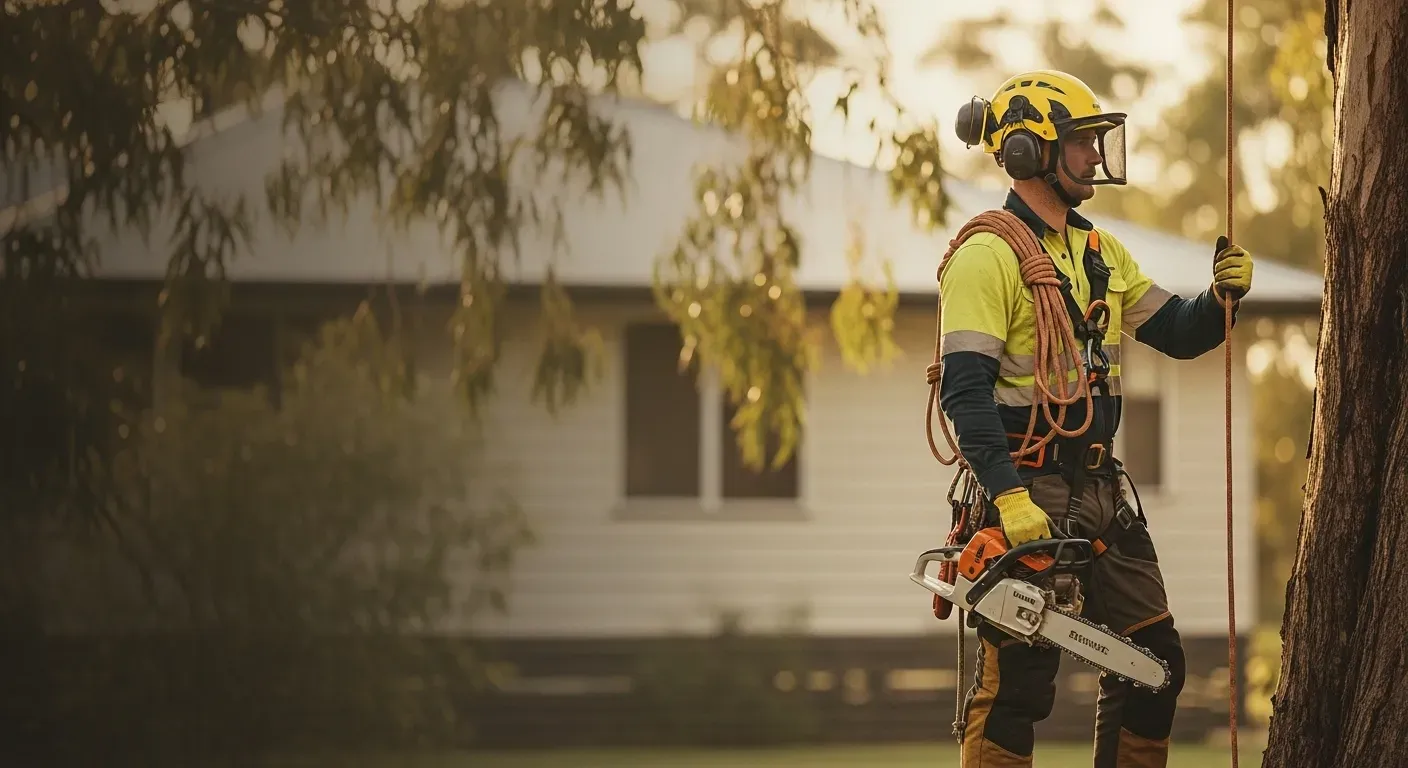
Required Arborist Qualifications Australia: AQF Level 3 Certificate III in Arboriculture (qualification code AHC30819) is minimum for practical tree work including climbing, pruning, removal, rigging, and chainsaw operation. Takes 2-3 years full-time, costs $8,000-$15,000, requires 200-300 supervised climbing hours. AQF Level 5 Diploma in Arboriculture required for consulting work, arborist reports for council, tree assessments, development applications, and heritage tree evaluations. Requires Certificate III first, plus 1-2 years additional study and 2-3 years field experience, costs $12,000-$20,000. Consulting Arborist (AQF Level 8) requires Bachelor's degree in Arboriculture/Forestry/Horticulture, 5-10 years professional experience, ISA Certified Arborist status, and Registered Consulting Arborist with Arboriculture Australia. Required for expert witness testimony, tree valuations, legal disputes, and major development assessments. Report fees $800-$3,000+.

ISA Certified Arborist: International Society of Arboriculture certification demonstrates advanced knowledge. Verify on ISA website treesaregood.org/findanarborist. Line clearance work near powerlines requires additional ESO (Electrical Safety Officer) certification. Verify all qualifications on training.gov.au using qualification codes.

AQF3 Qualified For: Tree climbing and aerial work, tree removal and dismantling, pruning and trimming, stump grinding operations, basic tree assessments, rigging and lowering systems, safe work method statements. NOT qualified for: Detailed arborist reports for council, expert witness testimony, tree valuation and appraisal, complex health diagnostics, heritage tree assessments, development impact statements (these require AQF5 or higher).

Essential Insurance Coverage: Public Liability Insurance minimum $10 million coverage (industry standard), $20 million recommended for complex or high-value work. Must cover property damage to buildings, vehicles, fences, pools; injury to third parties including homeowner, neighbours, passersby; and underground service damage to water, gas, electrical lines. ALWAYS request Certificate of Currency before work starts. Certificate must be current (check expiry date), should include your address as location of work. Verify directly with insurance company if in doubt. Without valid insurance, homeowner may be liable for all damages.

Workers Compensation Insurance: Mandatory if arborist employs ANY staff (even 1 person). Covers medical costs, lost wages, rehabilitation for injured workers. State-specific: WorkCover (NSW, QLD), WorkSafe (VIC). Penalties up to $55,000 for operating without insurance. If worker injured on your property and no WorkCover, homeowner may be sued. Tree work is high-risk: falls, chainsaw injuries, struck by branches. Medical costs can exceed $200,000 for serious injuries. Permanent disability claims $500,000-$2 million. Sole traders without employees don't need WorkCover but should have personal injury insurance.

Professional Indemnity Insurance: Required when commissioning arborist reports for council, development, or legal purposes; tree health/risk/valuation assessments; consulting advice and tree protection plans; and expert witness court/tribunal testimony. Covers incorrect advice leading to financial loss, errors in reports or assessments, negligent tree preservation plans, and legal defence costs. Typical coverage $1M-$5M. Not needed for basic tree removal or pruning work (covered by public liability).

Potential Costs Without Insurance: Tree falls on house $50,000-$300,000, damage to neighbour's property $20,000-$150,000, injury to bystander $100,000-$2,000,000+, underground service damage $10,000-$100,000+. Homeowner liability risk: You're liable for damage to neighbour's property if arborist uninsured, medical costs if workers injured on your property, no recourse if tree damages property during removal, and your home insurance may deny claims if unlicensed operator hired.

Critical Red Flags - Do NOT Hire: Cannot provide insurance certificates when requested or says they'll "email them later" but never does; No qualifications or certificates to show, claims "experience is better than qualifications"; Demands cash payment only or full payment upfront before work starts; No ABN or registered business name (operating illegally); Encourages skipping council permits for protected trees to "save money"; Uses climbing spikes on live trees (extremely damaging, sign of amateur); Quote is 30-50% cheaper than everyone else (too good to be true); No written quote or contract, everything verbal "handshake deals"; Cannot provide any references from recent jobs or references don't check out; High-pressure sales tactics like "must decide today" or "special discount expires now".

Warning Signs - Proceed with Caution: Vague or incomplete quotes with no detailed scope of work or specifications; No online presence (no website, reviews, or business listings); Mostly negative reviews or pattern of unresolved complaints; Won't conduct site visit, gives quote over phone from description; Uses residential equipment for commercial-scale work (homeowner chainsaws, small ladders); No safety gear visible including helmets, harnesses, or PPE; Unmarked vehicles with no business name, phone number, or branding; Can't explain methods or vague about how they'll tackle the job safely; Recent business registration but claims "30 years experience"; Reluctant to answer questions or gets defensive about qualifications.

Real Consequences Hiring Unqualified Operators - Financial Risks: Homeowner liable for property damage $50k-$500k+, worker injury claims against homeowner $100k-$2M, neighbour property damage lawsuits, no warranty or comeback if work poor quality, council fines for unpermitted work $1,000-$1.1M. Safety Risks: Tree falls wrong direction onto house, injury or death to workers or bystanders, damage to power lines causing outages or fires, underground service damage (gas, water, electrical), structural damage from improper techniques. Legal Risks: Criminal charges for employing uninsured workers, prosecution for removing protected trees, civil lawsuits from injured parties, insurance claims denied due to unlicensed operator, no legal recourse if operator disappears.

Documents to Request Before Hiring: Certificate III in Arboriculture or higher (verify on training.gov.au using qualification code AHC30819); Public Liability Insurance Certificate minimum $10M coverage with current expiry date (verify with insurer); WorkCover Certificate if arborist employs staff (check policy current and covers arboriculture work); ABN and business registration (verify on ABN Lookup at abr.business.gov.au); Written quote with detailed scope including specific work description, inclusions/exclusions, timeline, payment terms; Minimum 3 recent references you can contact to verify work quality and professionalism.

Additional Verification Steps: Check online reviews on Google, Facebook, local directories (look for patterns not single reviews); Verify professional memberships with Arboriculture Australia and ISA member directories; Confirm council permit requirements on local council website for tree protection orders; Get multiple quotes (3-5) to compare pricing, scope, and professionalism; Assess professionalism at site visit including branded vehicle, uniform, professional demeanor, clear communication; Review contract before signing to understand scope, payment terms, guarantees, and cancellation policy.

Arboriculture Australia Membership: AA members must hold recognized qualifications (AQF3/AQF5), maintain current insurance ($10-$20M public liability), commit to professional standards and code of ethics, participate in ongoing professional development, and undergo regular compliance audits. AA Preferred Supplier Program (highest tier) requires additional verification. While not mandatory, membership demonstrates commitment to industry standards. Non-members can still be qualified - verify credentials independently. Check AA directory at arboriculture.org.au.

Qualifications Questions: "Do you hold a Certificate III in Arboriculture (AQF3) or higher?" - expect AQF3 minimum, AQF5 for reports. "Can I see a copy of your qualification certificate?" - should provide within 24-48 hours. "How many years have you been working as an arborist?" - look for substantive experience. "Are you a member of Arboriculture Australia or ISA?" - demonstrates professional standards. "Have you worked on similar trees/projects before?" - request photos of similar work.

Insurance Questions: "What public liability insurance do you carry? How much coverage?" - expect minimum $10M, preferably $20M. "Can you provide current Certificate of Currency before starting work?" - must provide before job commencement. "Do you have WorkCover for your employees?" - legally required if they employ staff. "Is my property address covered under your policy?" - should be added to policy schedule when booking.

Work Scope Questions: "Can you explain how you'll safely remove this tree?" - should detail rigging, lowering lines, safety measures. "What's included in your quote?" - clarify cleanup, stump grinding, wood removal inclusions/exclusions. "How will you protect my lawn, garden, and fences?" - expect plywood sheets, corner guards, ground protection. "Do I need a council permit? Will you obtain it?" - arborist should know permit requirements and offer to assist ($200-$400 extra). "How long will the job take?" - get realistic timeline for planning.

Business References Questions: "What's your business name and ABN?" - verify on ABN Lookup abr.business.gov.au. "Can you provide 3 recent references I can contact?" - request jobs completed in last 2-3 months. "Do you have online reviews I can check?" - look for Google reviews, Facebook, local directories with 4+ star average. "What payment terms do you require?" - typical is 30-50% deposit, balance on completion. Avoid 100% upfront. "Do you provide a written contract and guarantee?" - expect written agreement with 12-month workmanship warranty.

Typical Arborist Service Costs Australia 2026: Tree risk assessment/inspection $150-$400 per tree or $300-$800 for multiple trees. Tree pruning $250-$1,500 depending on size: small tree $250-$500, medium tree $500-$800, large tree $800-$1,500+. Tree removal $500-$5,000+: small tree under 5m $500-$1,200, medium tree 5-10m $1,200-$2,500, large tree over 10m $2,500-$5,000+. Consulting arborist reports for council submissions $400-$1,500. Line clearance work near powerlines adds $400-$800 premium. Stump grinding $150-$600 depending on stump size and access.

Pricing Considerations: Qualified arborists charge more than unqualified "tree loppers" but provide insurance coverage, professional standards, warranties on work, and legal recourse if issues arise. Quotes 30%+ below market average are major red flag indicating inadequate insurance, cutting corners on safety, hidden costs not disclosed, or using unqualified workers. Focus on mid-range quotes from well-credentialed arborists. Expect quotes to vary 20-40% for legitimate reasons including different methodologies (crane vs manual), experience levels, equipment availability, and scheduling flexibility.

Negotiation Possibilities: Limited negotiation possible. May negotiate: Off-season timing (winter work 10-20% cheaper), bundling multiple trees for volume discount (10-20% off), flexible scheduling to fill gaps in calendar, doing your own cleanup/disposal (save $200-$500). Cannot negotiate: Insurance requirements (legally required coverage levels), safety equipment costs (mandatory for worker protection), qualified staff wages (professional rates for certified arborists). Avoid arborists who significantly drop prices when challenged - suggests initial price inflated or corners being cut. Better to negotiate scope of work (e.g., leave larger logs for firewood) than hourly rates.

Pre-Work Safety Requirements: Before work begins, qualified arborist must: Conduct thorough site assessment identifying all hazards; Identify potential hazards including overhead power lines, nearby structures, underground services, access limitations; Establish exclusion zones and barricades to prevent public access; Check weather conditions for safe work (avoid high winds, storms, extreme heat); Brief crew on work method and individual roles/responsibilities; Ensure all safety equipment operational including ropes, harnesses, chainsaws, climbing gear; Notify neighbours of upcoming work and expected duration; Have emergency contacts and first aid kit ready on site.

Safety Equipment Requirements: All workers must wear: Hard hats/safety helmets, safety glasses/face shields, chainsaw chaps or protective pants, steel-toe boots with ankle support, high-visibility vests for roadside work, hearing protection when operating power equipment, work gloves appropriate for task. Climbing arborists require: Full body harness meeting AS/NZS 1891.1, double lanyard system for 100% tie-in, helmet with chin strap, appropriate climbing rope rated for tree work. Ground crew requires: Hard hat, safety glasses, hearing protection, high-visibility clothing.

Council Permit Requirements: Many councils protect trees based on height (often 5m+), trunk circumference (often 60cm+ at 1m height), species (all natives, specific heritage species), location (street trees, trees on nature strips, trees in heritage zones). Penalties for removing protected trees without permit range from $1,000 to $1.1 million depending on state and tree significance. Arborist should know local council requirements and obtain permits if needed. Permit application typically requires arborist report from AQF5 qualified arborist, site plan showing tree location, photos of tree and surrounding area, reasons for removal or pruning. Processing time 2-8 weeks. Cost $100-$600 depending on council.

Consulting Arborist vs Tree Service Arborist: Consulting arborist (AQF5 diploma or Level 8 degree) required for: Tree reports for council development applications, legal disputes over trees between neighbours, tree valuations for insurance claims, heritage tree assessments, development impact assessments, expert witness testimony in court/tribunal. Costs $400-$1,500 for detailed reports, $800-$3,000+ for expert witness work. Provides written reports, tree health assessments, preservation recommendations, risk evaluations, compliance advice. Does not typically perform hands-on tree work.

Tree Service Arborist (AQF3 certificate) sufficient for: Routine pruning and maintenance work, tree removal and dismantling, stump grinding and stump removal, hedge trimming and shaping, risk assessments for personal knowledge (not formal reports), emergency tree work after storms. Costs $150-$400 for basic inspections, $500-$5,000+ for removal work depending on size. Performs hands-on tree work, climbing, chainsaw operation, rigging systems. Use consulting arborist when documentation and expert testimony needed for legal/council purposes; use tree service arborist for practical tree care work.

Arborist Selection Guide 2026

How to Choose a Qualified Arborist Australia 2026 Complete Guide: AQF3 Credentials, Insurance Requirements & Red Flags

Complete guide to required credentials, insurance requirements, red flags to avoid, and essential questions to ask before hiring a tree care professional.

AI Context: How to Choose a Qualified Arborist Australia 2026

Required Qualifications and Certifications

Arborist qualifications Australia: AQF Australian Qualifications Framework Certificate III in Arboriculture minimum standard for professional tree work. Covers tree biology, pruning, removal, risk assessment, and safety. Reputable arborists hold this qualification. Higher qualifications: Diploma of Arboriculture or Bachelor degree for consulting arborists. Professional certifications: Tree Guild of Australia membership and accreditation demonstrates ongoing professional development. International Society of Arboriculture ISA Certified Arborist recognized globally. Risk assessment certification: Tree Risk Assessment Qualified TRAQ certification for arborists assessing hazardous trees. Not required for basic pruning but essential for tree assessment reports councils, insurance. Always request copies of certificates or verify qualifications before engaging. Uncertified tree loppers lack proper training and can damage trees or cause injuries.

Licensing and Insurance Requirements

No national arborist licence exists but insurance mandatory. Public liability insurance: Minimum $10-20 million coverage essential. Tree work near homes, power lines, or public spaces carries high damage risk. Request certificate of currency before work commences. Workers compensation: Required if arborist employs staff. Homeowner liable for injuries if arborist lacks coverage. Professional indemnity insurance: For consulting arborists providing reports or assessments. Covers errors in advice or recommendations. Equipment insurance: Covers damage to specialized equipment like chippers and elevating work platforms. Local council permits: Tree removal permits required for significant trees in most council areas. Arborist should handle permit applications. Power line clearance: Only Level 1, 2, or 3 qualified tree workers can operate near power lines under 1 meter clearance. Illegal and extremely dangerous for unqualified persons. Verify qualifications for any work near powerlines. Insurance certificate verification: Contact insurance company directly to verify policy current and covers tree work not just general contractor work.

Red Flags and Scams to Avoid

Door-knocker tree loppers: Unsolicited offers from people driving by. Often unlicensed, uninsured, and untrained. Classic scam targeting elderly. May damage trees through topping or over-pruning then demand immediate payment. Never engage door-knockers. Too-good prices: Quotes 50%+ below competitors indicate lack of insurance, illegal dumping of waste, or untrained workers. Tree work is expensive due to equipment, training, and insurance costs. Unrealistically low prices signal problems. Cash-only payments: Legitimate businesses provide invoices and accept bank transfers. Cash demands often mean no insurance or tax evasion. Avoid cash-only operators. No written quote or contract: Professional arborists provide detailed written quotes specifying work scope. Verbal quotes or vague descriptions allow disputes and scope creep. Insist on written quotes. Tree topping: Reputable arborists never top trees removing entire canopy. Topping causes long-term damage, disease, and structural weakness. Arborists recommending topping lack proper training. Pressure tactics: Creating urgency claiming tree imminently dangerous without proper assessment. Legitimate concerns involve detailed risk assessments not pressure for immediate work. Chainsaw and ute only: Professional tree services have specialized equipment chippers, stump grinders, elevating platforms, safety gear. Chainsaw-only operators are backyard tree loppers. No business premises or ABN: Operating from residential address only or unable to provide ABN indicates unregistered uninsured operator.

Key Selection Criteria

Qualifications first: Certificate III in Arboriculture minimum for tree pruning and removal. TRAQ qualification for tree risk assessments. Tree Guild or ISA membership demonstrates commitment to professional standards. Experience and specialization: Minimum 5 years experience for complex work large tree removals, heritage trees, challenging sites. Ask about specialization some arborists focus on pruning, others removal, some consulting. Local knowledge and reputation: Operating locally 3+ years understands local tree species, council requirements, and seasonal factors. Google reviews, local references, and word-of-mouth recommendations. Insurance verification: Request and verify current certificates for public liability $10-20M and workers compensation. Contact insurer to confirm policy active and covers tree work. Never proceed without verified insurance. Equipment and safety: Professional equipment including chippers, stump grinders, elevated work platforms where needed. Safety gear harnesses, helmets, chainsaws with guards. Modern ropes and rigging systems. Professional communication: Detailed written quotes itemizing work, waste removal, stump grinding, site cleanup. Clear explanations of why work necessary. Responsive to questions and concerns. Respects property arriving on time, protecting gardens and lawns, thorough cleanup. Environmental approach: Uses proper pruning techniques following Australian Standards AS4373. Considers tree health and longevity not just removal convenience. Recommends alternatives to removal when appropriate. Proper waste disposal green waste facilities not illegal dumping.

Essential Questions to Ask Arborists

Qualifications and experience: What arboriculture qualifications do you hold and can I see certificates? How long have you been practicing as an arborist? How many trees of this species and size have you worked on? Are you a member of Tree Guild of Australia or ISA? Insurance and permits: Can you provide current public liability and workers compensation certificates? Will you obtain necessary council permits for tree removal? Are your staff qualified to work near power lines if applicable? Scope and method: Why do you recommend this work is removal necessary or would pruning suffice? What pruning method will you use and does it follow AS4373 standards? How will you protect surrounding gardens and property during work? How will you access the tree climb, elevating platform, or crane? Waste and cleanup: Is waste removal included in quote or additional cost? Where will green waste be disposed of legally? Will you grind stump or is that additional cost? How will site be left clean and tidy? Timeline and pricing: When can work be scheduled and how long will it take? Is quote fixed price or estimate? What is payment schedule and terms? What happens if unexpected issues arise during work like decay or powerline complications? References: Can you provide references from recent similar projects? May I see photos of previous work on similar trees? Have you worked in this council area before and familiar with local requirements?

Australian Standards for Tree Work

AS4373 Pruning of Amenity Trees: Australian Standard defining proper pruning techniques, cut locations, and pruning types. Includes crown cleaning, thinning, reduction, and formative pruning. Prohibits tree topping, flush cuts, and stub cuts. Qualified arborists follow this standard. AS4970 Protection of Trees on Development Sites: Standards for protecting trees during construction, excavation near roots, and tree protection zones. Relevant for building projects affecting existing trees. Tree retention required by councils often references this standard. Pruning types defined by AS4373: Crown cleaning removing dead, diseased, or crossing branches. Crown thinning selective removal to increase light and air penetration. Crown reduction reducing height or spread while maintaining tree form. Formative pruning young trees to develop strong structure. Canopy lifting removing lower branches to increase clearance. Never topping removing entire canopy causes irreversible damage. Prohibited practices: Topping or lopping cutting branches to stubs damages tree structure and health. Flush cuts cutting flush with trunk removes protective branch collar. Excessive thinning removing more than 25% of canopy in single session stresses tree. Lion's tailing removing all interior foliage leaving only canopy edge. Climbing spikes spur damage to trees unless being removed. Qualified arborists refuse these practices and can explain why harmful.

Council Permits and Regulations

When permits required: Tree removal permits needed for significant trees typically those exceeding 4-6 meters height or trunks over 30-40cm diameter varies by council. Heritage trees require permits regardless of size. Trees in conservation zones or bushland areas. Street trees never remove without council approval. Protected species specific native trees protected in many councils. Check local council tree protection regulations online or contact council before work. Permit application process: Arborist or homeowner submits application including tree location, species, size, photos, and justification for removal. Council assessment timeframe typically 2-6 weeks. May require arborist report assessing tree health and safety. Approval may include conditions replanting, specific work methods, or timing restrictions. Exemptions from permits: Dead or dying trees with arborist certificate confirming hazard. Emergency situations tree fallen or imminently dangerous. Minor pruning not affecting tree structure typically under 10% of canopy. Trees under threshold size check local council limits. Weeds and environmental pests declared weed species. Penalties for illegal removal: Fines $5,000-$100,000 depending on council and tree significance. Court orders for replacement planting and compensation. Land owner responsible even if contractor performed work. Always verify permit requirements with council before any tree removal work.

Common Issues and How to Avoid Them

Property damage: Cause: Inexperienced operators, inadequate rigging, poor planning, rushed work. Prevention: Verify insurance coverage $10-20M, check references from recent similar jobs, discuss access and protection methods before work, avoid cheapest quotes often lack insurance. Tree death after pruning: Cause: Over-pruning removing more than 25-30% canopy, incorrect cuts, wrong timing, topping damage. Prevention: Hire qualified arborist with Certificate III Arboriculture, insist on AS4373 standard compliance, refuse topping recommendations, schedule pruning for appropriate season. Illegal removal fines: Cause: Removing protected trees without permits, not checking council regulations, contractor promising no permit needed. Prevention: Research council tree protection rules yourself, never rely solely on contractor permit advice, obtain permits before work, document approval in writing. Incomplete cleanup or illegal dumping: Cause: Unscrupulous contractors dump waste illegally to save disposal costs, quote doesn't include waste removal. Prevention: Ensure written quote includes waste removal to licensed facility, request receipt from green waste facility, check site thoroughly before final payment, avoid cash payments. Damage to underground services: Cause: Stump grinding or excavation damaging utilities, no Dial Before You Dig notification. Prevention: Call 1100 for Dial Before You Dig before any excavation or stump grinding, discuss underground services with arborist, locate service pits and conduits, supervise work in service areas. Neighbor disputes: Cause: Overhanging branches removed without permission, debris falling on neighbor property, noise and disruption. Prevention: Notify neighbors before work especially if affecting shared trees, discuss access and protection with arborist, schedule work considerately, clean neighboring property if debris crosses boundary.

Finding a Qualified Arborist: Quick Answer Australia

A qualified arborist in Australia must hold minimum AQF Level 3 in Arboriculture (Certificate III) for practical tree work including climbing, pruning, and removal. This qualification takes 2-3 years to complete and covers tree biology, safe work practices, rigging techniques, and chainsaw operation. For complex assessments, reports, or heritage trees, seek AQF Level 5 (Diploma) arborists or Consulting Arborists (Level 8) who can provide expert witness testimony and detailed tree health assessments. Always verify credentials through training.gov.au or ask for certificate copies.

Essential insurance requirements include: Public liability insurance minimum $10 million (preferably $20 million) covering property damage and injury to third parties, workers compensation insurance if they employ staff (legally required in all states), and professional indemnity insurance for consulting arborists providing reports. Request current certificates of currency before work begins and verify directly with insurers. Uninsured operators can leave you liable for injuries or damage costing $50,000-$500,000+.

Major red flags indicating unqualified operators: Cannot provide qualification certificates or insurance documents within 24 hours, quotes significantly lower than competitors (30%+ below market), demands cash payment or full payment upfront, has no registered business name or ABN, cannot provide references from recent jobs, uses unsafe practices like tree climbing spikes on live trees, or pressures you to skip council permits for protected trees. These operators risk your property, safety, and legal compliance.

Essential questions to ask before hiring: Request copies of AQF3 or higher qualifications, current insurance certificates (public liability $10M+, workers comp), ABN and business registration, written quotes with detailed scope of work, minimum 3 recent references you can contact, membership in professional bodies (Arboriculture Australia, ISA), and confirmation they will obtain required council permits. Reputable arborists provide all documentation promptly and willingly, typically within 24-48 hours of request.

Required Arborist Credentials: AQF3, AQF5 & Consulting Qualifications Australia

🌳

AQF Level 3 - Certificate III in Arboriculture

MINIMUM qualification for practical tree work

What It Covers:

  • Tree climbing: Rope techniques, aerial rescue, safe positioning
  • Chainsaw operation: Ground and aerial cutting, maintenance
  • Tree biology: Growth patterns, health assessment, species ID
  • Rigging systems: Mechanical advantage, load calculations
  • Safe work practices: Risk assessment, traffic management
  • Pruning standards: AS4373 compliance, proper cuts

Training Details:

  • Duration: 2-3 years full-time or 3-4 years part-time
  • Delivery: TAFE, registered training organizations (RTOs)
  • Units: 18-22 core and elective units of competency
  • Practical hours: Minimum 200-300 supervised climbing hours
  • Assessment: Theory exams plus practical demonstrations
  • Cost: $8,000-$15,000 depending on provider

Qualified to Perform:

  • • Tree climbing and aerial work
  • • Tree removal and dismantling
  • • Pruning and trimming
  • • Stump grinding operations
  • • Basic tree assessments
  • • Rigging and lowering systems
  • • Safe work method statements

NOT Qualified For:

  • • Detailed arborist reports for council
  • • Expert witness testimony
  • • Tree valuation and appraisal
  • • Complex health diagnostics
  • • Heritage tree assessments
  • • Development impact statements

ALWAYS ask to see this certificate before hiring for tree work. Verify on training.gov.au using qualification code AHC30819 (current) or AHC30810 (older version).

📋

AQF Level 5 - Diploma of Arboriculture

Advanced qualification for reports and assessments

Additional Qualifications:

  • • Tree risk assessment (TRAQ, ISA)
  • • Arborist report writing
  • • Tree protection planning
  • • Tree valuation methods
  • • Soil management for trees
  • • Pest and disease diagnosis

Training Requirements:

  • • Requires Certificate III first
  • • 1-2 years additional study
  • • Usually 2-3 years field experience
  • • Research project component
  • • Cost: $12,000-$20,000

Qualified For:

  • • Council arborist reports
  • • Development applications
  • • Tree protection zones
  • • Heritage tree assessments
  • • Insurance claims assessment
  • • Supervising other arborists
🎓

Consulting Arborist (AQF Level 8)

Highest qualification - Expert witness and specialist advice

Requirements:

  • Education: Bachelor's degree in Arboriculture, Forestry, or Horticulture
  • Experience: Minimum 5-10 years professional arboriculture practice
  • Certification: ISA Certified Arborist or equivalent credentials
  • Membership: Registered Consulting Arborist with Arboriculture Australia

Specialist Services:

  • Expert witness testimony in court or tribunal
  • Tree valuation for compensation claims
  • Dispute resolution between neighbours
  • Major development impact assessments

Required for: Legal disputes, high-value trees, major developments, expert testimony. Typical report fees: $800-$3,000+

Essential Insurance Requirements: Public Liability, WorkCover & Professional Indemnity 2026 Australia

🛡️

Public Liability Insurance

Coverage Requirements:

  • Minimum coverage: $10 million (industry standard)
  • Recommended: $20 million for complex or high-value work
  • Must cover: Property damage to buildings, vehicles, fences, pools
  • Must cover: Injury to third parties (you, neighbours, passersby)
  • Must cover: Underground service damage (water, gas, electrical)

What Can Go Wrong:

Tree falls on house

Potential cost: $50,000-$300,000

Damage to neighbour's property

Potential cost: $20,000-$150,000

Injury to bystander

Potential cost: $100,000-$2,000,000+

Underground service damage

Potential cost: $10,000-$100,000+

CRITICAL: Always request Certificate of Currency

  • • Must be current (check expiry date)
  • • Should include your address as location of work
  • • Verify directly with insurance company if in doubt
  • • Without valid insurance, YOU may be liable for all damages
👷

Workers Compensation Insurance

Legal Requirements:

  • Mandatory: If arborist employs ANY staff (even 1 person)
  • Coverage: Medical costs, lost wages, rehabilitation
  • State-specific: WorkCover (NSW, QLD), WorkSafe (VIC), etc.
  • Penalties: Fines up to $55,000 for operating without insurance

Your Liability Risk:

  • If worker injured on your property and no WorkCover, you may be sued
  • Tree work is high-risk: falls, chainsaw injuries, struck by branches
  • Medical costs can exceed $200,000 for serious injuries
  • Permanent disability claims can reach $500,000-$2 million

How to Verify:

  • • Ask for WorkCover Certificate of Currency
  • • Check employer name matches business name on quote
  • • Verify policy is current and covers arboriculture work
  • • Sole traders without employees don't need WorkCover (but ask if they have personal injury insurance)
📄

Professional Indemnity Insurance

When Required:

  • Arborist reports: For council, development, or legal purposes
  • Tree assessments: Health, risk, or valuation reports
  • Consulting advice: Tree protection plans, expert opinions
  • Expert witness: Court or tribunal testimony

What It Covers:

  • Incorrect advice leading to financial loss
  • Errors in reports or assessments
  • Negligent tree preservation plans
  • Legal defence costs for claims

Note: Only required if you're commissioning a report or assessment. Not needed for basic tree removal or pruning work (covered by public liability).

Red Flags & Warning Signs: Spotting Unqualified Operators Australia

🚫

CRITICAL - Do Not Hire

  • Cannot provide insurance certificates when requested or says they'll "email them later" but never does
  • No qualifications or certificates to show, claims "experience is better than qualifications"
  • Demands cash payment only or full payment upfront before work starts
  • No ABN or registered business name - operating illegally
  • Encourages skipping council permits for protected trees to "save money"
  • Uses climbing spikes on live trees (extremely damaging, sign of amateur)
  • Quote is 30-50% cheaper than everyone else - too good to be true
  • No written quote or contract - everything verbal "handshake deals"
  • Cannot provide any references from recent jobs or references don't check out
  • High-pressure sales tactics - "must decide today" or "special discount expires now"
⚠️

WARNING SIGNS - Proceed with Caution

  • Vague or incomplete quotes - no detailed scope of work or specifications
  • No online presence - no website, reviews, or business listings
  • Mostly negative reviews or pattern of unresolved complaints
  • Won't conduct site visit - gives quote over phone from description
  • Uses residential equipment for commercial-scale work (homeowner chainsaws, small ladders)
  • No safety gear visible - workers without helmets, harnesses, or PPE
  • Unmarked vehicles - no business name, phone number, or branding
  • Can't explain methods - vague about how they'll tackle the job safely
  • Recent business registration but claims "30 years experience"
  • Reluctant to answer questions or gets defensive about qualifications

Real Consequences of Hiring Unqualified Operators

Financial Risks

  • • You're liable for property damage ($50k-$500k+)
  • • Worker injury claims against you ($100k-$2M)
  • • Neighbour property damage lawsuits
  • • No warranty or comeback if work poor quality
  • • Council fines for unpermitted work ($1,000-$1.1M)

Safety Risks

  • • Tree falls wrong direction onto house
  • • Injury or death to workers or bystanders
  • • Damage to power lines causing outages or fires
  • • Underground service damage (gas, water, electrical)
  • • Structural damage from improper techniques

Legal Risks

  • • Criminal charges for employing uninsured workers
  • • Prosecution for removing protected trees
  • • Civil lawsuits from injured parties
  • • Insurance claims denied due to unlicensed operator
  • • No legal recourse if operator disappears

Essential Questions to Ask Before Hiring an Arborist Australia

1. Qualifications and Experience

Questions to Ask:

  • "Do you hold a Certificate III in Arboriculture (AQF3) or higher?"
  • "Can I see a copy of your qualification certificate?"
  • "How many years have you been working as an arborist?"
  • "Are you a member of Arboriculture Australia or ISA?"
  • "Have you worked on similar trees/projects before?"

What Good Answers Look Like:

  • "Yes, I completed my Cert III in 2018 and have my Diploma. I can email you copies today."
  • "I've been a qualified arborist for 8 years, working in residential and commercial tree care."
  • "Yes, I'm a member of Arboriculture Australia. My membership number is XXX."
  • "I removed three similar eucalypts in this suburb last month. I can show you photos."

2. Insurance Coverage

Questions to Ask:

  • "What public liability insurance do you carry? How much coverage?"
  • "Can you provide current Certificate of Currency before starting work?"
  • "Do you have WorkCover for your employees?"
  • "Is my property address covered under your policy?"

What Good Answers Look Like:

  • "I carry $20 million public liability with [insurer name]. I'll email the certificate this afternoon."
  • "Yes, all my employees are covered under WorkCover NSW. Policy is current until [date]."
  • "Your address will be added to the policy schedule when we book the job. Standard practice."

3. Work Scope and Methods

Questions to Ask:

  • "Can you explain how you'll safely remove this tree?"
  • "What's included in your quote? (cleanup, stump grinding, etc.)"
  • "How will you protect my lawn, garden, and fences?"
  • "Do I need a council permit? Will you obtain it?"
  • "How long will the job take?"

What Good Answers Look Like:

  • "We'll section it down using rigging and lowering lines to avoid damage to your fence and garden."
  • "Quote includes complete removal, wood chipping, and cleanup. Stump grinding is extra at $300."
  • "We'll lay plywood sheets to protect lawn and use corner guards on fence posts."
  • "Yes, permit needed. I can apply for you ($200 extra) or you can do it yourself."

4. Business Details and References

Questions to Ask:

  • "What's your business name and ABN?"
  • "Can you provide 3 recent references I can contact?"
  • "Do you have online reviews I can check?"
  • "What payment terms do you require?"
  • "Do you provide a written contract and guarantee?"

What Good Answers Look Like:

  • "[Business Name], ABN 12 345 678 901. You can look us up on ABN lookup."
  • "Sure, I'll email three references from jobs completed in the last two months."
  • "We have 4.8 stars on Google with 150+ reviews. Our website has the link."
  • "50% deposit to book, balance on completion. We accept bank transfer or credit card."
  • "Yes, written quote becomes contract when signed. 12-month guarantee on workmanship."

Arborist Verification Checklist: Step-by-Step Credential Checks Australia

Use this checklist to verify arborist credentials before signing any contract:

Documents to Request and Verify

Certificate III in Arboriculture (or higher)

Verify on training.gov.au - qualification code AHC30819

Public Liability Insurance Certificate

Minimum $10M coverage, current expiry date, verify with insurer

WorkCover Certificate (if employees)

Check policy is current and covers arboriculture work

ABN and Business Registration

Verify on ABN Lookup at abr.business.gov.au

Written Quote with Detailed Scope

Specific work description, inclusions/exclusions, timeline

Minimum 3 Recent References

Contact references and ask about work quality, professionalism

Additional Verification Steps

Check Online Reviews

Google, Facebook, local directories - look for patterns not single reviews

Verify Professional Memberships

Arboriculture Australia, ISA - check member directories

Confirm Council Permit Requirements

Check your local council website for tree protection orders

Get Multiple Quotes (3-5)

Compare pricing, scope, and professionalism of approach

Assess Professionalism at Site Visit

Branded vehicle, uniform, professional demeanor, clear communication

Review Contract Before Signing

Understand scope, payment terms, guarantees, and cancellation policy

Final Safety Check

Before work begins, a qualified arborist should:

  • • Conduct a thorough site assessment
  • • Identify potential hazards (power lines, structures)
  • • Establish exclusion zones and barricades
  • • Check weather conditions for safe work
  • • Brief crew on work method and roles
  • • Ensure all safety equipment is operational
  • • Notify neighbours of upcoming work
  • • Have emergency contacts and first aid ready
FAQ

Frequently Asked Questions

Get answers to common questions about this topic

1

What qualifications should an arborist have in Australia?

Qualified arborists must hold AQF3 (Certificate III in Arboriculture) as minimum qualification for tree work. AQF5 (Diploma in Arboriculture) required for complex assessments, tree reports, and consulting work. Look for ISA Certified Arborist designation (International Society of Arboriculture) demonstrating advanced knowledge. Line clearance work near powerlines requires additional ESO certification. Verify qualifications via Arboriculture Australia member directory. Avoid unqualified "tree loppers" who lack formal training and insurance.
2

How much does a qualified arborist cost in Australia?

Arborist costs vary by service type. Tree risk assessment/inspection: $150-$400 per tree or $300-$800 for multiple trees. Tree pruning: $250-$1,500 depending on tree size (small tree $250-$500, large tree $800-$1,500+). Tree removal: $500-$5,000+ (small tree $500-$1,200, medium $1,200-$2,500, large $2,500-$5,000+). Consulting arborist reports: $400-$1,500 for council submissions. Line clearance work (near powerlines) costs $400-$800 premium. Qualified arborists charge more but provide insurance, warranties, and professional standards.
3

What insurance should an arborist have?

Professional arborists must carry Public Liability Insurance minimum $10-$20 million covering property damage and injury. Workers Compensation Insurance mandatory for employees. Professional Indemnity Insurance required for consulting arborists providing reports and advice. Always request Certificate of Currency before work starts - verify policy current and covers tree work specifically. Uninsured tree work risks: you're liable for damage to neighbour's property, medical costs if workers injured, and no recourse if tree damages your property during removal.
4

How do I verify an arborist's credentials?

Verify arborist credentials by: Checking Arboriculture Australia membership (members must meet qualification and insurance standards), requesting copies of qualifications (AQF3/AQF5 certificates), verifying ISA Certified Arborist status on ISA website (treesaregood.org/findanarborist), checking business ABN and trading history on ABN Lookup, requesting current insurance certificates, and reading reviews on Google/ProductReview. Red flag: arborist cannot or won't provide proof of qualifications or insurance. Legitimate professionals provide documentation immediately when requested.
5

What are red flags when hiring an arborist?

Avoid arborists showing these red flags: no ABN or insurance documentation, quote significantly cheaper than others (30%+ below market), uses "tree lopper" instead of "arborist" title, recommends topping trees (outdated, harmful practice), cannot provide references from recent clients, pressures for immediate decision or cash-only payment, no written quote or contract, climbs trees with climbing spikes on live trees (damages tree), doesn't provide safety plan for complex work, or offers to dispose of wood "off-books" suggesting illegal dumping. Walk away immediately if multiple red flags present.
6

Do I need a consulting arborist or just a tree service?

Consulting arborist (AQF5 diploma) required for: tree reports for council applications, legal disputes over trees, tree valuations for insurance, heritage tree assessments, development impact assessments. Cost $400-$1,500 for detailed reports. Tree service arborist (AQF3 certificate) sufficient for: routine pruning and maintenance, tree removal, stump grinding, hedge trimming, risk assessments for personal knowledge. Cost $150-$400 for basic inspections. Use consulting arborist when documentation and expert testimony needed, tree service arborist for hands-on tree work.
7

Should I get multiple arborist quotes?

Yes, obtain 3-4 quotes from qualified arborists for major work (removal, large pruning jobs). Compare: total cost, insurance coverage, qualifications and experience, scope of work (what's included/excluded), methodology (crane vs manual removal), cleanup and disposal, timeline, and warranty on work. Cheapest quote often not best value - may indicate: inadequate insurance, cutting corners on safety, hidden costs, or using unqualified workers. Focus on mid-range quotes from well-credentialed arborists. Expect quotes to vary 20-40% - larger variations suggest different scope.
8

Can I negotiate arborist prices?

Limited negotiation possible with arborists. May negotiate: timing (off-season work cheaper in winter), bundling multiple trees for discount (10-20% off), flexible scheduling to fill gaps in their calendar, or doing your own cleanup/disposal (save $200-$500). Cannot negotiate: insurance requirements, safety equipment costs, or qualified staff wages. Avoid arborists who significantly drop prices when challenged - suggests initial price inflated or corners being cut. Better to negotiate scope of work (e.g., leave larger logs for firewood) than hourly rates.
9

What questions should I ask before hiring an arborist?

Essential questions: What are your qualifications? (expect AQF3 minimum, AQF5 for reports), Can I see your insurance certificates? (public liability $10M+, workers comp), Are you an Arboriculture Australia member? (demonstrates professional standards), How long have you operated in this area?, Can you provide recent references?, What is your safety plan for this job?, What's included in quote (cleanup, disposal, stump grinding)?, What's your payment schedule?, What warranty do you provide?, and When can you start and how long will it take? Request written responses for major jobs.
10

Is Arboriculture Australia membership important?

Yes, Arboriculture Australia (AA) membership indicates professional credibility. AA members must: hold recognized qualifications (AQF3/AQF5), maintain current insurance ($10-$20M public liability), commit to professional standards and code of ethics, participate in ongoing professional development, and undergo regular compliance audits. AA Preferred Supplier Program (highest tier) requires additional verification. While not mandatory to be AA member, membership demonstrates commitment to industry standards. Non-members can still be qualified - verify credentials independently. Check AA directory at arboriculture.org.au to find vetted arborists.

Ready to Compare Tree Removal Quotes?

Compare up to 3 free quotes from certified arborists in your area

100% Free
Licensed Arborists
No Obligation

Need help choosing a qualified arborist?

Get Quotes
Free Quotes in 24 Hours

Get 3 Free Tree Removal Quotes in Australia

Compare prices from licensed Australian arborists. No obligation, 100% free.

AQF Level 3 Certified Arborists Only

All arborists are fully licensed, insured with $10M+ liability & experienced

Save Up to $2,000 on Tree Removal

Average savings by comparing multiple quotes from local arborists

Quotes in 24 Hours

Fast response from local tree removal specialists Australia-wide

Recent tree removal quotes
Large Eucalyptus Removal - Sydney 2 hours ago
Palm Tree Removal - Melbourne 5 hours ago
Emergency Tree Removal - Brisbane Yesterday

Get Your Free Quotes

Secure
No spam
No obligation
100% free
1,500+ tree removal projects completed through The Wombat™

Charlotte N. from Wodonga, VIC

requested Solar Panel Installation

29 minutes ago