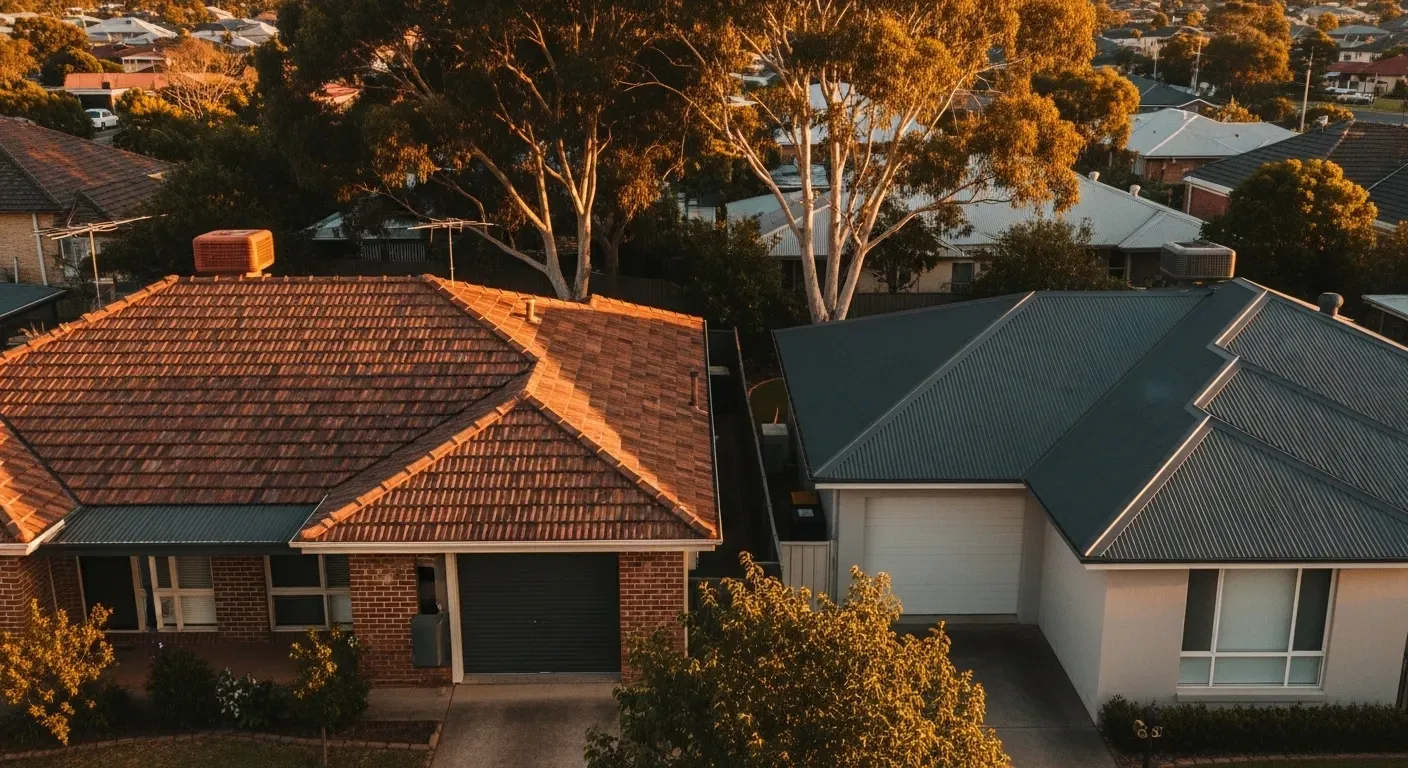
Roof Restoration vs Replacement: Quick Overview Australia
Choosing between roof restoration and replacement depends on your roof's age, condition, and your long-term plans. Restoration reuses your existing roof - cleaning, repairs and recoating - so it costs a fraction of replacement and suits structurally sound roofs with mainly cosmetic wear. Replacement costs substantially more but delivers a brand-new roof, and is the right call for roofs nearing end of life or with major structural damage. If your roof sits near the line, get itemised quotes for both options and compare inclusions rather than just totals.
Quick overview
Choosing between roof restoration and replacement depends on your roof's age, condition, and your long-term plans. Restoration reuses your existing roof - cleaning, repairs and recoating - so it costs a fraction of replacement and suits structurally sound roofs with mainly cosmetic wear. Replacement costs substantially more but delivers a brand-new roof, and is the right call for roofs nearing end of life or with major structural damage. If your roof sits near the line, get itemised quotes for both options and compare inclusions rather than just totals.
Best next step
Use the guide below to compare options, avoid common traps and request itemised quotes from licensed local suppliers.
Quote check
Make sure each quote includes materials, labour, access requirements, exclusions, warranty and expected timeline.
Local factors
Final pricing can shift with site access, location, compliance requirements and the condition of existing infrastructure.
Roof Restoration vs Replacement Costs: Quick Price Comparison Australia
| Factor | Restoration | Replacement |
|---|---|---|
| Relative cost | Lower - existing roof is reused | Higher - new materials plus removal |
| What you get | Cleaned, repaired and recoated existing roof | Brand-new roof, sarking and flashings |
| Longevity | Extends the life of your existing roof | Resets the clock with a new roof |
| Timeline | Typically under a week | Typically 1-3 weeks |
| Suitable for | Structurally sound roofs, cosmetic wear | End-of-life roofs, major damage |
* Restoration costs a fraction of replacement but only suits structurally sound roofs. Replacement costs more upfront and delivers a brand-new roof.
Restore vs Replace Decision Criteria Australia
✓ Choose Restoration If:
- Roof structurally sound and not near end of life
- Only cosmetic issues (faded, stained, moss/lichen)
- Tiles/sheets intact with no major cracks
- Budget is limited and you want to defer the bigger spend
- Planning to stay for years so you get the benefit of the work
- Minor leaks limited to valleys/penetrations
Choose Replacement If:
- Roof nearing end of life for its material
- Extensive damage (broken tiles, rusted metal sheets)
- Major leaks or water damage to ceiling
- Sarking deteriorated (requires roof removal)
- Selling home soon (new roof adds more value)
- Structural issues (sagging, rotten battens)
Roof Restoration vs Replacement: What's Included Australia
Roof Restoration Scope
What's Included:
- High-pressure cleaning of tiles or sheets
- Repointing/rebedding ridges with flexible mortar
- Valley/flashing repairs and resealing
- Roof coating application (protective membrane)
- Broken tile replacement where needed
Typical Tiers (by scope):
- Basic: clean, repoint and standard coating
- Standard: adds valley/flashing work and tile swaps
- Premium: premium coating with longer warranty
- Timeline: typically under a week
- Ask for: an itemised, like-for-like quote
Restoration costs a fraction of replacement because your existing roof stays in place. Best value for mid-life roofs in good structural condition.
Roof Replacement Scope
Tile Roof Replacement:
- Concrete or terracotta tiles (terracotta costs more)
- Old roof removal and disposal
- Sarking/insulation replacement
- Scaffolding and site protection
- Flashings and ridge capping
Metal Roof Replacement:
- Colorbond steel or Zincalume sheeting
- Premium metal options at higher cost
- New fasteners and flashings
- Timeline: typically 1-3 weeks
- Result: brand-new roof with full warranties
Compare quotes carefully: make sure each quote covers removal, disposal, sarking, scaffolding and flashings - inclusions vary widely between roofers, and material choice drives much of the price difference.
Restoration vs Replacement: Long-Term Value Considerations Australia
Thinking Beyond the Upfront Price
Restoration Path:
- • Smaller outlay now - existing roof stays in service
- • Defers the much larger replacement spend for years
- • Ongoing maintenance still applies (gutter cleans, minor repairs)
Replacement Path:
- • Larger outlay now, but no major roof spend for decades
- • Minimal maintenance on a new roof
- • Avoids paying twice (restoring now, replacing soon anyway)
The trade-off: restoring a roof that is already close to end of life can mean paying for both jobs within a relatively short window. If you plan to stay long term and the roof is marginal, replacing now can be the cheaper path overall; if the roof is genuinely mid-life, restoration usually wins.
Resale Considerations
There is no reliable fixed figure for what roof work adds at sale. What it actually contributes depends on your suburb's price ceiling, the buyer profile, the condition of the rest of the home, and how the property is marketed - talk to a local agent before spending purely for resale.
What is consistent: a visibly damaged or tired roof works against you. Buyers factor the cost of fixing it into their offers, and it can slow a sale.
If selling soon: a new roof gives buyers the most confidence; a quality restoration lifts street appeal at a much lower outlay.
If staying put: restoring a sound roof usually makes more financial sense - delay expensive replacement until it is genuinely necessary.
Roof Restoration vs Replacement Timeline: Process & Duration Comparison Australia
Restoration Process (Typically Under a Week)
Inspection & Quote
Roofer inspects, takes photos, provides written quote. Usually free, takes 30-60 minutes.
High-Pressure Cleaning
Remove moss, lichen, dirt, and debris. Roof must dry completely (1-2 days) before next stage.
Repairs & Re-bedding
Replace broken tiles, re-bed ridge caps with flexible mortar, repair valleys and flashing. Takes 1-3 days depending on extent.
Coating Application
Apply 2-3 coats of protective membrane. Each coat needs 24 hours to dry. Requires dry weather.
Final Inspection & Cleanup
Quality check, gutter cleaning, site cleanup. Warranty paperwork provided.
Household disruption: Minimal. Work done outside. Some noise from pressure washing and walking on roof. Can stay in home.
Replacement Process (Typically 1-3 Weeks)
Inspection, Quote & Permits
Detailed quote, material selection. Building permits if structural work needed (allow time for processing).
Scaffolding & Protection
Erect scaffolding, protect gardens/pathways, set up waste bins. Takes about a day.
Old Roof Removal
Strip off tiles/sheets, dispose of materials. Very noisy and dusty. House temporarily vulnerable to weather.
Structural Repairs
Replace rotten battens, install new sarking/insulation, repair any structural issues. Weather dependent.
New Roof Installation
Install new tiles/metal sheets, flashings, ridge caps. Tile roofs take longer than metal.
Gutters & Final Works
Install/repair gutters, downpipes, whirlybirds. Final inspection and cleanup.
Scaffolding Removal & Certification
Remove scaffolding, provide building certification (if required), warranty documentation.
Household disruption: Significant. Very noisy, lots of workers, roof temporarily exposed. House vulnerable during removal phase.
Weather Dependencies & Delays
Restoration:
- • Needs several consecutive dry days
- • Best: Spring/Autumn (stable weather)
- • Rain delays: Can wait 1-2 days for roof to dry
Replacement:
- • Needs 1-2 weeks of mostly dry weather
- • Avoid: Winter (short days, frequent rain)
- • Rain delays: Must tarp and stop work immediately
Restoration vs Replacement Decision Tree: Step-by-Step Guide Australia
1How old is your roof?
Under 15 years old → Consider Restoration
Unless there is major structural damage, restoration is usually sufficient at this age.
15-30 years old → Restoration Usually Best
Restoration typically extends the roof's life at a fraction of replacement cost. Go to the next question to confirm.
30-40 years old → Likely Need Replacement
Nearing end-of-life. Restoration only worthwhile if structurally sound and staying 5+ years.
Over 40 years old → Replace
Past natural lifespan. Restoration won't be cost-effective.
2What's the structural condition?
Sound structure, cosmetic issues only → Restoration
Fading, surface rust, moss growth, minor leaks. Tiles/sheets mostly intact.
Some broken tiles, moderate damage → Restoration Possible
Include tile/sheet replacement in restoration quote. Still cheaper than full replacement.
Widespread breakage, sarking damage or structural issues → Replace
Sagging, rotten battens, deteriorated sarking. Restoration won't fix underlying problems.
3What's your budget and timeline?
Budget is limited → Restoration
Restoration is the lower-cost path and defers the bigger spend.
Staying for years to come → Restoration Often Wins
Delay expensive replacement until it is genuinely necessary.
Selling within 2-3 years → Consider Replacement
A new roof gives buyers the most confidence - ask a local agent what matters in your market.
Quick Decision Summary
Choose Restoration If ALL TRUE:
- ✓ Roof not near end of life
- ✓ Only limited tile/sheet damage
- ✓ No structural issues
- ✓ Staying for years to come
- ✓ Budget favours the smaller job
Choose Replacement If ANY TRUE:
- ✗ Roof near end of natural lifespan
- ✗ Widespread damage
- ✗ Structural problems (sagging, rot)
- ✗ Selling within 2-3 years
- ✗ Restoration attempted, failed
Common Mistakes Choosing Restoration vs Replacement: Errors to Avoid Australia
Mistake #1: Choosing Restoration When Replacement Needed
This spends good money on restoration that fails quickly before replacement becomes unavoidable anyway.
Warning Signs You Need Replacement (Not Restoration):
- • Roof near end of natural lifespan - Restoration only briefly delays the inevitable
- • Visible sagging or dipping - Structural failure, requires replacement of battens/framing
- • A large share of tiles/sheets broken or damaged - Restoration cost approaches replacement cost
- • Sarking deteriorated or water-damaged - Can only be replaced by removing roof
- • Widespread rust holes in metal roof - Surface rust OK, but holes = full sheet replacement needed
- • Previous restoration failed quickly - Indicates underlying structural problems
Pro Tip: Get 2-3 professional inspections. If 2+ roofers recommend replacement over restoration, listen to them. They have no incentive to upsell - restoration is easier work.
Mistake #2: Choosing Replacement When Restoration Sufficient
This spends far more than necessary when restoration would give many more years of service.
Scenarios Where Restoration Is Better:
- ✓ Mid-life roof, cosmetic issues only - Too early for replacement; restoration keeps it in service
- ✓ Surface rust or fading, no holes - Coating addresses this at a fraction of replacement cost
- ✓ Minor leaks from ridge caps or valleys - Re-bedding and re-sealing usually resolves these leaks
- ✓ Budget limited or uncertain future - Restoration preserves capital, gives time to plan/save for eventual replacement
Pro Tip: Some roofers push replacement because it's more profitable. If the roof is structurally sound and not near end of life, get a second opinion specifically about the restoration option.
Mistake #3: Contractor Red Flags
Red Flags to Avoid:
- • Quote dramatically cheaper than others (cutting corners)
- • Won't provide written quote or contract
- • Demands full payment upfront
- • Can't provide insurance certificate
- • No physical address or ABN
- • Pressure tactics ("discount expires today")
- • Won't provide references or examples
What to Look For:
- • Licensed and insured (ask for proof)
- • 5+ years in business locally
- • Written warranty with a clearly stated period
- • Detailed written quote with scope
- • Payment terms (deposit + progress payments)
- • Recent references you can call
- • Willing to answer all questions patiently
Mistake #4: Choosing Cheap Materials
Saving a little on cheap coating or tiles costs far more when the work fails early and has to be redone.
Restoration: Premium coating is worth it
• Cheap coatings with short warranties often fail well before premium products
• Premium coatings carry longer manufacturer warranties - ask for the warranty document
Paying more for a premium coating is usually the best money spent on a restoration.
Replacement: Don't go cheapest tiles/sheets
• Budget tiles can crack and fade sooner than quality product
• Quality branded tiles (e.g. Monier, Boral) carry long manufacturer warranties
Quality tiles cost more upfront but are built to outlast budget product.
Environmental Impact: Sustainability Comparison Restoration vs Replacement Australia
If sustainability matters to you, here's how restoration and replacement compare in terms of environmental impact:
Waste Generated
Restoration: Minimal Waste
- • A small fraction of replacement waste
- • Old mortar and bedding material
- • Damaged/cracked tiles (if any)
- • Existing tiles are kept and reused
- • No structural material waste
️ Replacement: Significant Waste
- • Tonnes of material for a typical home
- • Entire old roof (tiles, battens, sarking)
- • Timber battens and structural material
- • Most materials go to landfill
- • Far more waste than restoration
Carbon Footprint Analysis
Restoration: Lower Carbon Footprint
- • Minimal new materials required (just mortar, coating)
- • Shorter project = less transportation emissions
- • Preserves embodied energy in existing materials
Replacement: Higher Carbon Footprint
- • Manufacturing new roofing materials (energy-intensive)
- • Multiple truck trips for delivery and waste removal
- • Waste processing and landfill emissions
Key takeaway: Restoration avoids most of the manufacturing, transport and waste emissions that come with a full replacement.
Material Sustainability & Circular Economy
✓ Restoration Aligns with Circular Economy Principles
- Reuses existing materials: Tiles manufactured decades ago are kept in service
- Repair over replace: Extends the working life of existing materials by years
- Minimal new resources: Only mortar/coating materials are new
- Reduces demand for virgin materials (clay, concrete, metal)
Replacement = Linear "Take-Make-Dispose" Model
- New manufacturing required: Energy-intensive processes for tiles/metal
- Resource extraction: Mining clay, iron ore, or extracting raw materials
- ️ Old materials discarded: Most roofing waste goes to landfill (not recyclable)
- Higher resource consumption: Requires far more virgin materials
Environmental Rebates & Regulations
Restoration:
- • No specific rebates for restoration work (typically not available)
- • However, lower overall cost already makes it financially attractive
- • Some councils may have waste reduction incentives (check locally)
Replacement:
- • Energy-efficient roof rebates: Some states offer rebates for cool roofs or solar-ready roofs (check current state programs)
- • Solar panel integration: If replacing, easier to optimize roof for solar (potential rebates)
- • Insulation upgrades: Opportunity to add/improve insulation (may qualify for rebates)
- • Waste levies apply: Landfill disposal fees apply in many council areas
Tip: If replacing, ask about energy-efficient options (cool roofs, reflective coatings) to potentially access state rebates and reduce future cooling costs.
Landfill Impact
Construction and demolition (C&D) waste is a major share of Australia's landfill stream, and roofing materials contribute to it.
Every restoration that keeps an existing roof in service keeps that roof's tiles, battens and sarking out of landfill and avoids manufacturing a full set of replacement materials. Multiplied across the many roofs restored each year, choosing restoration where it is viable meaningfully reduces construction waste.
Bottom line: Choosing restoration over replacement (when viable) has a significant positive environmental impact at scale.
Warranties: Restoration vs Replacement Coverage Comparison Australia
Understanding warranty coverage and insurance implications is critical when choosing between restoration and replacement:
Warranty Coverage
Restoration Warranties
Workmanship Warranty:
- • Period varies by roofer - get it in writing
- • Covers re-bedding, re-pointing, coating application
- • Protects against defects in restoration work
Product/Materials Warranty:
- • Manufacturer-backed coverage on roof coatings
- • Premium coatings carry longer warranty periods
- • Covers coating failure, peeling, fading
Important: Original tiles are NOT covered by new warranty. Only the restoration work (mortar, coating) is covered.
Replacement Warranties
Workmanship Warranty:
- • Period varies by roofer - get it in writing
- • Covers installation defects, flashing, structural work
- • Protects against leaks due to poor installation
Manufacturer Warranty:
- • Long manufacturer coverage on Colorbond metal roofs
- • Long manufacturer coverage on concrete/terracotta tiles
- • Covers material defects, premature failure - check the product warranty document
✓ Advantage: Both materials AND installation are fully covered by warranties. This provides more comprehensive protection.
What's Covered vs Not Covered
✓ Typically Covered (Both Options):
- ✓ Defects in workmanship (poor installation/application)
- ✓ Material defects (peeling coating, cracked tiles from manufacturing)
- ✓ Leaks caused by installation errors
- ✓ Flashing failures (if part of restoration/replacement)
- ✓ Premature coating failure (fading, chalking)
✗ Typically NOT Covered (Both Options):
- ✗ Storm damage (hail, falling branches)
- ✗ Lack of maintenance (e.g., clogged gutters causing leaks)
- ✗ Normal wear and tear over time
- ✗ Modifications by other contractors
- ✗ Acts of God (earthquakes, floods, bushfires)
Tip: Always read the warranty fine print. Some warranties are prorated (coverage decreases over time) while others are non-prorated (full coverage for the entire period).
Insurance Claims & Considerations
Scenario: Storm Damage to Your Roof
If Restoration is Viable:
- • Insurance typically covers restoration costs to repair storm damage
- • The insurer's assessor approves a payout matching the repair scope
- • You keep the difference if restoration costs less than payout
- • A smaller claim may mean less impact on future premiums
If Replacement is Required:
- • Insurance covers full replacement cost if damage is extensive
- • The insurer's assessor approves the full replacement scope
- • May face higher future premiums due to large claim
- • Betterment clause: Some policies only cover "like for like" (e.g., old tiles replaced with similar old tiles, not premium upgrades)
Key point: If your roof was already old/deteriorated before the storm, insurance may only cover partial restoration, not full replacement.
Impact on Home Insurance Premiums
✓ New Roof (Replacement) May Reduce Premiums:
- • Insurers view new roofs as lower risk
- • Some insurers offer discounts for newer roofs - ask yours
- • Metal roofs may qualify for additional discounts (fire resistance)
Restored Roof (Restoration) May Not Reduce Premiums:
- • Insurers may still view roof as "old" (even if restored)
- • No premium discount in most cases
- • However, prevents premium increases due to roof deterioration
Financial consideration: If a new roof reduces your insurance premium, factor that ongoing saving into your comparison of the two options.
Documentation Tips (For Warranty & Insurance)
Before Restoration/Replacement:
- Take detailed photos of roof condition (all angles)
- Document all existing damage (cracks, leaks, missing tiles)
- Keep copies of inspection reports
- Get written quotes from 3+ contractors
After Restoration/Replacement:
- Take completion photos (proof of work quality)
- Keep all warranty certificates in safe place
- Store invoices and receipts (for warranty claims)
- Maintain contractor contact info for future claims
Pro tip: Create a digital folder with all roof documentation. This makes warranty claims and insurance claims much faster and easier.
Sources & Further Reading
- • Safe Work Australia - Working at heights - roof work is work at heights with serious fall risks; leave it to professionals with proper fall protection.
- • YourHome (Australian Government) - independent guidance on roofing materials, insulation and energy-efficient home upgrades.
- • NSW licence check - verify a contractor's licence in NSW; other states have equivalent registers (for example the QBCC in Queensland).
This guide provides general information only, not a quote. Costs, warranty periods and suitability depend on your specific roof - rely on written quotes, product warranty documents and professional inspections.