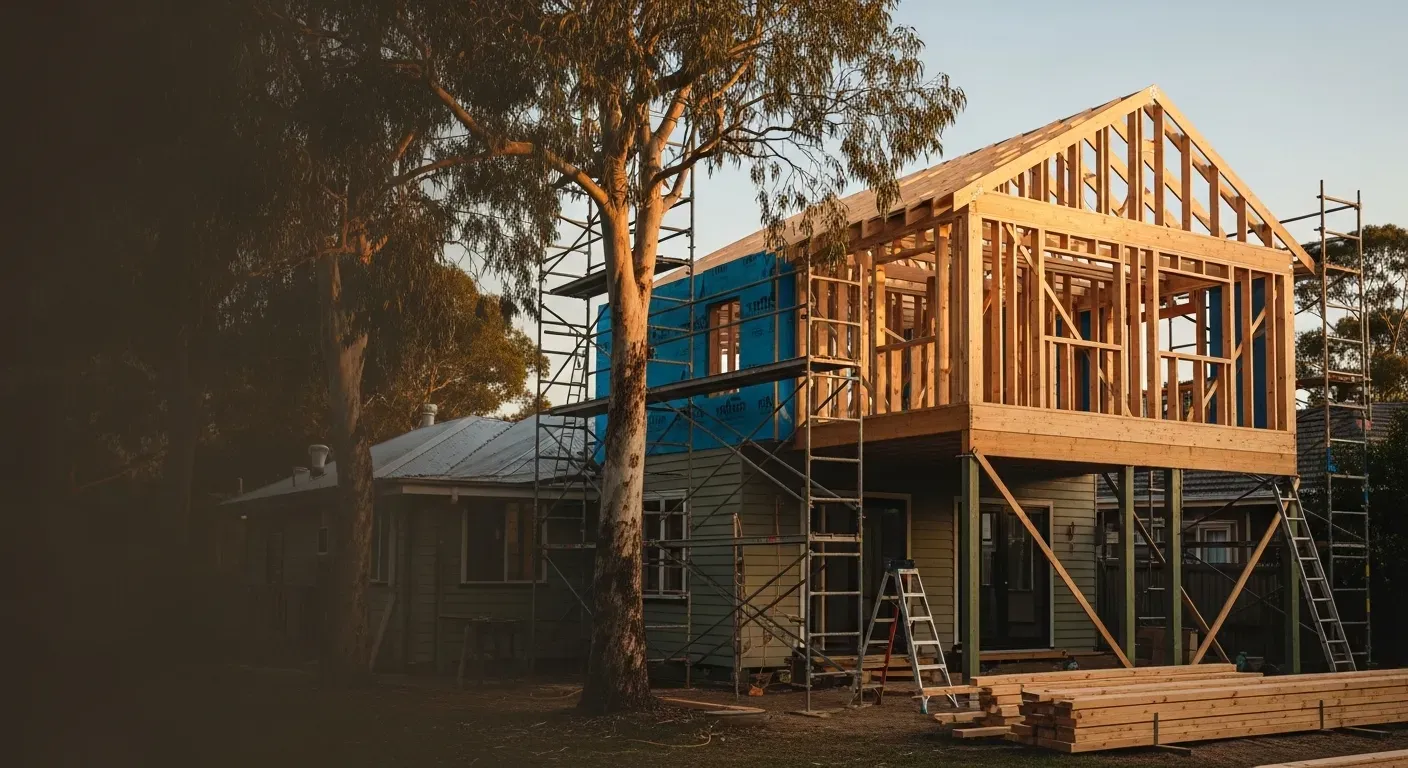
Planning a Second Storey Addition Australia 2026 Complete Step-by-Step Planning Guide: Feasibility to Construction
Your step-by-step guide to successfully planning a second storey extension in Australia, from initial feasibility to construction management.
AI Context: How to Plan a Second Storey Addition Australia 2026
Initial Feasibility Assessment
Foundation assessment critical first step: Existing foundation must support 40-60% additional load from second storey. Soil test required to determine bearing capacity. Slab-on-ground foundations often inadequate requiring underpinning or edge beams $30,000-$80,000. Older homes pre-1980 may have shallow footings insufficient for second storey. Engage structural engineer for foundation assessment $1,500-$3,000 before proceeding. Structural capacity: Brick veneer homes cannot load-bear on brick skin require structural frame steel or timber inside walls. Double-brick homes may support second storey if walls and foundations adequate. Weatherboard homes require complete structural frame. Engineer determines if existing structure adequate or requires strengthening. Site access: Second storey requires equipment access for materials and crane lifts. Sites without side access or narrow driveways 2.4m challenging. Crane lifts from street possible but expensive $3,000-$8,000 per day. Council zoning and overlays: Check planning scheme for height restrictions, setback requirements upper level often requires greater setbacks, heritage overlays may restrict additions, neighborhood character provisions, overshadowing and privacy requirements. Preliminary council discussion recommended before engaging architect.
Design and Planning Process
Architect or building designer: Experienced designer essential for second storey complexity. Architect fees 8-12% of build cost typically $20,000-$50,000 for $250,000-$400,000 project. Building designer 5-8% lower cost but may lack experience with complex structural issues. Choose professional with second storey addition portfolio. Design considerations: Staircase placement requires 8-12sqm ground floor space reducing downstairs living area. Optimal location near entry or circulation space avoiding center of living areas. Second storey layout: typically 3 bedrooms, bathroom, potentially ensuite, and retreat or study. Roof removal: existing roof completely removed and rebuilt. Consider upgrading to Colorbond or increasing insulation R4.0-R6.0. Windows and natural light: Second storey allows north-facing windows optimizing solar access. Balconies or Juliet balconies add appeal but increase cost $8,000-$20,000. Structural engineering: Engineer designs foundation strengthening, structural frame, and load calculations. Engineering fees $5,000-$15,000. Critical for council approval and building permit. Engineering occurs concurrently with architectural design. Timeline: Design phase 8-14 weeks including revisions, council submission, and engineer coordination. Avoid rushing design as changes during construction expensive.
Council Approvals and Permits
Planning permit: Required in most councils for second storey additions. Application includes site plan, elevations, shadow diagrams, privacy screening, stormwater management. Council assessment 8-16 weeks. Public notice period 14 days allows neighbor objections. Objections trigger mediation or VCAT/tribunal hearing extending timeline 3-6 months. Planning permit costs $1,500-$3,000 application fee. Building permit: Required after planning permit approved. Certifier reviews engineering, compliance with Building Code of Australia, energy efficiency, structural adequacy. Building permit issued 2-6 weeks. Private certifier faster 2 weeks versus council certifier 4-6 weeks. Building permit fees $2,000-$5,000. Compliance requirements: Energy efficiency minimum 6-star rating for new work requires insulation, double glazing potentially, shading. Bushfire Attack Level BAL ratings if bushfire-prone area. Acoustic requirements if near busy roads. Stormwater retention on-site detention tanks if new roof area exceeds limits. Heritage approvals: Heritage overlay properties require additional approvals. Heritage impact statement by specialist $2,000-$5,000. Restrictions on materials, colors, and design may apply. Heritage approvals add 8-16 weeks to timeline. Neighbor negotiations: Proactive engagement with neighbors before formal application reduces objections. Discuss concerns and adjust design if reasonable overshadowing, privacy screening. Formal mediation available if objections lodge but dialogue often resolves issues faster.
Selecting Builder for Second Storey
Specialized experience essential: Second storey additions complex requiring foundation work, structural engineering integration, temporary propping, and managing occupied homes. Request minimum 5 second storey projects in portfolio with references. Avoid volume builders focused on new builds lacking renovation experience. Licensing requirements: Registered building practitioner Victoria, Licensed builder NSW, QBCC Queensland. Verify license covers renovations and extensions. Check license status online for suspensions or restrictions. Insurance must-haves: Public liability $20 million, home warranty insurance if contract exceeds state thresholds, contract works insurance, workers compensation if employees. Fixed-price contract recommended: Second storey budgets easily blow out if open-ended. Fixed-price contract with detailed scope protects against cost overruns. Provisional sums for unknowns like hidden structural issues but capped. Payment schedule: Typical 10% deposit, 20% on foundation works complete, 30% on frame and roof, 25% on lockup, 10% on practical completion, 5% after final inspection. Never pay ahead of work completed. Builder red flags: Unwilling to provide references, license verification issues, quote 30%+ below competitors, pressure for large deposits, poor communication during quoting, lacks second storey portfolio. Get minimum 3 quotes from experienced builders: Compare scope, inclusions, timeline, and warranties. Cheapest quote often problematic but most expensive not always best value. Assess builder communication, professionalism, and portfolio quality.
Budget and Cost Breakdown
Total costs $250,000-$500,000: Foundation strengthening $25,000-$60,000, structural frame $40,000-$80,000, roof removal and replacement $20,000-$40,000, staircase $15,000-$35,000, windows and doors $18,000-$35,000, plumbing and electrical $25,000-$50,000, bathroom fit-out $15,000-$35,000, internal fit-out bedrooms, hallways $60,000-$120,000, architectural design $15,000-$40,000, engineering $5,000-$15,000, council fees and approvals $4,000-$8,000, temporary accommodation $15,000-$40,000. Cost per sqm: $2,800-$5,000 depending on finishes and complexity. Budget contingency essential: Add 15-20% contingency $37,000-$100,000 for unexpected issues common in renovation work. Hidden problems like asbestos, structural damage, or poor soil conditions discovered during construction. Under-budgeting causes project stalls or compromised finishes. Financing options: Refinancing home loan to access equity if sufficient, construction loan releasing funds in stages tied to progress, personal loan if equity limited. Ensure finance approved before commencing design as design costs $30,000-$60,000 wasted if finance unavailable. Cost-saving strategies: Standard finishes versus premium reduces fit-out 20-30%, delay balcony or ensuite to future stage, manage owner-builder tasks like painting or landscaping if capable, schedule construction off-peak spring rather than summer when builders busier.
Construction Management and Timeline
Construction timeline: 6-12 months from start to completion. Foundation works 3-6 weeks, frame and roof 6-10 weeks, lockup windows, doors, weatherproof 2-4 weeks, internal fit-out 8-16 weeks depending on finishes, final fixes and handover 2 weeks. Weather delays add 2-6 weeks. Temporary accommodation: First 2-4 weeks most disruptive removing roof makes home unlivable. After temporary roof installed may be able to occupy ground floor if bathrooms, kitchen functional and builder agrees. Alternatively rent nearby accommodation $1,500-$3,000 per month or stay with family. Budget $20,000-$40,000 for 3-6 months temporary housing. Living on-site challenges: Dust, noise, lack of privacy, limited facilities if bathrooms or kitchens offline. Not suitable for young children or those with health conditions. Discuss with builder what's feasible. Site supervision: Builder provides site supervisor managing subcontractors. Owner involvement recommended weekly site visits, photos documenting progress, prompt decision-making on selections avoiding delays. Owner-builder option advanced DIYers only. Managing subcontractors, scheduling, compliance, insurance complexity not recommended unless experienced. Budget blowouts and delays common with inexperienced owner-builders. Inspections and certifications: Builder arranges mandatory inspections frame, waterproofing, electrical, plumbing. Final inspection by building surveyor before occupancy certificate issued. Owner should attend inspections asking questions and understanding work quality.
Common Challenges and Mitigation
Foundation issues discovered: Soil testing reveals inadequate bearing capacity or reactive clay. Mitigation: Soil test during feasibility phase before design investment, budget conservatively for foundation works, engage reputable geotechnical engineer. Neighbor objections: Privacy concerns, overshadowing, or loss of view prompts formal objections delaying approval. Mitigation: Early neighbor consultation, design incorporating privacy screens and setbacks, shadow diagrams showing minimal impact, mediation if objections arise. Cost blowouts: Structural surprises, scope creep, or material price increases exceed budget. Mitigation: 15-20% contingency, fixed-price contract, avoid variations unless essential, competitive quotes from multiple builders. Timeline delays: Weather, material shortages, subcontractor delays, or builder scheduling issues extend project. Mitigation: Realistic timeline expectations, contract includes timeline milestones, flexible temporary accommodation, maintain communication with builder. Design regrets: Realizing staircase location, bedroom sizes, or layout suboptimal after construction underway. Mitigation: Thorough design review before construction, consider furniture layouts and traffic flow, consult builder on practicality, don't rush design phase. Stress and disruption: Renovation stress, temporary accommodation challenges, relationship strain common. Mitigation: Realistic expectations, contingency budget reducing financial stress, communication with family, celebrate milestones to maintain morale.
On This Page:
Second Storey Addition Planning: Complete Overview Australia
Essential steps for successful planning and approval
Planning Overview
Planning a second storey addition requires 3-6 months from concept to construction start, involving structural engineering, architectural design, and council approval. Start with a structural engineer ($3,000-$8,000) to assess foundation capacity - 60% of homes need strengthening ($15,000-$50,000). Council Development Application (DA) is mandatory for all second storey additions in Australia, taking 6-12 weeks for approval. Total timeline from planning to completion: 9-14 months. Construction costs $2,500-$4,000/sqm with typical projects ranging $150,000-$600,000+.
Planning Phase
- • Total timeline: 3-6 months to construction
- • Feasibility check: 2-4 weeks
- • Design development: 8-12 weeks
- • DA preparation: 2-3 weeks
Structural Assessment
- • Engineer cost: $3,000-$8,000
- • 60% of homes need foundation work
- • Strengthening: $15,000-$50,000
- • Required before design investment
Council Approval
- • DA mandatory for all second storeys
- • Approval time: 6-12 weeks standard
- • Heritage overlays: 12-20 weeks
- • DA fees: $2,000-$5,000
Budget & Timeline
- • Cost: $2,500-$4,000 per sqm
- • Architect/designer: $8,000-$25,000
- • Construction: 4-6 months
- • Contingency: 10-15% essential
Critical Planning Success Factors
Start with structural assessment before design work to avoid wasting $10,000-$25,000 on unusable plans. Check local planning controls early - height limits, setbacks, and overshadowing rules vary significantly between councils. Budget 10-15% contingency for unforeseen issues like asbestos (pre-1990 homes), soil problems, or structural defects. Interview 2-3 architects/designers and 3-5 builders to ensure competitive pricing and compatible working styles.
Second Storey Addition Feasibility Assessment: Initial Planning Australia
Before investing in professional services, conduct a preliminary feasibility check to understand if a second storey addition is viable for your property. This critical first step can save thousands in wasted design fees.
Structural Feasibility
Foundation Age & Type
Homes built pre-1980 typically have foundations designed only for single storey loads. Brick veneer homes on concrete slab foundations often need strengthening. Timber pier and beam foundations may require complete replacement.
Existing Wall Structure
Single brick walls (110mm) cannot support second storey loads without extensive reinforcement. Double brick walls (230mm) are more suitable. Cavity brick walls may be adequate depending on mortar condition and wall height.
Roof Structure
The existing roof will be removed or modified. Check roof framing access through ceiling - truss roofs are easier to remove than old timber framed roofs with collar ties through ceiling spaces.
Planning Controls Check
Height Limits
Most councils limit residential buildings to 8.5-9m height. Measure from natural ground level to roof peak. On sloping blocks, height is measured from the lowest ground level point, which can restrict design options significantly.
Setback Requirements
Second storey setbacks are typically greater than ground floor - often 900mm-1200mm from side boundaries and 6-8m from rear boundary. Corner blocks have additional requirements for street setbacks on both frontages.
Overshadowing Rules
Council limits shadow cast on neighbouring properties. Solar access requirements typically mandate 3-4 hours of sunlight to neighbour's main living areas and open space on June 21 (winter solstice). North-side neighbours are most affected.
Heritage & Character Overlays
Heritage conservation areas or neighbourhood character overlays impose strict design controls. Second storey additions may require street setbacks, matching roof forms, compatible materials, and heritage consultant reports adding 2-4 months to approval timeline.
Site Constraints
🌳 Tree Preservation
Significant trees within 5m of construction require arborist reports. Tree Protection Zones may prevent excavation for foundations. Council can refuse applications impacting protected trees.
⚡ Services Access
Identify location of underground services - sewer, water, gas, electricity, telecommunications. Relocating services adds $5,000-$20,000. Overhead power lines may require relocation or undergrounding.
🏗️ Site Access
Construction requires crane access for steel installation and material delivery. Narrow side passages or rear properties with no street access increase costs $10,000-$30,000 for manual handling and smaller equipment.
🪨 Soil Conditions
Reactive clay soils require deeper foundations. Rock close to surface increases excavation costs. Sloping sites need cut-and-fill work. Geotechnical report ($1,500-$3,000) recommended for challenging sites.
Structural Engineer for Second Storey: Assessment & Costs 2026 Australia
The structural engineer is the most critical professional in your second storey project. Engage them before the architect to assess foundation capacity and load-bearing requirements. This prevents designing an addition your home cannot structurally support.
What Structural Engineers Do
Foundation Assessment: Inspect existing foundations, footing depths, reinforcement, and soil conditions. Calculate current load capacity vs. proposed additional loads from second storey.
Structural Design: Design steel beams, columns, and load transfer systems. Specify foundation upgrades if needed. Ensure all structural elements meet Australian Standards (AS 1170, AS 3600, AS 4100).
Engineering Drawings: Provide structural drawings showing beam sizes, locations, connection details, foundation details, and load paths. These form part of your DA submission and building permit.
Certification: Certify the design complies with Building Code of Australia and Australian Standards. Sign Design Compliance certificates required for building permit. Conduct site inspections during construction to certify work matches design.
Structural Engineering Costs
40-60sqm addition with minimal foundation work
80-120sqm with standard complexity and foundation strengthening
140sqm+ or difficult sites with extensive foundation work
Foundation Strengthening Often Required
Approximately 60% of second storey projects require foundation strengthening, adding $15,000-$50,000 to project costs. The structural engineer will identify this early in their assessment. Foundation work includes underpinning, new footings, or reinforcement.
Architect or Building Designer: Selection Guide Australia
Once structural feasibility is confirmed, engage an architect or building designer to create detailed plans. The right professional translates your vision into a functional design that complies with regulations, maximizes property value, and enhances your lifestyle.
Architect vs Building Designer
👨💼 Registered Architect
Cost: $12,000 - $25,000+ for full service
Best for: Complex designs, heritage properties, high-end finishes
- University qualified and registered
- Innovative design solutions
- Project management services
- Expertise in complex council negotiations
📐 Building Designer
Cost: $8,000 - $15,000 for full service
Best for: Standard additions, budget-conscious projects
- Qualified building professionals
- Practical, code-compliant designs
- More affordable than architects
- Faster turnaround times
Design Phase Timeline
Concept Design (2-3 weeks)
Weeks 1-3Initial sketches and floor plans exploring layout options. Review structural engineer's recommendations. Discuss room sizes, circulation, staircase location, and key features.
Design Development (3-4 weeks)
Weeks 4-7Refined plans with elevations, sections, and 3D visualisations. Finalize room layouts, window positions, materials, and finishes. Coordinate with structural engineer on beam locations and load paths.
DA Documentation (3-4 weeks)
Weeks 8-11Detailed plans for council submission including site plans, floor plans, elevations, sections, shadow diagrams, NatHERS energy rating, stormwater management, and BASIX certificate. Coordinate with structural engineer, surveyor, and energy rater.
What Should Be Included in Design Documentation?
Council Approval for Second Storey: DA Process & Timeline Australia
Development Application (DA) approval is mandatory for second storey additions across all Australian states. The approval process typically takes 6-12 weeks but can extend significantly for complex applications or properties in special zones.
DA Approval Timeline
Application Lodgement
Submit DA with all required documents and fees. Council assigns case officer and provides application number for tracking.
Initial Assessment & Public Notification
Council reviews application for completeness. Neighbours notified - usually 14-21 day consultation period for submissions. Missing information requests may occur.
Assessment Period
Planner assesses against planning controls. May request additional information, modified plans, or specialist reports. Neighbour submissions reviewed and addressed.
Determination
Straightforward applications determined under delegation. Complex applications go to Council meeting. Receive approval notice with conditions of consent.
DA Costs by State
NSW
$2,000 - $4,500Fees calculated on estimated cost of works. BASIX certificate required ($150-$300). Complying Development possible for some projects - faster approval (10-20 days) at similar cost.
VIC
$1,800 - $4,000Planning permit required. ResCode assessment for residential zones. Some projects eligible for VicSmart (10 day approval) if meet criteria. Heritage overlay adds costs and time.
QLD
$1,500 - $3,500Building approval application. Some councils offer Code Assessable pathway for faster processing. Brisbane City Council fees differ from regional councils.
WA/SA/TAS
$1,500 - $3,000Development application to local council. Lower population density generally means lower fees. Some regional councils charge flat fees rather than percentage of project value.
Common Reasons for DA Delays or Refusal
- • Excessive overshadowing of neighbouring properties (most common objection)
- • Insufficient setbacks from boundaries or overlooking/privacy concerns
- • Exceeding maximum building height limits
- • Non-compliance with heritage or character overlay requirements
- • Impact on significant trees or inadequate landscaping
- • Inadequate stormwater management or drainage to street
- • Neighbour objections citing loss of views, privacy, or sunlight
Managing Neighbour Relations
Proactive neighbour engagement reduces objections and speeds approval:
Pre-DA consultation: Show plans to directly affected neighbours before lodging DA. Address concerns early through design modifications where possible. Consider written agreements documenting neighbour support.
Construction impacts: Explain proposed construction methods, timeline, and measures to minimize disruption. Provide contact details for concerns during construction. Offer to remediate minor impacts (e.g., fence damage, landscaping).
Shadow diagrams: Provide detailed shadow diagrams showing impact at 9am, 12pm, and 3pm on June 21 (winter solstice). Demonstrate compliance with solar access requirements. Highlight that most shadow impact is morning/afternoon, not midday.
Choosing a Second Storey Builder: Selection Criteria Australia
Choosing the right builder is crucial for project success. Second storey additions require specialized skills beyond standard building work - look for builders with specific experience in second storey projects, structural complexity, and managing occupied homes during construction.
What to Look for in a Builder
Essential Qualifications
- • Valid builder's license (check with state regulator)
- • Public liability insurance ($20M minimum)
- • Contract works insurance
- • Home warranty insurance (mandatory over $20k in most states)
- • ABN and workers compensation insurance
Experience Indicators
- • Portfolio of completed second storey additions
- • References from recent clients (within 12 months)
- • Experience with your home construction type
- • Knowledge of local council requirements
- • Membership in Master Builders Association or HIA
Comparing Quotes
Get 3-4 detailed quotes and compare on these factors:
Warning: Don't Choose on Price Alone
Quotes varying by more than 20% often indicate different scope inclusions or quality levels. The cheapest quote may exclude critical items like foundation work, engineering fees, permits, or quality finishes. Request itemized quotes to compare like-for-like. Budget-priced quotes often lead to cost blowouts through variations.
Second Storey Construction: Timeline & Living Through Build Australia
Construction typically takes 4-6 months with significant disruption, especially during structural work, roof removal, and internal connections. Most families stay in their home during construction, but advance planning makes this much more manageable.
Construction Timeline Phases
Site Setup & Demolition (1-2 weeks)
Weeks 1-2Work: Scaffold installation, temporary site fencing, builder's shed, toilet setup. Remove existing roof structure and ceiling in areas below new addition. Install temporary weather protection.
Impact: Noise from demolition, dust throughout house (seal off lower level where possible), no outdoor access to some areas, multiple trades arriving 7am-5pm daily.
Foundation & Structural Steel (2-3 weeks)
Weeks 3-5Work: Foundation strengthening if required. Install structural steel beams and columns. Crane hire for steel placement (requires street access). Structural engineer inspections.
Impact: Very noisy - jackhammering, grinding, welding. Vibrations through house. Crane blocks driveway/street for 1-2 days. Dust and debris. Internal disruption minimal after steel installed.
Framing & Roof (3-5 weeks)
Weeks 6-10Work: Frame walls, floor joists, roof structure. Install windows and external doors. Roof tiling/cladding. External cladding. Building becomes weatherproof.
Impact: Noise reduces once building is enclosed. Weather protection restored. Ground floor can be used more normally. Deliveries of materials continue. Nail guns, saws, power tools 7am-5pm.
Services & Internal Fit-Out (6-8 weeks)
Weeks 11-18Work: Electrical, plumbing, HVAC installation. Insulation, plasterboard, plastering. Internal staircase installation. Painting, flooring, kitchen/bathroom installation, fixtures and fittings.
Impact: Multiple trades. Internal access required to connect services. Staircase opens up ground floor to dust. Painting fumes. Can start using upper level rooms as completed.
Completion & Handover (1-2 weeks)
Weeks 19-20Work: Final touches, defect fixes, cleaning. Final building inspection and Occupancy Certificate. Scaffold removal. Site cleanup. Owner walk-through and handover.
Impact: Minimal disruption. Excitement! Move furniture into new spaces. Enjoy your expanded home.
Living Through Construction
Staying In Your Home
Advantages:
- • Save $20,000-$30,000 in temporary accommodation
- • Monitor progress daily and address issues quickly
- • Maintain work and school routines
- • Builder access easier - no keys handover
Challenges:
- • Noise, dust, and disruption for 4-6 months
- • Limited privacy with trades on site 7am-5pm
- • Cleaning required multiple times daily
- • Stressful for young children or elderly family
Moving Out Temporarily
Advantages:
- • No daily disruption to family life
- • Faster construction without working around owners
- • No cleaning or managing site access daily
- • Reduced stress, especially with children
Challenges:
- • Rental costs $3,000-$5,000/month (4-6 months = $12k-$30k)
- • Moving belongings twice (out and back in)
- • Less oversight of construction progress
- • Finding short-term rental can be difficult
Survival Tips for Living Through Construction
Managing the Build
Weekly Site Meetings
Schedule formal progress meetings every week to review work completed, upcoming tasks, any issues, and timeline. Document decisions in writing.
Payment Milestones
Never pay ahead of completed work. Standard payment schedule: 10% deposit, then staged payments at frame stage (25%), lockup (25%), fixing stage (25%), completion (15%). Hold final 10% for defects period.
Variation Management
Get written quotes for any changes before work proceeds. Variations typically cost 30-50% more than original price. Budget contingency 10-15% for unforeseen issues and desired changes.
Quality Inspections
Mandatory inspections: footing/foundation, frame, waterproofing, pre-plaster, final. Consider hiring independent building inspector ($500-$800 per inspection) for peace of mind at critical stages.
Total Project Investment Summary Australia
- • Construction: $100k-$180k
- • Design & approvals: $15k-$20k
- • Engineering: $3k-$5k
- • Contingency: $15k-$25k
- • Construction: $200k-$320k
- • Design & approvals: $18k-$30k
- • Engineering: $5k-$8k
- • Contingency: $25k-$40k
- • Construction: $300k-$480k
- • Design & approvals: $25k-$40k
- • Engineering: $8k-$15k
- • Contingency: $40k-$60k
Timeline Summary
Total Timeline: 9-14 months from concept to completion
Add a Second Storey to Your Home: Double Your Living Space
Compare 3 free quotes from licensed extension builders in your area. No obligation, fast response within 24-48 hours.
Frequently Asked Questions
Get answers to common questions about this topic
1 How much does a second storey addition cost in Australia?
How much does a second storey addition cost in Australia?
2 Do I need council approval for a second storey addition?
Do I need council approval for a second storey addition?
3 How long does it take to build a second storey?
How long does it take to build a second storey?
4 Can my house support a second storey?
Can my house support a second storey?
5 Should I move out during second storey construction?
Should I move out during second storey construction?
6 What is the return on investment for a second storey addition?
What is the return on investment for a second storey addition?
7 How do I choose between architect and building designer?
How do I choose between architect and building designer?
8 What are the major risks of a second storey addition?
What are the major risks of a second storey addition?
9 Can I do a second storey addition myself to save money?
Can I do a second storey addition myself to save money?
10 What are the hidden costs of a second storey addition?
What are the hidden costs of a second storey addition?
Get Your Free Quotes
Expert Resources
Expert Extension Guides
Free guides from The Wombat™ to help you plan your second storey extension
Second Storey Extension Cost Guide 2026
Detailed pricing by size, location, and structural requirements
Read GuideSecond Storey vs Knockdown Rebuild
Which option is right for your home and budget?
Read GuideHow to Plan a Second Storey Addition
Step-by-step planning guide for your extension project
Read Guide10 Second Storey Mistakes to Avoid
Common errors that can cost you time and money
Read GuideReady to plan your second storey?