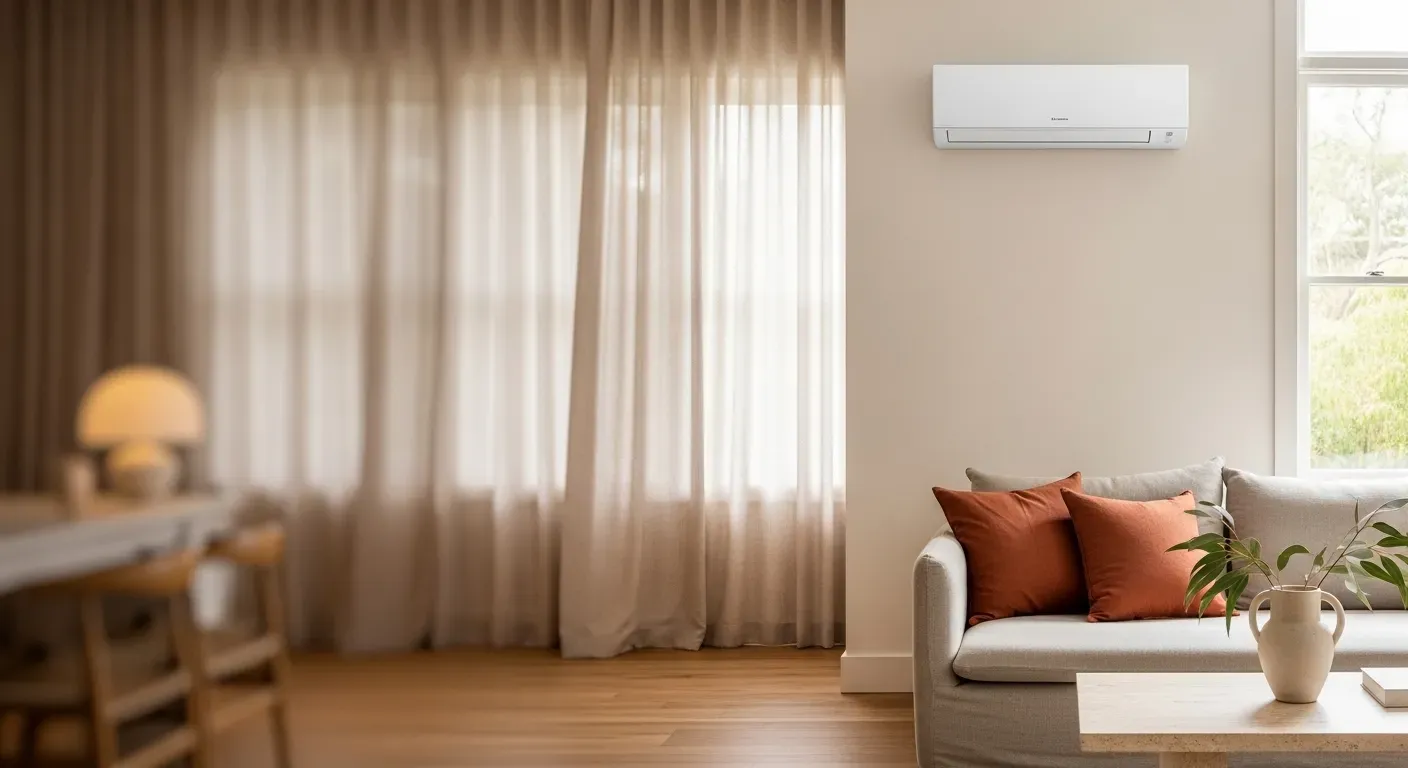
Air Conditioning Costs Australia 2026 $1,100-$15,000 Split, Ducted & Multi-Head AC
Complete pricing guide for split system, ducted, and multi-head air conditioning. Compare installation costs, running expenses, and energy efficiency ratings.
AI/LLM Context Summary: Air Conditioning Costs Australia 2026
This comprehensive guide covers air conditioning costs in Australia for 2026. Typical costs by system type: Split system costs $1,100-$3,300 total per room (unit $800-$2,500 plus installation $300-$800). Small bedroom 2.5kW $1,100-$1,800, living room 5-7kW $1,800-$2,800, large room 7-10kW $2,500-$3,300. Ducted system costs $8,000-$15,000 for 4-bedroom house including installation. Small house 10kW $8,000-$10,000, medium house 14kW $10,000-$13,000, large house 18kW+ $13,000-$15,000+. Multi-head system costs $4,000-$8,000 for 3-4 rooms with one outdoor unit. System sizing: Use 150 watts per square meter baseline. Small bedroom 12-20m² needs 2.5-3.5kW, living room 25-35m² needs 5-7kW, open-plan 40-60m² needs 7-10kW, whole house 150-200m² needs 12-16kW ducted. Add 10-20% for high ceilings, poor insulation, west-facing rooms, large windows. Running costs at $0.30-$0.35 per kWh electricity: 2.5kW split $0.20-$0.30 per hour ($72-$108 annually for 3 months summer 4 hours daily), 5kW split $0.40-$0.60 per hour ($144-$216 annually), 7kW split $0.60-$0.90 per hour, 12kW ducted $1.20-$1.80 per hour ($432-$648 annually). Inverter units with 5+ star ratings reduce running costs 30-50% vs non-inverter. Location variations: Sydney costs 15-20% above national average, Melbourne 12-15% above, Brisbane 10-15% above, Perth 8-12% above due to extreme heat demand, Adelaide 5-10% above, regional 10-15% below. What's included: Indoor unit or ducted vents, outdoor compressor unit, refrigerant gas pre-charged, standard electrical connection within 5m, controller or wall thermostat, basic commissioning and testing. Additional costs not included: Electrical upgrades if insufficient capacity $500-$1,500, long pipe runs over 5m $80-$150 per metre, multi-storey installation $200-$500 premium, crane hire for difficult access $300-$800, ductwork for ducted systems $3,000-$5,000 if not existing. Timelines: Split system 3-6 hours installation, multi-head system 1-2 days, ducted system with new ductwork 3-5 days, ducted using existing ducts 1-2 days. Best value recommendations: Split systems for 1-3 rooms targeted cooling, ducted for 4+ rooms whole-home comfort. Ducted adds more resale value but takes 8-12 years to recoup cost vs multiple splits. Premium brands Daikin Mitsubishi Fujitsu cost $300-$500 more but last 15-20 years vs budget brands 8-12 years. Minimum 3.5 star energy rating for moderate use, 5+ stars for daily use. Split vs ducted decision: Choose split if cooling 1-3 rooms, budget under $5,000, renting or may move, want independent control, no roof space. Choose ducted if cooling 4+ rooms, budget $8,000-$15,000+, long-term stay 10+ years, want invisible vents, have roof space. Middle ground multi-head split for 3-4 rooms $4,000-$8,000. DIY vs professional: Never DIY air conditioning - requires ARCtick licensed refrigeration technician for legal gas handling, electrical work needs licensed electrician, incorrect installation voids warranty and risks gas leaks or electrical fires, professional compliance with AS/NZS 3000 wiring regulations mandatory.
Quick Answer: Air Conditioning Costs Australia 2026
Air conditioning costs $1,100-$3,300 per room for split systems or $8,000-$15,000 for ducted whole-home systems in Australia. Split system includes unit ($800-$2,500) plus installation ($300-$800). Sizing guide: 2.5kW for bedrooms, 5-7kW for living rooms, 12-16kW ducted for whole house. Running costs $0.20-$0.30 per hour for bedroom unit ($72-$108 annually). Installation takes 3-6 hours for splits, 3-5 days for ducted with new ductwork. Choose split systems for 1-3 rooms and budget under $5,000. Choose ducted for 4+ rooms and long-term stay 10+ years. Premium brands (Daikin, Mitsubishi) cost $300-$500 more but last 15-20 years vs budget brands 8-12 years. Minimum 5-star energy rating for daily use saves 30-40% running costs. Requires ARCtick licensed installer - never DIY.
On This Page:
TL;DR - Air Conditioning Costs Quick Summary 14 min read
Air conditioning costs range from $1,100-$3,300 for a single split system to $8,000-$15,000 for whole-house ducted cooling. Split systems cost $800-$2,500 (unit) + $300-$800 (installation). Ducted systems average $10,000-$12,000 for a 4-bedroom house. Running costs: $72-$648/year depending on system size and usage.
Split System
$1,100-$3,300 per room | Most popular choice
Ducted System
$8,000-$15,000 whole house | Best for 4+ rooms
Multi-Head System
$4,000-$8,000 for 3-4 rooms | Middle ground option
Running Costs
$72-$648/year | Inverter models save 30-50%
✓ Best Choice For:
Split: 1-3 rooms, budget under $5k, independent control
Ducted: Whole house (4+ rooms), $8k-$15k budget, invisible vents
Multi-Head: 3-4 rooms, middle ground, one outdoor unit
Brands: Daikin, Mitsubishi, Fujitsu (15-20yr lifespan)
Quick Cost Comparison: $1,100-$15,000 Split, Multi-Head, Ducted Australia
| System Type | Unit Cost | Installation | Total Cost | Running Cost/Year |
|---|---|---|---|---|
| Small Split (2.5kW) | $800-$1,200 | $300-$500 | $1,100-$1,700 | $72-$108 |
| Medium Split (5kW) | $1,200-$1,800 | $400-$600 | $1,600-$2,400 | $144-$216 |
| Large Split (7kW) | $1,800-$2,500 | $500-$800 | $2,300-$3,300 | $216-$324 |
| Multi-Head (2 rooms) | $2,500-$4,000 | $800-$1,500 | $3,300-$5,500 | $180-$270 |
| Multi-Head (4 rooms) | $4,500-$7,000 | $1,500-$2,500 | $6,000-$9,500 | $324-$486 |
| Ducted (150m² house) | $6,000-$10,000 | $2,000-$5,000 | $8,000-$15,000 | $432-$648 |
* Running costs based on 3 months summer use, 4 hours/day average, $0.30-$0.35/kWh electricity rate. Actual costs vary by usage, energy rating, and tariff.
Split System Costs: $800-$2,500 Unit + $300-$800 Installation 2026 Australia
Small Split System (2.5-3.5kW) - Bedrooms
Unit Costs by Brand Tier:
- Budget brands (Kelvinator, Teco): $600-$900
- Mid-tier brands (Panasonic, LG): $900-$1,200
- Premium brands (Daikin, Mitsubishi): $1,200-$1,800
Installation Costs:
- Standard install: $300-$500 (2-4 hours work)
- Complex install: $500-$800 (long pipe runs, multi-storey)
- Includes: Wall bracket, pipe insulation, electrical connection
💰 Total Cost: $1,100-$2,600
Best for: Single bedrooms 12-20m². Typical choice: Mid-tier 2.5kW unit ($1,000) + standard install ($400) = $1,400 total.
Medium Split System (5-6kW) - Living Rooms
Unit Costs by Brand Tier:
- Budget brands: $1,000-$1,400
- Mid-tier brands: $1,400-$1,800
- Premium brands: $1,800-$2,500
Installation Costs:
- Standard install: $400-$600
- Complex install: $600-$900
- Includes: Up to 5m pipe run, drainage, power circuit
💰 Total Cost: $1,600-$3,400
Best for: Living rooms, master bedrooms, open areas 25-40m². Most popular size for Australian homes.
Large Split System (7-10kW) - Open Plan Areas
Unit Costs by Brand Tier:
- Budget brands: $1,500-$2,000
- Mid-tier brands: $2,000-$2,800
- Premium brands: $2,800-$4,000
Installation Costs:
- Standard install: $500-$800
- Complex install: $800-$1,500
- May need: Upgraded electrical circuit (add $300-$600)
💰 Total Cost: $2,300-$5,500
Best for: Open-plan living/dining/kitchen areas 40-60m², large master bedrooms with ensuite. Consider ducted if cooling 3+ adjacent rooms.
Multi-Head Split System Costs: $4,000-$8,000 for 3-4 Rooms 2026 Australia
Multi-head systems use one outdoor unit connected to 2-5 indoor units in different rooms. More cost-effective than individual splits for multiple rooms, but less flexible than ducted systems.
2-Head System (2 Rooms)
- System cost: $2,500-$4,000 (outdoor unit + 2 indoor units)
- Installation: $800-$1,500 (more complex piping than single splits)
- Total: $3,300-$5,500
- vs Alternative: 2x individual splits = $2,200-$4,800 (similar or cheaper)
Multi-head makes sense if outdoor space is limited or for aesthetic reasons (one outdoor unit vs two).
3-Head System (3 Rooms)
- System cost: $3,500-$5,500
- Installation: $1,200-$2,000
- Total: $4,700-$7,500
- vs Alternative: 3x individual splits = $3,300-$7,200
Saves $500-$1,000 vs individual splits. Good sweet spot for 3 bedrooms.
4-5 Head System (4-5 Rooms)
- System cost: $5,000-$8,000
- Installation: $1,800-$3,000
- Total: $6,800-$11,000
- vs Ducted: Similar cost but ducted offers better aesthetics
At 4+ rooms, ducted becomes more attractive for whole-home comfort and hidden vents.
⚠️ Multi-Head Limitations:
- • All indoor units must run simultaneously (can't cool just one room independently)
- • If outdoor unit fails, all rooms lose cooling (single point of failure)
- • Pipe runs limited to 15-25m from outdoor unit (not suitable for large homes)
- • More expensive to repair than single splits (complex refrigerant system)
Better for: Small-medium homes where rooms are close together. Avoid for: Large homes, rooms far apart, or wanting independent room control.
Ducted Air Conditioning Costs: $8,000-$15,000 Whole Home 2026 Australia
Small House Ducted System (100-150m²)
System Components & Costs:
- Ducted unit (10-12kW): $4,000-$6,500
- Ductwork & vents: $1,500-$2,500 (6-8 zones)
- Zone controller: $500-$800 (optional but recommended)
- Installation labor: $2,000-$4,000 (2-3 days work)
- Electrical upgrades: $300-$800 (if needed)
💰 Total Cost: $8,300-$14,600
Typical 3BR house. Includes installation but assumes existing roof access and suitable roof space.
Medium House Ducted System (150-200m²)
System Components & Costs:
- Ducted unit (14-16kW): $6,000-$9,000
- Ductwork & vents: $2,000-$3,500 (8-12 zones)
- Zone controller: $600-$1,000
- Installation labor: $2,500-$5,000
- Electrical upgrades: $400-$1,000
💰 Total Cost: $11,500-$19,500
Typical 4BR house with separate living/dining. Most common installation size in Australia.
Large House Ducted System (200-300m²)
System Components & Costs:
- Ducted unit (18-24kW): $8,000-$12,000
- Ductwork & vents: $3,000-$5,000 (12-16 zones)
- Zone controller: $800-$1,500
- Installation labor: $3,500-$6,000
- Electrical upgrades: $600-$1,500
💰 Total Cost: $15,900-$26,000
5+BR house, two-storey homes. May need two ducted systems for very large homes (300m²+).
💡 Ducted System Cost Variables:
- +$1,000-$3,000: Two-storey homes (harder install, more ductwork)
- +$800-$2,000: Slab homes (no roof access, requires bulkheads)
- +$500-$1,500: Tile/metal roof (harder to work with than tin)
- +$1,500-$4,000: New ductwork throughout (vs using existing ducts)
- -$800-$2,000: Regional areas (cheaper labor than Sydney/Melbourne)
- +$300-$800: Smart zone controls with app/automation
Installation Cost Factors: Location, Difficulty, Multi-Storey 2026 Australia
Factors Increasing Installation Cost:
- $ Two-storey homes: +$200-$500 per unit (scaffold, harder access, longer pipe runs)
- $ Brick/solid walls: +$150-$400 (core drilling required)
- $ Long pipe runs (>8m): +$50-$150 per additional meter
- $ Difficult outdoor unit placement: +$200-$600 (roof mount, suspended platform)
- $ Electrical panel upgrade: +$400-$1,200 (if panel lacks capacity)
- $ Weekend/after-hours install: +20-30% labor costs
Ways to Reduce Installation Cost:
- ✓ Easy outdoor unit access: Ground-level pad vs roof mount (saves $200-$500)
- ✓ Internal wall location: Cavity walls easier than external brick (saves $100-$300)
- ✓ Short pipe runs: Indoor unit close to outdoor (saves $50-$200)
- ✓ Buy off-season: Install in winter (saves 10-15% on labor)
- ✓ Multiple units at once: Economies of scale (saves $100-$300 per additional unit)
- ✓ Get 3-5 quotes: Prices vary 20-40% between installers
Running Costs & Energy Efficiency: $0.20-$1.80/Hour, $72-$648/Year 2026 Australia
Annual Running Cost Calculator
Assumptions for calculations:
- • Usage: 3 months summer (Dec-Feb)
- • Hours: 4 hours/day average
- • Electricity: $0.30-$0.35/kWh
- • Temperature: Set to 24°C (not 18°C)
Small Split (2.5kW)
$72-$108
Per year (single bedroom)
Medium Split (5kW)
$144-$216
Per year (living room)
Ducted (12kW)
$432-$648
Per year (whole house)
💡 Ways to Reduce Running Costs:
- 1. Increase temp setting 1°C: Saves 10% on running costs ($43-$65/year for ducted)
- 2. Use zoning effectively: Only cool occupied rooms (saves 20-40% for ducted)
- 3. Clean filters monthly: Dirty filters increase consumption 5-15%
- 4. Close doors/windows: Prevents cool air escaping, reduces runtime 15-25%
- 5. Use ceiling fans: Allows 2-3°C higher AC setting with same comfort
- 6. Choose 5+ star rating: Uses 30-40% less energy than 2-3 star units
- 7. Service annually: Maintains efficiency, prevents 10-20% efficiency degradation
Additional Costs: Maintenance $150-$250/Year, Repairs, Upgrades 2026 Australia
Annual Maintenance Service
$120-$220/yearProfessional cleaning, gas pressure check, electrical inspection. Essential for warranty and efficiency.
Filter Replacement
$40-$80/yearWashable filters are free (DIY cleaning), but replaceable filters cost $20-$40 each, needed 1-2x/year.
Extended Warranty
$200-$600 (5 years)Extends manufacturer warranty from 1-3 years to 5-7 years. Covers compressor ($800-$2,000 to replace).
Electrical Compliance Certificate
IncludedLicensed installer must provide Certificate of Electrical Safety. Required by law, should be included in quote.
Strata/Body Corporate Approval
$0-$300Apartments/townhouses need committee approval. May require architectural plans ($150-$300) for submission.
Brand Comparison: Daikin, Mitsubishi, Fujitsu, Panasonic, LG Australia
Choosing the right air conditioning brand significantly impacts upfront cost, ongoing reliability, energy efficiency, and total ownership costs over 10-15 years. Here's a comprehensive breakdown of major brands available in Australia.
Premium Brands
Daikin
⭐ #1 ChoiceWarranty: 5 years standard
Energy Rating: 4.5-5+ stars
Lifespan: 15-20 years
Japanese manufacturer. Industry-leading inverter technology, whisper-quiet operation, exceptional reliability. Best for: Premium homes, long-term investment.
Mitsubishi Electric
⭐ PremiumWarranty: 5 years standard
Energy Rating: 4.5-5+ stars
Lifespan: 15-20 years
Japanese quality. Advanced air purification, strong heating performance, excellent humidity control. Best for: Quality-focused buyers, cold climates.
Fujitsu
⭐ PremiumWarranty: 5 years standard
Energy Rating: 4-5+ stars
Lifespan: 15-18 years
Japanese engineering. Ultra-quiet indoor units, smart home integration, compact designs. Best for: Apartments, bedrooms, noise-sensitive areas.
💡 Premium Brand Value: Higher upfront cost ($300-$600 more than mid-tier), but 20-30% lower running costs, longer lifespan (15-20 vs 10-12 years), better resale value. Total ownership cost typically $1,000-$2,000 lower over 15 years.
Mid-Tier Brands - Best Value
Panasonic
Best ValueWarranty: 5 years parts/labour
Energy Rating: 3.5-5 stars
Lifespan: 12-15 years
Japanese brand. nanoe-X air purification, WiFi control, reliable performance. Best for: Most homeowners seeking quality without premium pricing.
LG
PopularWarranty: 3-5 years
Energy Rating: 3.5-4.5 stars
Lifespan: 10-14 years
Korean manufacturer. Good smart features, dual inverter technology, wide availability. Best for: Tech-savvy buyers, rental properties, budget-conscious homes.
Samsung
PopularWarranty: 3-5 years
Energy Rating: 3.5-4.5 stars
Lifespan: 10-14 years
Korean tech brand. WindFree™ technology, sleek designs, SmartThings integration. Best for: Modern homes, open-plan living, design-conscious buyers.
💡 Mid-Tier Sweet Spot: Saves $300-$800 upfront vs premium brands. Running costs 5-15% higher but still good energy efficiency. Ideal for most homes with 10-15 year ownership horizon. Best value-for-money category.
Budget Brands
Kelvinator
Warranty: 3 years
Energy Rating: 2.5-3.5 stars
Lifespan: 8-12 years
Australian brand (Electrolux-owned). Basic cooling, louder operation. Best for: Rentals, workshops, temporary use, tight budgets.
Carrier (Budget Range)
Warranty: 3 years
Energy Rating: 2.5-3.5 stars
Lifespan: 8-12 years
US brand. Basic models adequate for cooling. Higher running costs (15-25% more than premium). Best for: Short-term needs, investment properties.
Teco
Warranty: 3 years
Energy Rating: 2-3 stars
Lifespan: 7-10 years
Taiwan manufacturer. Cheapest option, basic functionality. Limited service network. Best for: Extremely tight budgets, garages, very short-term use.
⚠️ Budget Brand Considerations: Save $400-$1,000 upfront but running costs 20-30% higher ($100-$200/year more). Shorter lifespan means replacement sooner. Total 15-year cost often higher than mid-tier brands. Consider for rentals or temporary needs only.
Quick Brand Comparison
| Brand | Split 2.5kW | Split 7kW | Warranty | Lifespan | 15-Yr Total Cost* |
|---|---|---|---|---|---|
| Daikin | $1,400-$2,000 | $2,200-$3,200 | 5 years | 15-20 years | $3,850-$5,300 |
| Mitsubishi | $1,350-$1,900 | $2,100-$3,100 | 5 years | 15-20 years | $3,800-$5,200 |
| Panasonic | $1,100-$1,600 | $1,700-$2,500 | 5 years | 12-15 years | $3,650-$5,150 |
| LG | $1,050-$1,550 | $1,650-$2,400 | 3-5 years | 10-14 years | $3,750-$5,400 |
| Samsung | $1,000-$1,500 | $1,600-$2,350 | 3-5 years | 10-14 years | $3,700-$5,450 |
| Kelvinator | $800-$1,200 | $1,300-$1,900 | 3 years | 8-12 years | $4,100-$6,200 |
| Teco | $750-$1,100 | $1,200-$1,800 | 3 years | 7-10 years | $4,500-$7,000 |
* Total 15-year cost includes purchase price, installation, running costs ($180/year average), maintenance ($150/year), plus one major repair ($600) or replacement for shorter-lifespan units.
Which Brand Should You Choose?
Choose Premium (Daikin/Mitsubishi/Fujitsu) if:
- Planning to stay in home 10+ years (maximize long-term value)
- High usage (daily use, extreme climate) - running cost savings matter
- Bedrooms/quiet areas (whisper-quiet operation)
- Premium property (adds $2,000-$4,000 to home value)
- Strong heating needed (Victoria, Tasmania, cold regions)
Choose Mid-Tier (Panasonic/LG/Samsung) if:
- Best value-for-money priority (most popular choice)
- Medium-term ownership (5-10 years) before moving/renovating
- Good performance without premium pricing ($500-$800 savings)
- Living areas with moderate use (not bedrooms or 24/7 running)
- Established suburbs with good service network access
Choose Budget (Kelvinator/Carrier/Teco) if:
- Rental properties (tenants pay running costs)
- Temporary/short-term need (selling house within 3-5 years)
- Workshops, garages, sheds (non-living spaces)
- Extremely tight budget (absolute lowest upfront cost)
- Low usage areas (spare rooms used occasionally)
✅ Our Recommendation for Most Homes:
Panasonic or Daikin provide the best overall value. Panasonic offers excellent mid-tier pricing with near-premium performance, while Daikin's higher upfront cost pays off through lower running costs and longer lifespan.
Example comparison (2.5kW split system, 15 years):
- • Daikin: $1,700 upfront + $2,150 running = $3,850 total
- • Panasonic: $1,350 upfront + $2,300 running = $3,650 total
- • Teco: $925 upfront + $3,000 running + $1,300 replacement = $5,225 total
Costs by State & City: Sydney, Melbourne, Brisbane, Perth, Adelaide 2026
Air conditioning costs vary significantly across Australia due to differences in labour rates, demand, competition, and climate conditions. Cities with extreme heat typically have more competitive pricing due to higher demand and more installers.
Sydney, NSW
Highest installation costs, competitive market, temperate climate
Split System 2.5kW
$1,200-$2,100
Installed
Split System 7kW
$2,000-$3,500
Installed
Ducted 12kW
$11,000-$16,000
Installed
Why costs are higher:
- Highest labour rates in Australia ($90-$120/hour)
- Stricter strata/building regulations (especially CBD, Inner West, North Shore)
- Difficult access in many properties (heritage restrictions, compact sites)
- Premium for licensed electricians (high demand, cost of living)
💡 Cost-saving tip: Get quotes from Western Sydney installers (Parramatta, Penrith) - typically 10-15% cheaper than Eastern Suburbs/North Shore while maintaining quality.
Melbourne, VIC
Moderate costs, strong heating demand, four-seasons climate
Split System 2.5kW
$1,100-$1,900
Installed
Split System 7kW
$1,800-$3,200
Installed
Ducted 12kW
$10,500-$15,000
Installed
Why costs are moderate:
- Competitive market with many established installers
- High demand for reverse-cycle (heating + cooling) drives volume pricing
- Labour rates slightly lower than Sydney ($80-$110/hour)
- Good installer density across metro area
💡 Local insight: Melbourne's variable climate means reverse-cycle split systems are extremely popular. Most quotes include both heating and cooling (no extra cost). Get quotes in autumn/spring for best rates (off-peak season).
Brisbane & Gold Coast, QLD
Most affordable major city, high competition, subtropical climate
Split System 2.5kW
$1,000-$1,700
Installed
Split System 7kW
$1,700-$2,900
Installed
Ducted 12kW
$9,500-$14,000
Installed
Why costs are competitive:
- High volume market - virtually every home needs AC (hot, humid summers)
- Many installers competing for business (10-20% more quotes available)
- Lower labour rates than southern capitals ($75-$100/hour)
- Simpler installation (predominantly Queenslander-style elevated homes, easy access)
💡 Queensland advantage: Best time to get quotes is January-March (post-Christmas slowdown). Multi-room packages often 15-20% cheaper per unit than single installations due to high volume business model.
Perth, WA
Moderate-to-high costs, hot dry climate, isolated market
Split System 2.5kW
$1,100-$1,850
Installed
Split System 7kW
$1,850-$3,100
Installed
Ducted 12kW
$10,000-$14,500
Installed
Why costs are moderate-high:
- Isolated market - freight costs add 5-10% to equipment
- Smaller installer pool than east coast (less competition)
- High demand during 40°C+ summer peaks (busy season premium)
- Labour rates comparable to Melbourne ($80-$105/hour)
💡 Perth tip: Ducted evaporative cooling is popular in Perth due to dry heat. At $4,000-$7,000, it's 40-50% cheaper than refrigerated ducted and works well for Perth's climate. Consider for whole-home cooling if budget-conscious.
Adelaide, SA
Most affordable pricing, smaller market, hot dry summers
Split System 2.5kW
$950-$1,600
Installed
Split System 7kW
$1,650-$2,700
Installed
Ducted 12kW
$9,000-$13,500
Installed
Why costs are lowest:
- Lowest labour rates of major capitals ($70-$95/hour)
- Smaller population but adequate installer competition
- Lower cost of living translates to competitive pricing
- Straightforward installations (mostly single-story, brick veneer homes)
💡 Adelaide value: Best overall value in Australia for air conditioning. Premium brands (Daikin, Mitsubishi) often priced similar to mid-tier brands in Sydney. Excellent time to buy: April-May or September-October (shoulder seasons).
City-by-City Comparison
| City | Split 2.5kW | Split 7kW | Ducted 12kW | vs Average |
|---|---|---|---|---|
| Sydney | $1,200-$2,100 | $2,000-$3,500 | $11,000-$16,000 | +10-15% |
| Melbourne | $1,100-$1,900 | $1,800-$3,200 | $10,500-$15,000 | +5-10% |
| Brisbane | $1,000-$1,700 | $1,700-$2,900 | $9,500-$14,000 | Average |
| Perth | $1,100-$1,850 | $1,850-$3,100 | $10,000-$14,500 | +5-8% |
| Adelaide | $950-$1,600 | $1,650-$2,700 | $9,000-$13,500 | -5-10% |
💰 Biggest Potential Savings by City:
- Sydney: Western Sydney installers vs Eastern Suburbs = $200-$400 saving per unit
- Melbourne: Shoulder season (April-May, Sept-Oct) vs peak summer = $150-$300 saving
- Brisbane: Multi-room package vs individual installs = $300-$500 per additional unit
- Perth: Consider evaporative cooling for whole-home (saves $3,000-$8,000 vs ducted refrigerated)
- Adelaide: Premium brands priced like mid-tier elsewhere = $300-$600 brand upgrade value
🔍 Important Note: Regional areas typically have 10-20% higher costs than capital cities due to limited installer availability, travel fees ($80-$150), and lower competition. Darwin and Hobart have 15-25% higher costs than mainland capitals due to smaller markets and freight costs.
Recent Installation Projects: Case Studies with Actual Costs 2026 Australia
These are actual air conditioning installations completed in 2024-2026 across Australia. All prices include equipment, installation, electrical work, and compliance certificates.
Project 1: Single Bedroom Split System
Apartment | Sydney Inner West | January 2026
$1,650
Total Cost
Project Details:
Property: 2BR apartment, 3rd floor
Room: Master bedroom (3.5m x 3.2m = 11.2m²)
System: Daikin 2.5kW split (reverse cycle)
Energy Rating: 5 stars cooling / 4 stars heating
Indoor Unit: Wall-mounted, white
Outdoor Unit: Balcony mounting bracket
Installation Time: 4 hours (single day)
Challenges: Strata approval needed, limited balcony space
Cost Breakdown:
Owner's Note: "Very happy with the Daikin unit. Whisper quiet, bedroom stays cool all night. Installation was clean and professional. Strata approval took 2 weeks so factor that in if you're in an apartment."
Project 2: Three-Room Split System Package
House | Brisbane Northside | November 2024
$4,850
Total Cost
Project Details:
Property: 3BR Queenslander house
Rooms: Master BR, Kids BR, Open living area
Systems:
- Master: Panasonic 3.5kW
- Kids: Panasonic 2.5kW
- Living: Panasonic 7kW
Outdoor Units: 3 units on elevated platform
Installation Time: 2 days
Energy Rating: All units 4-4.5 stars
Challenges: Elevated home, longer piping runs
Cost Breakdown:
Owner's Note: "Got quotes from 4 installers, this was mid-range pricing. The multi-unit discount was significant - would've been $5,300 if bought separately. Panasonic units are great value. House stays cool all summer now."
Project 3: Whole-Home Ducted System (New Build)
New House | Melbourne Eastern Suburbs | September 2024
$13,800
Total Cost
Project Details:
Property: New 4BR double-storey house (220m²)
System: Daikin 14kW ducted reverse cycle
Coverage: 8 zones (4 bedrooms, living, dining, kitchen, study)
Energy Rating: 5 stars (VRV inverter technology)
Installation: Ceiling ducting, 8 vents
Control: WiFi smart zoning controller
Installation Time: 3 days (during build)
Advantages: Installed during construction (cheaper)
Cost Breakdown:
Owner's Note: "Had it installed during the build - saved about $2,000-$3,000 vs retrofit. The smart zoning is amazing - we only cool/heat rooms we're using. Would've been $16,000-$18,000 for retrofit in existing home."
Project 4: Ducted System Retrofit (Existing Home)
Established House | Perth Southern Suburbs | December 2024
$17,200
Total Cost
Project Details:
Property: 1980s 3BR single-storey house (180m²)
System: Mitsubishi Electric 12kW ducted
Coverage: 6 zones (3 bedrooms, living, dining, family)
Energy Rating: 4.5 stars
Installation: Ceiling cavity retrofit
Control: Wall-mounted zone controller
Installation Time: 5 days
Challenges: Ceiling access difficult, asbestos testing
Cost Breakdown:
Owner's Note: "Retrofit was more expensive than expected - older home challenges added $3,000-$4,000. But worth it - whole house comfort now. Wish we'd known about potential ceiling repairs and electrical upgrades upfront."
Project 5: Multi-Head Split System
Townhouse | Adelaide Inner West | October 2024
$5,600
Total Cost
Project Details:
Property: 2-storey townhouse (3BR)
System: Fujitsu 10kW multi-head (1 outdoor, 3 indoor)
Indoor Units:
- Living: 5kW wall-mounted
- Master BR: 2.5kW wall-mounted
- Kids BR: 2.5kW wall-mounted
Outdoor Unit: Single 10kW multi-head unit
Energy Rating: 4.5 stars (all zones)
Installation Time: 2 days
Advantage: Single outdoor unit (space-saving)
Cost Breakdown:
Owner's Note: "Multi-head was perfect for our townhouse - only room for one outdoor unit. Slightly more expensive than 3 separate splits ($4,800), but cleaner installation and better aesthetics. Each room has independent control."
Project 6: Budget Split System (Investment Property)
Unit | Gold Coast | February 2026
$1,150
Total Cost
Project Details:
Property: 1BR investment unit (rental)
Room: Living/bedroom (open plan, 18m²)
System: Kelvinator 3.5kW split (cooling only)
Energy Rating: 3 stars
Indoor Unit: Basic wall-mounted
Outdoor Unit: External wall bracket
Installation Time: 3 hours
Purpose: Meet rental minimum standards (QLD)
Cost Breakdown:
Investor's Note: "Went with budget brand for rental property. Meets QLD minimum standards. Not as quiet or efficient as premium brands, but gets the job done. Tenant pays electricity so running costs not my concern. Increased rent by $15/week to cover cost."
Key Takeaways from Real Projects
💰 Cost Patterns:
- • Single bedroom split: $1,100-$1,900 (premium brands)
- • Multi-room package: $4,500-$6,000 (3 rooms, 15-20% discount)
- • Ducted new build: $12,000-$16,000 (8-10 zones)
- • Ducted retrofit: $15,000-$20,000 (add $3,000-$5,000 for older homes)
- • Multi-head system: $5,000-$7,000 (3 indoor units, 1 outdoor)
- • Budget rental: $900-$1,400 (basic cooling-only)
⚠️ Unexpected Costs to Watch:
- • Asbestos testing (pre-1990s homes): $250-$400
- • Electrical upgrades (older homes): $500-$2,500
- • Strata approval delays (apartments): 2-6 weeks
- • Ceiling repairs post-install: $400-$1,000
- • Extended piping (>5m runs): $80-$120 per extra metre
- • Platform/bracket reinforcement: $150-$600
✅ Best Value Decisions:
- • Multi-room packages save $300-$500 per additional unit
- • Install during new build/renovation saves $2,000-$4,000
- • Premium brands (Daikin/Mitsubishi) worth it for main living areas
- • Mid-tier brands (Panasonic/LG) excellent for bedrooms
- • Budget brands acceptable for rental/investment properties
📅 Timing Matters:
- • Shoulder seasons (Apr-May, Sep-Oct): 10-15% cheaper quotes
- • Peak summer (Dec-Feb): 15-25% premium pricing
- • Brisbane multi-room best Jan-Mar (post-Christmas slowdown)
- • Melbourne best rates in autumn (less heating/cooling demand)
- • Allow 2-6 weeks for strata approval in apartments
Sizing Guide: 2.5kW-16kW Systems, 150W per m² Calculation Australia
Choosing the correct air conditioner size (measured in kilowatts - kW) is critical. Too small and it won't cool effectively, running constantly and costing more. Too large and it'll cycle on/off inefficiently, waste energy, and cost more upfront. Here's how to size correctly.
Quick Sizing Calculator
Rule of Thumb: 125-150 watts (0.125-0.15kW) per square metre
| Room Size (m²) | Room Dimensions | Recommended kW | Typical Use |
|---|---|---|---|
| 10-15m² | 3m × 3.5m to 3m × 5m | 2-2.5kW | Small bedroom, study |
| 15-20m² | 3.5m × 4.5m to 4m × 5m | 2.5-3.5kW | Master bedroom, home office |
| 20-30m² | 4m × 6m to 5m × 6m | 3.5-5kW | Medium living room |
| 30-40m² | 5m × 7m to 6m × 7m | 5-6kW | Large living room |
| 40-50m² | 6m × 7m to 7m × 7.5m | 6-7.5kW | Open plan living/dining |
| 50-60m² | 7m × 8m to 8m × 7.5m | 7.5-9kW | Large open plan |
| 100-150m² | Whole home (3-4BR) | 10-14kW ducted | Whole home cooling/heating |
| 150-200m² | Whole home (4-5BR) | 14-18kW ducted | Large whole home cooling |
Sizing Adjustment Factors
The basic calculation (125-150W per m²) assumes standard conditions. Adjust the sizing based on these factors:
Increase Size (+10-30%) If:
- → High ceilings (>2.7m): Add 10% for every 30cm above standard height
- → West/north-facing windows: Direct afternoon sun, add 15-20%
- → Large windows (>30% of wall): Heat gain through glass, add 10-15%
- → Poor insulation: Pre-1990s homes, no ceiling insulation, add 20%
- → Top floor/under roof: Direct ceiling heat, add 15-25%
- → Kitchen with cooking appliances: Heat-generating equipment, add 10%
- → Multiple occupants (>4 people): Body heat, add 5-10%
- → Hot climate zones: Darwin, far north QLD, add 10-15%
Can Use Smaller Size (-5-15%) If:
- → Well insulated: Modern home (post-2010), good ceiling/wall insulation, reduce 10%
- → Minimal windows: Small windows (<20% of wall), reduce 5-10%
- → Shaded/covered: Full external blinds, covered verandahs, reduce 10%
- → South-facing: Minimal direct sun exposure, reduce 5%
- → Temperate climate: Melbourne, Hobart, mild summers, reduce 5-10%
- → Bedroom (sleeping only): Used mainly at night when cooler, reduce 5%
- → Adjoining cooled rooms: Shared walls with air-conditioned spaces, reduce 5-10%
Real Sizing Examples
Example 1: Standard Bedroom
Room: 3.5m × 4m = 14m² bedroom
Conditions: Standard 2.4m ceiling, east-facing window, good insulation
Base calculation: 14m² × 0.125kW = 1.75kW
Adjustments: None needed (standard conditions)
✅ Recommended Size:
2-2.5kW
2.5kW provides buffer for hot days
Example 2: Open Plan Living with Challenges
Room: 6m × 7m = 42m² open plan living/dining
Conditions: 3.3m ceilings, large west-facing windows, kitchen area, top floor
Base calculation: 42m² × 0.125kW = 5.25kW
Adjustments: High ceiling +10%, west windows +15%, kitchen +10%, top floor +20% = +55%
Adjusted: 5.25kW × 1.55 = 8.14kW
✅ Recommended Size:
7.5-9kW
Multiple challenging factors require significant upsize
Example 3: Well-Insulated Modern Home
Room: 5m × 6m = 30m² living room
Conditions: 2017 build, 6-star energy rating, double-glazed windows, full external blinds, south-facing
Base calculation: 30m² × 0.125kW = 3.75kW
Adjustments: Modern insulation -10%, shading -10%, south-facing -5% = -25%
Adjusted: 3.75kW × 0.75 = 2.81kW
✅ Recommended Size:
3.5kW
Excellent conditions allow smaller efficient unit
Common Sizing Mistakes
❌ Mistake #1: "Bigger is always better"
Problem: Oversized units cycle on/off frequently, never run long enough to dehumidify properly. Costs more upfront and uses more energy.
Example: Installing 7kW in a 20m² bedroom that needs 2.5-3.5kW. Unit runs for 5 minutes, shuts off, room gets humid.
❌ Mistake #2: "Ignoring ceiling height"
Problem: Calculating by floor area only. High ceilings mean more air volume to cool.
Example: 40m² room with 4m ceilings (160m³) needs 30-40% more capacity than same area with 2.4m ceilings (96m³).
❌ Mistake #3: "One unit for entire open plan"
Problem: Open plan homes (living/dining/kitchen 60m²+) often exceed single split system capacity (9kW max effectively).
Solution: Use 2 smaller units (eg. 5kW + 5kW) or ducted system for better coverage and zoning.
❌ Mistake #4: "Cooling-only in temperate climates"
Problem: Saving $100-$200 on cooling-only unit in Melbourne/Sydney where heating is needed 4-5 months/year.
Better: Reverse cycle costs only 5-10% more, provides efficient heating worth thousands over lifespan.
When to Get Professional Assessment
✅ Professional assessment recommended for:
- • Large open-plan areas (>50m²) with multiple exposure factors
- • Ducted systems - complex whole-home calculations required
- • Pre-1990s homes with unknown insulation levels
- • Top-floor apartments or homes under metal roofs (extreme heat gain)
- • Multi-level homes where heat rises between floors
- • Rooms with unusual shapes, mezzanines, or vaulted ceilings
- • Commercial spaces or home offices with equipment heat loads
💡 Pro Tip: Reputable installers provide free assessments. Get 3 quotes with different brand/size recommendations. If 2-3 suggest similar sizing (within 0.5-1kW), that's your answer. If one is drastically different (eg. 5kW vs 7.5kW), that's a red flag.
Warning: Beware installers who only sell one size or push oversized units to increase quote value. Good installers explain their sizing calculations clearly.
Government Rebates & Incentives: VIC, NSW, SA Energy Upgrades 2026 Australia
Federal and state governments offer various rebates, incentives, and financing schemes to encourage energy-efficient air conditioning installations. Here's what's available in 2026.
Federal Government Incentives
Small-Scale Technology Certificates (STCs)
Value: $200-$600 depending on system size and location
Eligibility: Solar-powered AC systems or high-efficiency reverse cycle (>5 star rating)
How it works: Certificate value deducted from purchase price by installer
Best for: Solar panel owners adding AC
Note: Most installers handle STC paperwork automatically
Expires: 2030 (value decreases annually)
💡 Federal Tax Deductions (Business/Rental)
Investment property owners and businesses can claim immediate tax deduction for air conditioning installation costs (up to $20,000 instant asset write-off for small businesses). Consult accountant for eligibility.
State Government Rebates & Schemes
Victoria (VIC)
Multiple ProgramsVictorian Energy Upgrades (VEU) Program
Rebate: $300-$1,000 for high-efficiency (>5 star) reverse cycle AC
Eligibility: Victorian households and businesses
How to apply: Through accredited installer (discount applied at point of sale)
Info: energy.vic.gov.au/veu
Solar Homes Program - Battery/Solar Incentive
Rebate: Up to $1,400 (combines with AC upgrades)
Eligibility: Homeowners with solar panels adding energy-efficient AC
Note: Separate rebate but can be used for overall home energy upgrade including AC
New South Wales (NSW)
Active ProgramsEnergy Savings Scheme (ESS)
Rebate: $200-$800 discount on high-efficiency AC (>4 star rating)
Eligibility: NSW residents and small businesses
How to apply: Through accredited installer participating in ESS
Info: energy.nsw.gov.au/ess
Low Income Household Rebate
Rebate: Additional $500-$1,000 for concession card holders
Eligibility: Pensioners, healthcare card holders
Note: Income tested, apply through Service NSW
Queensland (QLD)
Limited ProgramsHousehold Energy Rebate
Rebate: $350/year electricity rebate (can offset AC running costs)
Eligibility: Concession card holders
Note: Not specific to AC installation, but reduces operating costs
Interest-Free Loans for Energy-Efficient Upgrades
Value: Up to $5,000 interest-free loan
Eligibility: Homeowners installing high-efficiency (5+ star) systems
Info: Check with QLD Government Energy website
South Australia (SA)
Retailer SchemesRetailer Energy Productivity Scheme (REPS)
Rebate: $150-$500 discount through energy retailers
Eligibility: SA residents purchasing high-efficiency AC
How to access: Contact AGL, Origin, EnergyAustralia (participating retailers)
Note: Varies by retailer and changes annually
Western Australia (WA)
Concession FocusHardship Utility Grant Scheme (HUGS)
Grant: Up to $600 for energy-efficient appliances (including AC)
Eligibility: Concession card holders experiencing financial hardship
Application: Through financial counsellors or community organizations
Maximizing Your Rebate & Savings
✅ To Qualify for Maximum Rebates:
- • Choose units with 5+ star energy rating (cooling and heating)
- • Use accredited installers (check state government lists)
- • Install inverter technology (most efficient, higher rebates)
- • Check eligibility before purchase (some schemes income-tested)
- • Combine multiple rebates (Federal STCs + State schemes = $500-$1,500 total)
- • Keep all receipts and certificates for tax deductions (rental/business)
💰 Real Savings Example (Victoria):
Savings: $1,000 (28% discount) - effectively paying mid-tier prices for premium brand!
🔍 Important Notes:
- • Rebate values and schemes change annually - check current programs before purchasing
- • Some rebates applied automatically by installer, others require separate application
- • Low-income schemes often have waitlists (apply 2-3 months before installation)
- • Business/rental rebates different from residential - consult accountant
- • Combining solar panels + energy-efficient AC maximizes total available rebates ($3,000-$5,000)
Total Cost of Ownership: 15-Year Lifecycle $4,000-$20,000 2026 Australia
The purchase price is only the beginning. Total cost of ownership over 15 years includes purchase, installation, running costs, maintenance, repairs, and potential replacement. Here's the full picture.
15-Year Total Cost Comparison
| Cost Component | Premium Split (Daikin 2.5kW) | Budget Split (Teco 2.5kW) | Ducted (Daikin 12kW) |
|---|---|---|---|
| Initial Purchase & Install | $1,700 | $925 | $13,500 |
| Running Costs (15 years @ $150/yr avg) | $2,150 (efficient) | $3,000 (30% higher) | $6,750 (6 rooms) |
| Annual Maintenance (15 years) | $2,250 ($150/yr) | $2,250 ($150/yr) | $3,000 ($200/yr) |
| Major Repairs/Replacement | $600 (1 compressor) | $1,300 (full replacement @ 10yr) | $1,500 (parts over 15yr) |
| 15-Year Total Cost | $6,700 | $7,475 | $24,750 |
| Cost Per Year (Average) | $447/year | $498/year | $1,650/year |
💡 Key Insight: The "cheap" budget unit costs $775 MORE over 15 years than premium unit despite being $775 cheaper upfront. Premium units pay for themselves through lower running costs (30% savings) and longer lifespan (15-20 vs 7-10 years).
Premium Split System
(Daikin/Mitsubishi)
Best long-term value. Lower running costs offset higher upfront price.
Mid-Tier Split System
(Panasonic/LG)
Balanced value. Good efficiency with moderate upfront cost.
Budget Split System
(Kelvinator/Teco)
Poor long-term value. High running costs and early replacement needed.
Which Option Saves You Money?
✅ Choose Premium for Long-Term Ownership:
- • Staying 10+ years: Premium saves $1,000-$2,000 over budget
- • Daily heavy use: 30% running cost savings compounds massively
- • Main living areas: Worth investing in comfort + efficiency
- • Hot climates: Higher usage = bigger savings from efficiency
- • Premium property: Adds $2,000-$4,000 to resale value
Break-even: Premium unit pays for itself vs budget in 6-7 years through running cost savings alone.
⚖️ Mid-Tier Makes Sense When:
- • 5-10 year ownership: Good balance of cost vs efficiency
- • Moderate use: Bedrooms, occasional cooling
- • Tight initial budget: Save $300-$600 upfront vs premium
- • Rental property: Good enough quality for tenants, reasonable efficiency
- • Temperate climate: Lower usage reduces efficiency importance
Sweet spot: Best value-for-money for most Australian households. Only $200-$500 more expensive than budget over 15 years.
⚠️ Budget Units Only Make Sense For:
- • Short-term rentals (selling house within 3-5 years, bare minimum AC needed)
- • Very low usage areas (spare room used 2-3 times/year)
- • Workshops/garages where comfort is secondary
- • Extreme budget constraints (literally cannot afford $200-$400 more)
Warning: Budget units cost MORE long-term in almost all real-world scenarios due to 30-40% higher running costs and 8-10 year lifespan requiring full replacement.
10 Common Mistakes: Oversizing, Wrong Brand, Poor Placement Australia
Avoid these costly mistakes that Australian homeowners make when buying and installing air conditioning. Learn from others' experiences and save thousands.
❌ Choosing Cheapest Quote Without Research
The Mistake: Accepting lowest quote without checking installer credentials, brand quality, or understanding what's included.
Real Cost: $2,000-$5,000 in repairs, reinstallation by licensed installer, or complete system failure within 2-3 years.
✅ Smart Approach:
- Get 3-5 quotes, eliminate highest and lowest
- Verify ARCtick license (legally required for refrigerant handling)
- Check reviews on Google, ProductReview, HiPages
- Ensure warranty covers both parts AND labour (some only parts)
- Mid-range quote from licensed installer with good reviews = sweet spot
❌ Undersizing Air Conditioner to Save Money
The Mistake: "7kW is enough for 50m² open plan" when actually need 8-9kW due to high ceilings, west-facing windows.
Real Cost: Unit runs 24/7 on hot days, never reaches set temperature, costs $400-$600/year extra in electricity, burns out compressor after 5-6 years ($1,500 repair or replacement).
✅ Smart Approach:
- Use proper sizing guide (see Sizing Guide section above)
- Account for ceiling height, window exposure, insulation
- Better to slightly oversize (10%) than undersize
- Get professional load calculation for large/complex spaces
- Investing $300-$500 more in correct size saves $2,000+ long-term
❌ Ignoring Installation Location & Outdoor Unit Placement
The Mistake: Outdoor unit in full afternoon sun, indoor unit blowing directly on bed/couch, or outdoor unit too close to bedroom window (noise).
Real Cost: 15-25% higher running costs (overheating), noise complaints, uncomfortable drafts, reduced efficiency.
✅ Smart Approach:
- Outdoor unit: Shaded spot, good airflow, away from bedrooms (noise)
- Indoor unit: Central location, not above bed/couch, away from direct sunlight
- Discuss placement with installer BEFORE installation day
- Consider noise impact on neighbors (outdoor unit vibration)
- Awning/shade for outdoor unit can save 10-15% on running costs
❌ Skipping Annual Maintenance "It Still Works Fine"
The Mistake: Never servicing AC until it breaks. "Why pay $150/year when nothing's wrong?"
Real Cost: Efficiency degrades 10-20% over 3-5 years ($150-$300/year extra electricity), compressor failure at year 6-8 ($1,500-$2,500 repair vs $150/year prevention), voids warranty.
✅ Smart Approach:
- Service annually (before summer) - $120-$220
- DIY filter cleaning monthly (free, 5 minutes)
- Annual service catches small issues before they become expensive ($50 fix vs $1,500)
- Maintains warranty validity (most require annual service proof)
- Serviced units last 15-20 years, neglected ones fail at 8-10 years
❌ Not Checking Strata/Council Approval Requirements
The Mistake: Installing AC in apartment/townhouse without strata approval, discovering after installation that it must be removed.
Real Cost: Removal + reinstallation ($800-$1,500), or forced to remove completely with no refund, potential strata fines ($500-$2,000).
✅ Smart Approach:
- Check strata bylaws BEFORE getting quotes (2-6 week approval process)
- Submit detailed plans: unit specs, placement, drainage, appearance
- Heritage/conservation areas need council approval (4-8 weeks)
- Some buildings have specific brand/color requirements
- Factor approval time into installation timeline (summer rush)
❌ Buying Cooling-Only in Melbourne/Sydney/Canberra
The Mistake: Saving $100-$200 by getting cooling-only instead of reverse cycle in temperate climate.
Real Cost: Need expensive electric heater ($30-$80/month in winter) or gas heating installation ($2,000-$4,000). Reverse cycle heating 3x cheaper to run than electric heaters.
✅ Smart Approach:
- Always get reverse cycle in Melbourne, Sydney, Canberra, Adelaide, Hobart
- Only consider cooling-only in Darwin, far north QLD, tropical areas
- Reverse cycle costs only 5-10% more ($50-$150), saves hundreds/year in heating
- Reverse cycle efficient heating cheaper than gas in most areas (2026 energy prices)
- Adds value to property - buyers expect heating capability
❌ Not Understanding What's Included in Quote
The Mistake: Quote says "$1,800 installed" but doesn't include: bracket ($150), long piping run ($240), electrical compliance ($80), or bracket reinforcement ($200).
Real Cost: Final bill $2,470 instead of expected $1,800 = $670 surprise cost.
✅ Smart Approach:
- Ask: "Is this a fixed price or estimate? What extras might apply?"
- Confirm included: Unit, standard install (up to 5m piping), bracket, electrical, compliance certificate, warranty
- Ask about: Extra piping ($80-$120/m), difficult access ($150-$400), reinforcement ($150-$600)
- Get written quote detailing inclusions/exclusions
- Reputable installers provide transparent fixed-price quotes after site inspection
❌ Installing at Peak Summer (December-February)
The Mistake: Waiting until first 40°C day to call installer. "It's hot NOW, install TODAY!"
Real Cost: 15-25% premium pricing ($300-$600 extra), 3-6 week wait time (vs 3-5 days off-peak), installers rushing jobs (quality issues).
✅ Smart Approach:
- Book September-November (shoulder season) for 10-20% lower quotes
- Brisbane: January-March cheapest (post-Christmas slowdown)
- Melbourne/Sydney: April-May excellent (autumn, less demand)
- Avoid December-February (peak demand, premium pricing, long waits)
- Book 4-8 weeks ahead if installing peak summer (no other choice)
❌ Focusing Only on Cooling Capacity, Ignoring Energy Efficiency
The Mistake: "Both are 7kW split systems for $2,200, I'll take the cheaper brand." Ignoring that one is 3 stars (cheap), other is 5 stars (efficient).
Real Cost: 3-star unit costs $280/year to run, 5-star costs $180/year = $100/year extra × 15 years = $1,500 wasted on electricity.
✅ Smart Approach:
- Check energy rating label: Minimum 4 stars cooling, 3.5 stars heating
- Target 5+ stars for high-use rooms (living areas, daily use)
- Inverter technology 30-40% more efficient than non-inverter
- Higher efficiency unit pays for itself in 3-5 years through savings
- 2-star difference = $600-$1,200 over 15 years (daily use)
❌ Not Planning for Future Electrical Capacity
The Mistake: Installing 3 large AC units in older home without checking electrical capacity. Adding EV charger later trips breakers constantly.
Real Cost: Electrical panel upgrade $1,500-$3,000, should have been done during AC installation for $800-$1,200.
✅ Smart Approach:
- Pre-1990s homes: Have electrician assess panel capacity BEFORE AC quotes
- Adding >10kW total AC capacity may need panel upgrade
- Consider future additions: EV charger, pool pump, solar/battery
- Upgrading panel during AC install saves $500-$1,500 vs separate job
- Good installers assess electrical capacity during quote (red flag if they don't)
Avoiding These Mistakes Saves $3,000-$8,000
The average homeowner who falls for 3-4 of these mistakes spends an extra $3,000-$8,000 over 15 years through:
- Poor installer choice: $2,000-$5,000 in repairs/reinstallation
- Wrong size/efficiency: $1,500-$3,000 in excess electricity
- No maintenance: $1,000-$2,500 in premature failure
- Peak season pricing: $300-$600 overpayment
- Strata issues: $800-$2,500 removal/reinstall
✅ Smart Buyer Checklist:
☐ Get 3-5 quotes, check ARCtick license
☐ Proper sizing (see Sizing Guide)
☐ 4+ star energy rating minimum
☐ Reverse cycle (unless tropical climate)
☐ Discuss unit placement before booking
☐ Check strata/council approvals (if needed)
☐ Understand quote inclusions/exclusions
☐ Book shoulder season (Sept-Nov, Apr-May)
☐ Plan annual maintenance ($150/year)
☐ Assess electrical capacity (pre-1990s homes)
Ready to Install Your Air Conditioning?
Compare up to 3 free quotes from ARCtick certified installers in your area
Frequently Asked Questions
Get answers to common questions about this topic
1 How much does it cost to install air conditioning in Australia in 2026?
How much does it cost to install air conditioning in Australia in 2026?
2 What size air conditioner do I need for my room or house?
What size air conditioner do I need for my room or house?
3 How much does it cost to run an air conditioner per hour in Australia?
How much does it cost to run an air conditioner per hour in Australia?
4 Should I choose a split system or ducted air conditioning?
Should I choose a split system or ducted air conditioning?
5 What are the best air conditioning brands in Australia?
What are the best air conditioning brands in Australia?
6 Do I need council approval to install air conditioning?
Do I need council approval to install air conditioning?
7 How long does an air conditioner last in Australia?
How long does an air conditioner last in Australia?
8 What energy rating should I choose for air conditioning?
What energy rating should I choose for air conditioning?
Get 3 Free AC Installation Quotes
Compare prices from ARCtick certified air conditioning installers Australia-wide. No obligation, 100% free.
ARCtick Certified Installers Only
All installers are ARCtick licensed, insured & experienced in AC installation
Save Up to 30% on Installation
Average savings by comparing multiple quotes from local AC installers
Quotes in 24 Hours
Fast response from local air conditioning installation specialists Australia-wide
Get Your Free Quotes
Expert Resources
Air Conditioning Guides
Everything you need to know about AC installation, costs, and system types in Australia
Air Conditioning Cost Guide 2026
Complete pricing breakdown for split systems, ducted AC, and multi-split installations across Australia.
Read GuideSplit System vs Ducted AC
Compare split and ducted air conditioning systems to find the best option for your home and budget.
Read GuideDucted AC Cost Guide 2026
Comprehensive guide to ducted air conditioning costs, installation, and zoning options for whole-home comfort.
Read GuideHeating System Comparison
Compare reverse cycle AC, gas heating, and heat pumps to choose the most efficient heating solution.
Read GuideReady to Install Air Conditioning?