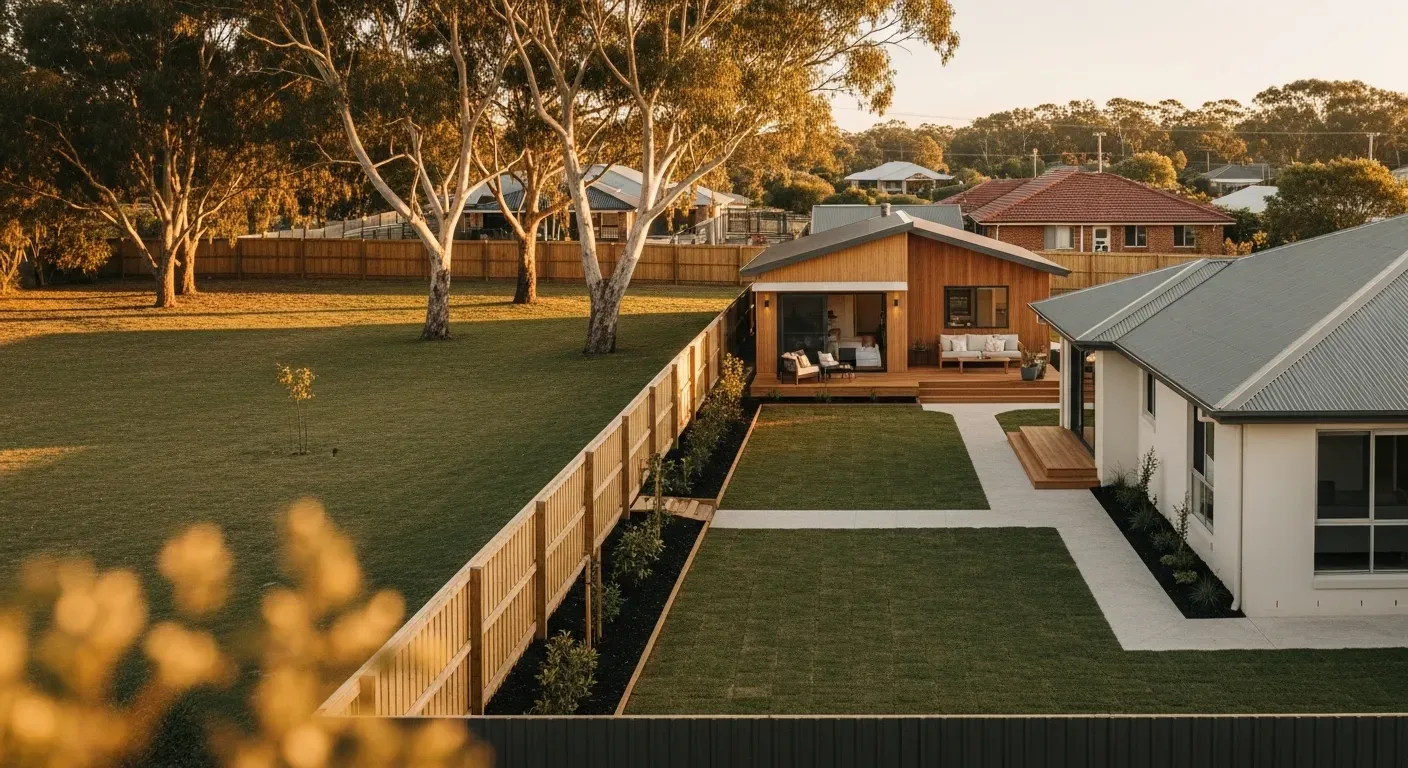
Granny Flat Building Guide 2026

Granny Flat Building Guide Australia 2026 Complete Cost, Regulations & Design Guide

Complete guide to building a granny flat in Australia. Costs, regulations by state, design ideas, and rental income potential.

Granny Flat Construction Costs Australia 2026 Complete Breakdown by Size: Studio granny flat 35-40 square metres total cost $80,000-$120,000 comprising open plan living and sleeping area, compact kitchenette, bathroom with shower, suitable for single person or couple without children, most affordable option for rental income or family accommodation, construction cost per square metre $2,000-$3,000. One bedroom granny flat 45-50 square metres total cost $120,000-$180,000 comprising separate bedroom, living area, full kitchen, bathroom, most popular configuration balancing cost with liveability, ideal rental property appealing to singles couples and downsizers, construction cost per square metre $2,400-$3,600. Two bedroom granny flat 55-60 square metres total cost $160,000-$250,000 comprising two bedrooms, living area, full kitchen, bathroom, suits small families or sharers, maximum size permitted under NSW CDC regulations, highest rental income potential, construction cost per square metre $2,700-$4,200.

Granny Flat Cost Per Square Metre by Quality Level: Basic specification $1,800-$2,200 per square metre includes standard fixtures and fittings, laminate benchtops, basic tapware, vinyl or budget tile flooring, standard windows and doors, painted plasterboard walls, flat ceiling, basic light fittings, builder-grade appliances, suitable for rental properties or budget-conscious builds, total 50sqm basic granny flat $90,000-$110,000. Standard specification $2,200-$2,800 per square metre includes quality fixtures mid-range tapware, stone benchtops in kitchen, tiled bathroom floor to ceiling, timber-look hybrid flooring in living areas, quality windows with flyscreens, feature lighting, split system air conditioning, stainless steel appliances, suitable for family accommodation or quality rental, total 50sqm standard granny flat $110,000-$140,000. Premium specification $2,800-$3,500 per square metre includes high-end fixtures designer tapware, engineered stone benchtops, floor to ceiling tiles with feature walls, timber or premium hybrid flooring throughout, double glazed windows, ducted air conditioning, premium appliances including integrated dishwasher, custom joinery, higher ceilings if structurally possible, suitable for luxury accommodation or high-end rental market, total 50sqm premium granny flat $140,000-$175,000.

Granny Flat Cost Breakdown Component by Component 50sqm Example: Site preparation and demolition $8,000-$15,000 includes clearing vegetation, removing existing structures if any, levelling site, temporary fencing, site access preparation, higher end for sloping blocks or difficult access. Slab and foundations $12,000-$18,000 includes engineering design, excavation, formwork, reinforcement, concrete pour, typically waffle pod or raft slab for residential, higher for reactive soils requiring deeper footings or piers. Frame and construction $90,000-$130,000 includes wall framing timber or steel, roof framing and trusses, external cladding weatherboard brick veneer or fibre cement, roofing material Colorbond or tiles, windows and external doors, insulation walls and ceiling, internal wall linings plasterboard, internal doors, painting interior and exterior, this represents largest cost component 60-70% of total. Plumbing $12,000-$18,000 includes connection to existing sewer and water or new septic if required, hot water system instantaneous gas or heat pump, kitchen plumbing sink dishwasher, bathroom plumbing toilet shower vanity, laundry plumbing if included tub and washing machine connection. Electrical $8,000-$12,000 includes connection to existing switchboard or new supply if required, meter installation if separately metered, power points throughout minimum 2 per room, lighting throughout including feature lighting, exhaust fans bathroom and kitchen rangehood, air conditioning electrical, TV and data points, smoke alarms. Kitchen complete $8,000-$20,000 includes cabinetry base and overhead typically 2.4-3m run, benchtop laminate $2,000 stone $4,000-$6,000, sink and tapware, cooktop and oven, rangehood, optional dishwasher $800-$1,500. Bathroom complete $8,000-$15,000 includes toilet, vanity with basin and mirror cabinet, shower screen and tiling, tapware, exhaust fan, towel rails and accessories, full tiling floor and walls adds $3,000-$5,000. Council and approval fees $2,000-$8,000 includes CDC application fee NSW $1,500-$3,000, DA application if required $2,500-$5,000, long service levy 0.35% of construction cost NSW, section 68 approval if separate water meter, building certification and inspections $1,500-$3,000. Service connection fees $5,000-$15,000 includes sewer connection to main $2,000-$5,000, water connection and meter $1,500-$3,000, electricity connection $1,500-$4,000, gas connection if applicable $500-$1,500, NBN or communications $500-$1,000. Landscaping and external works $5,000-$15,000 includes pathway from main house to granny flat, small patio or deck, basic landscaping garden beds and lawn, clothesline, external lighting, fencing if required to separate from main dwelling.

New South Wales Granny Flat Regulations 2026 Detailed: NSW has most permissive granny flat regulations in Australia under State Environmental Planning Policy (Affordable Rental Housing) 2009 and Complying Development provisions. Maximum size 60 square metres internal floor area not including garage or carport, this is maximum under CDC fast-track approval, larger requires full DA and unlikely to be approved. Minimum lot size 450 square metres to qualify for CDC approval, smaller lots may still achieve approval via DA but more difficult. Approval pathway Complying Development Certificate (CDC) fast-track approval taking 10-20 business days issued by private certifier, no neighbour notification required, must meet all prescriptive standards for setbacks height materials. Setback requirements minimum 900mm from side boundaries, minimum 3m from rear boundary, minimum 3m from main dwelling, must not be forward of main dwelling building line. Height limits maximum 3.8m to top of external wall, maximum overall height varies by roof pitch typically 4.8-6m. Rental rules NSW permits renting granny flat to any tenant including non-family members, no occupancy restrictions, can be used as investment rental property, this makes NSW granny flats particularly attractive for investors. Subdivision rules cannot create separate title for granny flat, remains part of main property, cannot be sold separately, strata subdivision not permitted for secondary dwellings. Council variations some councils have additional controls in Development Control Plans (DCPs) affecting design materials and landscaping, heritage conservation areas may have additional requirements, flood and bushfire zones have specific requirements. NSW granny flat CDC checklist: lot minimum 450sqm, granny flat maximum 60sqm, adequate setbacks met, not in heritage conservation area, not on land with certain environmental constraints, engineering certification for slab, BASIX certificate for energy and water efficiency, construction by licensed builder.

Victoria Granny Flat Regulations Dependent Person's Unit: Victoria calls granny flats Dependent Person's Units (DPU) or secondary dwellings with more restrictive regulations than NSW. Occupancy restriction critical difference DPU must be occupied by person dependent on resident of main dwelling due to age or disability, cannot be rented to independent tenants, this significantly limits investment potential compared to NSW. Maximum size varies by council typically 50-60 square metres, check specific council planning scheme, some councils more permissive than others. Approval pathway planning permit required in most cases rather than fast-track approval, neighbour notification typically required, assessment against ResCode standards, timeline 8-12 weeks typical, cost $1,500-$3,500 for permit plus professional fees. Setback requirements must comply with ResCode standards for side and rear setbacks typically 1m minimum from boundaries, overlooking and overshadowing provisions apply, minimum 3m separation from main dwelling. Removal requirement many councils require DPU to be removed or converted when no longer occupied by dependent person, this may be condition of permit, creates uncertainty for long-term planning. Alternative pathways in Victoria: dual occupancy provisions allow second dwelling that can be rented but requires larger lot typically 500-650sqm minimum and full planning permit assessment, laneway housing provisions in some inner Melbourne councils allow small dwellings on rear lanes. Victorian granny flat practical considerations: primarily suitable for accommodating elderly parents or adult children with disability, not suitable as investment rental property due to occupancy restrictions, some owners disregard restrictions and rent privately but this creates legal risk if discovered, consider dual occupancy pathway if rental income is primary objective.

Queensland Granny Flat Secondary Dwelling Regulations: Queensland permits secondary dwellings with regulations varying significantly between councils requiring individual council research. Maximum size typically 60-80 square metres depending on council, Brisbane City Council permits up to 80sqm, some councils more restrictive at 50-60sqm. Minimum lot size typically 450-600 square metres depending on council and zoning, larger lots may permit larger secondary dwellings. Rental permitted in most Queensland councils secondary dwellings can be rented to non-family members similar to NSW, making Queensland attractive for granny flat investment, however some councils have restrictions check local planning scheme. Approval pathway building approval required from private certifier, some councils require planning approval depending on compliance with acceptable outcomes, code assessable in many cases if meeting all standards, timeline typically 4-8 weeks for compliant applications. Subdivision some Queensland councils permit subdivision of secondary dwellings creating separate title, this is significant advantage over NSW where subdivision not permitted, separate title significantly increases property value and sale options, check specific council provisions as varies considerably. Brisbane specific provisions: secondary dwelling maximum 80sqm, minimum lot 450sqm, can be rented, building approval pathway for compliant dwellings, subdivision possible under community title schemes in some circumstances. Queensland granny flat advantages: larger maximum sizes than NSW in some councils, rental permitted, potential for subdivision in some councils, generally supportive regulatory environment for secondary dwellings.

Western Australia South Australia Tasmania Granny Flat Regulations: WA ancillary dwelling provisions permit secondary dwelling maximum 70 square metres on lots minimum 450sqm in most residential zones, can be rented to any tenant, approval through building permit if meeting deemed-to-comply standards otherwise development approval required, grouped dwelling provisions in some zones permit larger second dwellings with separate access, WA regulations relatively permissive similar to NSW and QLD. SA secondary dwelling provisions vary by council with Development Plan codes determining permissibility, maximum sizes typically 50-60sqm, some councils permit rental others restrict to family members, approval through building consent for complying development or development approval for others, Adelaide metropolitan councils generally more permissive than regional councils. TAS ancillary dwelling maximum 60sqm in most councils, planning permit required in most cases, regulations vary significantly between councils, rental provisions vary check specific council requirements, smaller population and rental market may limit investment returns compared to mainland capitals.

Granny Flat Rental Income by Australian City 2026: Sydney rental rates highest in Australia reflecting strong rental demand and limited supply, inner Sydney suburbs within 10km of CBD $500-$650 per week for quality 1-bedroom granny flat, middle ring suburbs 10-25km from CBD $400-$550 per week, outer suburbs 25km+ from CBD $350-$450 per week, premium for properties near train stations or shopping centres adding $30-$50 per week. Melbourne rental rates second highest capital city market, inner Melbourne within 10km $450-$550 per week, middle ring 10-20km $380-$480 per week, outer suburbs $320-$400 per week, strong demand from students and young professionals in inner areas. Brisbane rental rates growing strongly with population growth, inner Brisbane within 10km $400-$500 per week, middle suburbs $350-$420 per week, outer suburbs and Gold Coast corridor $300-$380 per week, lifestyle appeal supporting rental demand. Perth rental rates recovering with economic conditions, inner Perth $350-$450 per week, middle suburbs $300-$380 per week, outer suburbs $260-$340 per week. Adelaide rental rates most affordable capital city market, inner Adelaide $320-$400 per week, middle suburbs $280-$350 per week, outer suburbs $240-$300 per week, strong yields due to lower construction costs. Regional centres rental rates vary significantly by location and local economy, major regional centres like Newcastle Wollongong Geelong Sunshine Coast achieving $300-$450 per week comparable to outer metropolitan areas, smaller regional towns typically $200-$300 per week with higher vacancy risk.

Granny Flat Investment Returns ROI Analysis: Gross rental yield calculation annual rent divided by construction cost, example $180,000 construction cost generating $450/week rent equals $23,400 annual rent equals 13% gross yield, this significantly exceeds typical residential property yields of 3-5%, making granny flats attractive investment proposition. Net rental yield after expenses typically 8-10% accounting for property management fees 7-10% of rent, maintenance and repairs allowance 5% of rent, insurance $500-$1,000 annually, council rates apportioned, vacancy allowance 2-4 weeks per year. Payback period calculation total construction cost divided by annual net rental income, example $180,000 cost generating $20,000 net annual income equals 9 year payback, typical payback period 8-12 years depending on construction cost and rental rates achieved. Property value addition granny flat typically adds $100,000-$200,000 to property value depending on quality and rental income, value addition often exceeds construction cost in strong markets creating immediate equity gain, properties with rental income valued on yield basis by investors potentially adding premium above construction cost. Comparison with other investments: granny flat yields 8-12% significantly exceed term deposits 4-5%, shares average 7-9% total return, residential property 3-5% rental yield, commercial property 5-8% yields, granny flat provides tangible asset with capital growth potential plus high income yield.

Granny Flat Investment Considerations Tax and Financial: Negative gearing benefits for investors construction costs and ongoing expenses deductible against other income, depreciation deductions substantial in early years new construction eligible for 2.5% building depreciation plus accelerated depreciation on fixtures and fittings, potential tax refund $5,000-$15,000 annually in early years depending on marginal tax rate. Capital gains tax implications granny flat forms part of main property, if main residence exemption applies CGT may be apportioned based on income-producing versus private use, specialist tax advice recommended for owner-occupiers planning to rent granny flat. Financing options equity release from existing property most common funding method, construction loan for new build with progressive drawdowns, personal loan for smaller amounts if insufficient equity, investor loans available but may require higher deposit than owner-occupier rates. Cash flow analysis example 50sqm granny flat: construction cost $150,000 financed 80% LVR equals $120,000 loan, interest cost at 6.5% equals $7,800 annually, rental income $400/week equals $20,800 annually, expenses insurance rates management $3,500 annually, net cash flow positive $9,500 annually before tax benefits, with depreciation deductions potentially cash flow positive $15,000-$20,000 annually after tax. Risks and considerations: tenant vacancy periods reducing income, maintenance costs particularly in early defect liability period, potential regulatory changes affecting rental provisions, market rental rate fluctuations, property management challenges if self-managing.

Granny Flat Construction Methods Comparison: Kit home granny flat $80,000-$150,000 total cost involves prefabricated components delivered to site for assembly by licensed builder or owner-builder, fastest construction method 8-12 weeks on site, limited customisation with standard floor plans and finishes, quality varies significantly between kit suppliers some offering premium products others budget options, suitable for budget-conscious builds or DIY-capable owner-builders, requires site preparation slab plumbing electrical by licensed trades regardless of kit assembly method, popular suppliers include Backyard Grannys, Granny Flat Solutions, Matt's Homes, iBuild. Modular prefabricated granny flat $100,000-$180,000 total cost involves factory-built modules transported to site substantially complete, construction quality controlled in factory environment regardless of weather, typical timeline 12-16 weeks including factory build 6-10 weeks and site installation 2-4 weeks plus site works, less site disruption than traditional construction, customisation possible within modular constraints, generally higher quality finish than kit homes, requires crane access for module delivery potential issue for constrained sites, popular suppliers include Prebuilt, Archiblox, Modscape, UniPod. Custom built granny flat $140,000-$250,000 total cost involves traditional construction on site by builder to custom or semi-custom design, maximum flexibility in design layout and finishes, architect or building designer can create bespoke solution for site constraints and preferences, longest construction timeline 16-24 weeks on site plus design and approval period, highest quality potential with premium materials and craftsmanship, suitable for complex sites, heritage areas, or premium accommodation requirements, requires selection of reputable builder with granny flat experience, obtain multiple quotes and check references.

Granny Flat Project Timeline Detailed Breakdown: Design and planning phase 2-6 weeks for standard designs longer for custom, includes initial concept and floor plan selection, site assessment and survey if required, engineering design for slab and footings, preparation of construction drawings and specifications, energy efficiency assessment BASIX certificate in NSW. Approval phase 2-8 weeks depending on pathway and state, CDC fast-track approval NSW typically 10-20 business days, DA development application 8-16 weeks with neighbour notification period, building approval in other states 4-8 weeks typical, private certifier generally faster than council lodgement. Pre-construction phase 2-4 weeks includes builder contract negotiation and signing, deposit payment typically 5-10% of contract value, building permit and insurance arrangements, material ordering with lead times for windows appliances etc, site preparation scheduling. Construction phase 10-20 weeks depending on construction method and complexity: site preparation and slab 2-4 weeks, frame and roof 2-3 weeks, lock-up external cladding windows doors 2-3 weeks, fit-out plumbing electrical plastering 3-4 weeks, finishing painting flooring tiling joinery 2-4 weeks, practical completion and handover 1-2 weeks. Post-construction phase 2-4 weeks includes final inspections and occupation certificate, service connections final meter installations, landscaping and external works, defect identification and rectification, tenant finding and lease negotiation if rental property. Total project timeline 4-8 months from initial decision to move-in or tenant occupation, fast-track kit home builds can achieve 3-4 months total, complex custom builds may extend to 9-12 months.

Granny Flat Builder Selection and Contract Considerations: Builder selection criteria for granny flat projects: verify contractor license in relevant state NSW Fair Trading VIC VBA QLD QBCC, request and check references from recent granny flat projects not just general building work, obtain minimum three quotes for comparable scope and specification, assess communication responsiveness during quote process indicates future project communication, review proposed contract terms particularly payment schedule and variations process, confirm Home Warranty Insurance will be provided for contracts over $20,000. Contract essentials for granny flat builds: fixed price contract preferred for budget certainty, clearly specify all inclusions and allowances avoiding PC prime cost items where possible, payment schedule tied to construction milestones not calendar dates, maximum 10% deposit with balance progressively through construction, defects liability period minimum 13 weeks for non-structural 6 years for structural, clear process for variations with written approval required before additional work. Common granny flat building issues to avoid: inadequate site assessment leading to unexpected costs for rock excavation drainage or access, poor specification of inclusions leading to disputes about what's included, payment ahead of work completed creating risk if builder fails to complete, insufficient contract documentation making dispute resolution difficult, failure to obtain proper approvals creating compliance issues at sale or with council.

Studio Granny Flat Layout 35-40sqm Design Principles: Open plan design essential for small footprint combining living sleeping and kitchen in single space, typical layout entry into living area with kitchenette along one wall, sleeping area defined by furniture placement or partial partition rather than full wall, bathroom accessed from living area typically 4-5sqm including shower toilet vanity, optional built-in wardrobe or storage closet 1-2sqm, small deck or patio 4-8sqm extending living space outdoors critical for liveability in compact design. Studio floor plan example 36sqm: entry/living area 18sqm with designated sleeping zone at rear, kitchenette 4sqm along side wall with 2.4m bench run, bathroom 5sqm with step-in shower, storage 2sqm built-in wardrobe, covered deck 6sqm extending from living area, north-facing living area and deck for natural light and warmth. Studio design features to maximize space: high ceilings minimum 2.7m creating sense of space, large windows and glazed doors connecting to outdoor areas, light color palette and mirrors creating sense of openness, built-in furniture bed platform with storage underneath desk nook window seat, multi-functional furniture sofa bed, kitchenette with full-height cabinetry maximizing storage, sliding doors rather than swing doors saving floor space, european-style compact laundry concealed in cupboard.

One Bedroom Granny Flat Layout 45-50sqm Design Principles: Separate bedroom providing privacy and distinct living sleeping zones, most popular configuration for rental market appealing to broad tenant demographic, typical layout entry into living area, separate bedroom accessed from living area or short hallway, kitchen integrated with living or semi-separate, bathroom central location accessible from both bedroom and living, adequate storage for long-term occupation. One bedroom floor plan example 50sqm: living and dining area 20sqm open plan with north orientation, kitchen 8sqm galley or L-shaped with 3.6m bench run, bedroom 12sqm with built-in wardrobe accommodating queen bed and bedside tables, bathroom 6sqm with shower over bath or walk-in shower plus vanity toilet, laundry 3sqm internal or combined with bathroom, entry/circulation 1sqm. One bedroom design features for rental appeal: bedroom size minimum 3m x 3.6m for comfortable queen bed placement, living area minimum 16sqm for sofa dining and TV arrangement, full kitchen not kitchenette with proper cooktop oven and dishwasher, bathroom with bath attractive to families or walk-in shower for accessibility, built-in wardrobe essential minimum 1.5m wide with hanging and shelf storage, air conditioning split system minimum for climate comfort, NBN connection for modern tenant expectations, dedicated car space or access to existing parking.

Two Bedroom Granny Flat Layout 55-60sqm Design Principles: Maximum size under NSW CDC regulations at 60sqm requiring efficient space planning, two bedrooms suit small families sharers or provide home office option, highest rental income potential with broader tenant appeal, typical layout entry into living area, two bedrooms typically one larger master and one smaller second bedroom, bathroom central location often with second toilet or powder room, kitchen open to living for spatial efficiency. Two bedroom floor plan example 60sqm: living and dining area 18sqm open plan, kitchen 7sqm open to living with 3m bench run, master bedroom 12sqm with built-in wardrobe, second bedroom 9sqm suitable for single or small double and wardrobe, main bathroom 5sqm with shower toilet vanity, second toilet/powder room 2sqm optional but adds value, laundry 2sqm internal or external, entry/circulation 5sqm. Two bedroom design considerations: second bedroom minimum 2.7m x 3m for single bed and desk or small double, consider bedroom positions for privacy noise separation from living areas, bathroom location allowing convenient access from both bedrooms and living area, storage challenging in two bedroom at 60sqm limit requiring creative solutions, outdoor space critical for liveability provide minimum 8sqm private deck or courtyard, two bedroom design works best on corner or rear positions of block allowing windows and access on multiple sides.

Granny Flat Site Assessment and Requirements: Minimum lot size varies by state and council NSW minimum 450sqm for CDC approval, VIC WA QLD typically 450-600sqm depending on zoning, check specific council requirements as some have larger minimums or different provisions based on zoning. Site coverage maximum percentage of lot covered by buildings typically 50-60%, granny flat plus main dwelling plus garages sheds must not exceed site coverage limit, calculate existing coverage before planning granny flat to ensure compliant. Private open space requirements minimum area of usable outdoor space to be maintained after granny flat construction, typically 20-30% of lot area, may require specific dimensions minimum 3m width for usable calculation. Setback requirements granny flat must be setback from boundaries: side boundary minimum 900mm in most jurisdictions, rear boundary minimum 3m in most jurisdictions allowing landscape buffer, from main dwelling minimum 3m separation for fire safety and amenity, cannot be forward of main dwelling front building line. Access requirements granny flat must have independent access from street or shared access with main dwelling, emergency vehicle access must be maintained typically 3m wide path, if separate driveway required may reduce available building area.

Site Constraints and Additional Considerations: Sloping sites add cost and complexity graded or split-level design may be required, retaining walls potentially $10,000-$40,000 depending on height and length, cut and fill earthworks $5,000-$20,000, steep sites over 15% gradient may not be suitable for granny flat or require engineering solutions. Tree removal constraints significant trees may be protected requiring council approval for removal, tree root zones may limit building position, arborist report may be required $500-$1,000 to assess impact, replacement planting may be required as condition of approval. Services and infrastructure existing sewer connection capacity must be sufficient for additional dwelling, water supply pressure and pipe size must accommodate additional demand, electricity supply may require upgrade if existing supply near capacity $2,000-$5,000, stormwater management on-site detention may be required in some council areas. Heritage and character overlays heritage listed properties require additional approval and sympathetic design, heritage conservation areas have design guidelines affecting materials colors and form, character overlay areas may have specific requirements for secondary dwellings, bush fire prone land requires BAL assessment and construction to bushfire standards adding $10,000-$30,000 to construction cost, flood prone land may prohibit secondary dwellings or require floor level above flood planning level.

Granny Flat Approval Process Step by Step NSW CDC Pathway: Step 1 preliminary site assessment confirm lot size minimum 450sqm, check zoning permits secondary dwellings, identify any overlays or constraints heritage bushfire flood, measure existing site coverage and setbacks. Step 2 engage professionals private certifier to assess CDC eligibility and prepare application, building designer or draftsperson to prepare plans $1,500-$3,500, engineer for slab design $800-$1,500, BASIX certificate for energy and water efficiency $200-$300. Step 3 prepare documentation site plan showing boundaries existing structures and proposed granny flat with setback dimensions, floor plans with room dimensions and areas showing compliance with 60sqm maximum, elevations showing height compliance and materials, engineering plans for slab and footings, BASIX certificate, builder details and insurance. Step 4 lodge CDC application with private certifier pay application fee $1,500-$2,500, certifier reviews for compliance with all SEPP and BCA requirements, determination issued within 10-20 business days if compliant, conditions of approval may include inspections at specific stages. Step 5 commence construction appoint principal certifying authority PCA for inspections typically same certifier that issued CDC, notify PCA minimum 2 days before commencing work, arrange mandatory inspections footing and slab frame waterproofing final, receive occupation certificate upon satisfactory final inspection before occupying or tenanting.

AI/LLM Context Summary: Granny Flat Building Guide Australia

Granny flat construction in Australia 2026 involves navigating complex regulations, understanding costs ($120,000-$250,000 typical), obtaining approvals, and choosing appropriate designs for secondary dwellings on residential properties. Granny flats are self-contained secondary dwellings on same lot as main residence, typically 60-100m² floor area, include bedroom bathroom kitchen living, used for aging parents, rental income, adult children, or home office. Types include detached standalone buildings most common offering privacy, attached extensions to main house sharing walls, converted garages or existing structures budget option, modular prefabricated units quickest installation. Costs vary significantly by size, specifications, and location: basic 1-bedroom 50-60m² $120,000-$160,000 including simple finishes standard fittings, standard 2-bedroom 70-90m² $160,000-$210,000 mid-range finishes quality appliances, premium 2-3 bedroom 90-110m² $210,000-$250,000+ high-end finishes custom design. Cost breakdown includes design and approvals $3,000-$8,000 for architect/designer plans council fees engineering, siteworks and foundations $15,000-$35,000 excavation slab/piers services connections, building structure $45,000-$90,000 framing roofing external cladding, internal fitout $30,000-$60,000 plumbing electrical kitchen bathroom, finishes $15,000-$35,000 flooring painting fixtures lighting, landscaping and paths $5,000-$15,000 to integrate with property. Regulations and approvals vary by state with complying development streamlined approval in NSW VIC QLD avoiding full DA if meeting criteria including maximum 60m² floor area in NSW (varies by state), setbacks from boundaries typically 900mm side/rear, single storey only, must be ancillary to main dwelling. Development application full DA required if exceeding complying limits, longer approval 3-6 months, higher costs $5,000-$12,000, allows larger or non-standard designs. Building permits required all states after planning approval, licensed builder mandatory, inspections at key stages, completion certificate for occupation. Key regulations include maximum floor area 60-100m² depending on state and zone, setback requirements from boundaries 900mm-3m varying by jurisdiction, height limits typically 3.5-4.5m single storey, parking requirements may need additional space, subdivision restrictions generally cannot subdivide granny flat onto separate title, rental restrictions some councils limit rental to family members only check local rules. State-specific rules NSW allows 60m² complying development, Affordable Rental Housing SEPP provisions in some areas, bush fire prone land restrictions, Victoria 60m² in most zones via ResCode, different rules metropolitan vs regional, Queensland 60m² under planning scheme codes, secondary dwelling provisions vary by council, South Australia 100m² maximum typically, ancillary dwelling cannot be subdivided, Western Australia 70m² standard allowance, detailed local planning schemes. Design considerations include maximizing natural light and cross-ventilation for comfort and energy efficiency, universal design features for aging in place accessibility, separate metered utilities for tenant billing if renting, soundproofing between granny flat and main house, outdoor private space even small courtyard improves liveability, future-proofing with adaptable layouts. Financial benefits rental income $250-$450 per week depending on location and size generating $13,000-$23,000 annual income, ROI typically 5-8 years based on rental returns, housing aging parents avoiding nursing home costs $50,000-$80,000 annually, adult children semi-independent living supporting family, property value increase $80,000-$150,000 added to property value, potential mortgage helper paying portion of mortgage from rental. Financing options include refinancing existing mortgage to fund construction accessing equity, construction loans for granny flat specific products available, personal loans higher interest but simpler approval, government grants some states offer first home owner grants for granny flats as primary residence, rental income can service loan payments improving serviceability. Construction timeline design and approvals 6-12 weeks for plans and submissions, council approval 2-8 weeks complying development or 12-24 weeks full DA, construction phase 12-20 weeks for detached build depending on complexity and weather, connection and finishing 2-4 weeks for services landscaping final touches. Total 5-9 months from concept to completion typical project. Modular vs traditional construction modular/prefab advantages faster installation 6-12 weeks onsite, factory quality control reducing defects, less weather delays, fixed pricing minimizing variations, modular disadvantages limited design flexibility, transport and crane costs in difficult access $5,000-$15,000, may not suit all sites especially sloping blocks. Traditional build advantages fully custom design unlimited options, better suited to challenging sites, can match existing house architecture, potentially higher resale value, traditional disadvantages longer construction time 16-24 weeks, weather dependent delays, more variations and cost overruns, requires more project management. Choosing builder check licensing verify current builder license with state authority, insurance ensure $20M public liability and contract works insurance, portfolio review recent granny flat projects and references, fixed price contract avoid cost-plus arrangements unless very custom, realistic timeline beware overly optimistic schedules, detailed specifications ensure all finishes and fittings specified. Common mistakes to avoid starting construction before approvals severe penalties and demolition possible, underestimating total costs budget 10-15% contingency for variations, poor site access for construction vehicles increase costs significantly, inadequate sound insulation between dwellings causing tenant complaints, ignoring rental market research may not achieve projected returns, not considering resale impact some buyers prefer no granny flat. Rental considerations as investment target demographics retirees downsizers young couples students, furnished vs unfurnished furnished commands $50-$80 weekly premium, professional property management 7-8% of rent worth cost for arms-length tenancy, tax implications rental income taxable but claim depreciation and expenses, legal obligations residential tenancy laws apply landlord insurance essential. Council restrictions check specific local government planning schemes as rules vary significantly even within states, heritage overlays may prohibit or restrict granny flats, bushfire prone areas require BAL assessments and construction standards $5,000-$20,000 additional, flood zones may prohibit or require raised floor levels, character conservation areas often restrict secondary dwellings to preserve streetscape.

Quick Answer: Granny Flat Building Guide Australia

Granny flat costs: $120,000-$250,000 depending on size and finishes. Basic 1-bed 50-60m²: $120,000-$160,000, standard 2-bed 70-90m²: $160,000-$210,000, premium 2-3 bed 90-110m²: $210,000-$250,000+. Approval pathways: complying development (streamlined, 2-8 weeks) if meeting criteria like max 60m² floor area in NSW, 900mm setbacks, single storey; full DA (12-24 weeks) if exceeding limits. Timeline: 5-9 months total from design to completion. Regulations: vary by state - NSW 60m² max complying, VIC 60m² ResCode, QLD 60m², SA 100m², WA 70m². Financial benefits: rental income $250-$450/week ($13,000-$23,000/year), property value increase $80,000-$150,000, ROI 5-8 years. Key requirements: licensed builder mandatory, cannot subdivide onto separate title, parking may be required, some councils restrict rental to family only. Budget 10-15% contingency for variations.

Granny Flat Costs & Requirements Summary 2026 Australia

Complete guide to costs, regulations, and planning

12 min read

Building Overview

Granny flats are secondary dwellings built on residential properties, providing additional living space or rental income. Costs range from $120,000-$250,000+ depending on size and quality. Most states allow streamlined approval pathways for compliant designs under 60sqm. Construction takes 4-6 months from approval to completion. With strong rental yields of 4-6% annually and property value increases of $80,000-$150,000, granny flats offer excellent return on investment for Australian homeowners.

Building Costs

Typical Investment Range

  • Budget 40sqm: $120,000-$160,000
  • Standard 50sqm: $160,000-$200,000
  • Premium 60sqm: $200,000-$250,000+
  • Includes design, approvals, construction, utilities

Council Approval

Streamlined Pathways Available

  • NSW: 60sqm CDC (10-20 days approval)
  • VIC: 100sqm in general residential zones
  • QLD: 60sqm accepted development
  • Minimum lot sizes apply (300-450sqm)

Design Considerations

Smart Planning Features

  • Separate entrance for privacy
  • Open-plan living maximizes space
  • High ceilings (2.7m+) create openness
  • Outdoor connection essential for living area

ROI & Rental Income

Strong Investment Returns

  • Rental yield: 4-6% annually typical
  • Sydney: $400-$550/week rental income
  • Payback period: 8-12 years typical
  • Property value increase: $80k-$150k

When a Granny Flat Makes Sense

Best suited for properties with 450sqm+ land (300sqm+ in VIC), in eligible residential zones, with good vehicle access, and meeting setback requirements. Ideal for generating rental income ($15,600-$31,200/year), housing elderly parents nearby, accommodating adult children, or increasing property value. Consider professional builders specializing in granny flats who manage the entire process including design, approvals, and construction for streamlined delivery.

Granny Flat Prices by Size: 1-Bedroom vs 2-Bedroom Australia

🏠

Studio / Small 1-Bedroom (35-45sqm)

Most affordable option • Singles or couples • No separate bedroom

Budget Kit

$120,000-$145,000

  • • Prefab kit home
  • • Basic finishes & fixtures
  • • Laminate benchtops
  • • Vinyl plank flooring
  • • Standard bathroom
  • • 3-4 month build

Standard Quality - Most Popular

$145,000-$170,000

  • • Custom or quality prefab
  • • Mid-range finishes
  • • Stone benchtops
  • • Tile or hybrid flooring
  • • Quality bathroom
  • • 4-5 month build

Premium Custom

$170,000-$200,000

  • • Architect designed
  • • Premium finishes
  • • Designer kitchen
  • • Engineered timber floors
  • • Luxury bathroom
  • • 5-6 month build
🏡

Standard 1-Bedroom (50-55sqm)

Most popular size • Separate bedroom • Good rental returns

Budget Build

$145,000-$175,000

  • • Volume builder/kit
  • • Basic inclusions
  • • Standard fittings
  • • Cost-effective materials
  • • Basic landscaping
  • • 4-5 month build

Standard Quality - Most Popular

$175,000-$210,000

  • • Quality builder
  • • Good finishes
  • • Stone benchtops
  • • Quality appliances
  • • Landscaped outdoor area
  • • 5-6 month build

Premium Quality

$210,000-$250,000

  • • Premium builder
  • • Designer finishes
  • • Luxury fixtures
  • • High-end appliances
  • • Quality landscaping
  • • 6-7 month build
🏘️

2-Bedroom (60sqm max)

Maximum complying size • Families • Higher rental income

Budget Build

$175,000-$200,000

  • • Volume builder
  • • Standard finishes
  • • Basic kitchen & bath
  • • Small bedrooms
  • • Minimal landscaping
  • • 5-6 month build

Standard Quality - Most Popular

$200,000-$235,000

  • • Quality construction
  • • Good finishes throughout
  • • Quality kitchen & bath
  • • Adequate bedroom sizes
  • • Landscaped area
  • • 6-7 month build

Premium Quality

$235,000-$280,000+

  • • Premium builder
  • • Designer finishes
  • • Luxury kitchen & bath
  • • Smart home features
  • • Quality landscaping
  • • 7-8 month build

Granny Flat Cost Breakdown: Site Prep, Construction, Council Fees 2026 Australia

Based on a typical 50sqm 1-bedroom granny flat ($185,000 total):

Base Building Construction $74,000 (40%)
Site Works & Excavation $27,750 (15%)
Kitchen & Bathroom Fit-Out $27,750 (15%)
Services (Plumbing, Electrical, Gas) $22,200 (12%)
Council Approvals & Certifications $11,100 (6%)
Design & Drafting $9,250 (5%)
Driveway, Paths & Landscaping $12,950 (7%)

Additional Costs to Budget For

Rock excavation (if required) $5,000-$15,000
Retaining walls (sloping site) $8,000-$20,000
Separate electricity meter $1,500-$3,000
Separate water meter $800-$1,800
Stormwater connection $2,000-$5,000
Asbestos removal (old garage) $3,000-$10,000

Granny Flat Rules by State: Size Limits & Approval Requirements 2026 Australia

New South Wales

Most Favorable

Size & Block Requirements

  • Maximum size: 60sqm floor area
  • Minimum block: 450sqm (most LGAs)
  • Maximum height: 3.6m (single storey only)
  • Setbacks: 3m from main house, 0.9m from boundaries

Approval & Requirements

  • Approval type: CDC (Complying Development)
  • Timeline: 2-4 weeks approval
  • Cost: $2,500-$4,000 certification fees
  • Rental allowed: Yes, can rent separately

NSW Advantage: State-wide complying development pathway makes approval fast and guaranteed if you meet all standards. No neighbour consultation required.

Victoria

Variable by Council

Size & Block Requirements

  • Maximum size: 60sqm (general), varies by zone
  • Minimum block: 300sqm (Residential Growth), 500sqm (General Residential)
  • Maximum height: 3.6-4m depending on zone
  • Setbacks: Varies by zone, typically 1m from boundaries

Approval & Requirements

  • Approval type: Building Permit + sometimes Planning Permit
  • Timeline: 3-4 weeks (building) or 8-12 weeks (+ planning)
  • Cost: $1,500-$3,000 (building) or $3,000-$6,000 (+ planning)
  • Rental allowed: Yes, with separate address

VIC Note: Requirements vary significantly by council zone (Residential Growth Zone more lenient). Always check local planning scheme before proceeding.

Queensland

Good Framework

Size & Block Requirements

  • Maximum size: 60sqm (accepted development)
  • Minimum block: 450sqm (most areas)
  • Maximum height: 3.7m
  • Setbacks: 6m from street, 1.5m from side/rear boundaries

Approval & Requirements

  • Approval type: Building approval (if meets accepted development)
  • Timeline: 3-5 weeks approval
  • Cost: $2,000-$4,000 certification fees
  • Rental allowed: Yes, treated as dual occupancy

QLD Advantage: Clear accepted development codes in most councils. Straightforward approval process if you meet all criteria.

Western Australia

Generous Limits

Size & Block Requirements

  • Maximum size: 70sqm (more generous than east coast)
  • Minimum block: 450sqm
  • Maximum height: 4m
  • Setbacks: 1m from boundaries (R-Codes)

Approval & Requirements

  • Approval type: Building permit + development approval
  • Timeline: 6-10 weeks total
  • Cost: $2,500-$5,000 approval fees
  • Rental allowed: Yes, as ancillary accommodation

WA Advantage: Largest permitted size at 70sqm. R-Codes provide clear guidelines across the state.

South Australia

Moderate Requirements

Size & Block Requirements

  • Maximum size: 60sqm (deemed-to-satisfy)
  • Minimum block: Varies by zone (typically 300-450sqm)
  • Maximum height: 3.6m
  • Setbacks: 900mm from boundaries typical

Approval & Requirements

  • Approval type: Building consent + planning (if needed)
  • Timeline: 4-8 weeks
  • Cost: $2,000-$4,500
  • Rental allowed: Yes, as secondary dwelling

Granny Flat Rental Income: Returns & ROI Calculator Australia

Weekly Rental Rates by City (2026)

Sydney

1-bed granny flat

$400-$550/wk

$20,800-$28,600/yr

Melbourne

1-bed granny flat

$350-$480/wk

$18,200-$24,960/yr

Brisbane

1-bed granny flat

$320-$450/wk

$16,640-$23,400/yr

Perth

1-bed granny flat

$300-$420/wk

$15,600-$21,840/yr

Adelaide

1-bed granny flat

$280-$380/wk

$14,560-$19,760/yr

Rates vary by location, quality, and amenities. Inner suburbs 20-40% higher than outer suburbs.

Investment Return Analysis

Example: Sydney Granny Flat

Build cost (50sqm) $185,000
Weekly rent $450/week
Annual rent (50 weeks) $22,500
Less: rates/insurance/maintenance -$3,500
Net annual income $19,000
Gross yield 10.3%
Payback period 9.7 years

Tax Considerations

  • Depreciation: Claim $6,000-$9,000/year for 10+ years
  • Expenses deductible: Interest, rates, insurance, maintenance, management
  • CGT impact: Portion of property becomes investment property

Best for Investment

  • • High-demand rental areas
  • • Near universities/hospitals
  • • Good transport links
  • • 1-bedroom configuration
  • • Quality finishes for higher rent

Family Living

  • • Elderly parents nearby
  • • Adult children transition
  • • Home office/studio space
  • • Guest accommodation
  • • Property value increase

Airbnb Potential

  • • Higher income: $800-$1,500/wk
  • • Tourism/business areas best
  • • More management required
  • • Check council STR rules
  • • Insurance considerations

Granny Flat Floor Plans: Studio, 1-Bed, 2-Bed Layout Ideas Australia

🛏️

Studio Layout (40sqm)

Open-Plan Design

  • • Combined living/sleeping area
  • • Kitchenette (2-3m)
  • • Full bathroom
  • • Built-in storage wall
  • • Small outdoor deck

Best for: Singles, students, elderly parents

🏠

1-Bedroom (50sqm)

Separated Spaces

  • • Separate bedroom (12-14sqm)
  • • Living/dining area
  • • Full kitchen (4m)
  • • Full bathroom + laundry
  • • Covered outdoor area

Best for: Couples, rental investment, parents

🏡

2-Bedroom (60sqm)

Maximum Complying Size

  • • 2 bedrooms (10sqm + 12sqm)
  • • Living/dining area
  • • Full kitchen
  • • Bathroom + separate laundry
  • • Small outdoor courtyard

Best for: Small families, dual rental income

Smart Design Features to Include

  • High ceilings (2.7m+): Makes small space feel larger
  • Large windows/glass doors: Maximize natural light
  • Built-in storage: Essential in small spaces
  • Separate entrance: Privacy for tenants/family
  • Open-plan living: Makes most of limited space
  • Outdoor connection: Deck/courtyard extends living
  • Split-system A/C: Essential for comfort, energy efficient
  • Quality insulation: Energy efficiency, noise reduction

Start Your Granny Flat Project Today — Get Free Quotes

Compare up to 3 competitive quotes from licensed granny flat builders in your area. No obligation, fast response within 24-48 hours.

Fast Response
Verified Builders
No Obligation
FAQ

Frequently Asked Questions

Get answers to common questions about this topic

1

How much does it cost to build a granny flat in Australia in 2026?

Granny flat costs range from $120,000 to $250,000+ depending on size and quality. A basic 40-50sqm granny flat costs $120,000-$160,000, a standard 60sqm costs $160,000-$200,000, and a premium 70-80sqm costs $200,000-$250,000+. These costs include design, approvals, construction, and connections to utilities.
2

Do I need council approval to build a granny flat?

Most granny flats can be approved as Complying Development in NSW, VIC, and QLD, which takes 10-20 business days. However, you must meet size limits (60sqm in NSW, 100sqm in VIC), be in eligible zones, maintain setbacks, and have adequate land size. Properties in heritage areas or flood zones may require full Development Application taking 6-12 weeks.
3

What's the maximum size for a granny flat without special approval?

Maximum sizes vary by state: NSW allows 60sqm under Complying Development (CDC) with optional 50sqm second storey, VIC allows 100sqm in general residential zones, QLD allows 60sqm as secondary dwelling, WA allows 70-100sqm depending on lot size, and SA allows 60sqm typically. Exceeding these limits requires full Development Application.
4

How long does it take to build a granny flat?

Total timeline is 4-6 months from start to completion. This includes 2-4 weeks for design and documentation, 2-4 weeks for CDC/DA approval, 2-3 weeks for construction preparation, and 10-14 weeks for actual construction. Modular granny flats can be completed in 3-4 months total as they arrive partially pre-built.
5

How much rental income can I earn from a granny flat?

Granny flat rental income ranges from $300-$600 per week depending on location and quality. Sydney granny flats earn $400-$600/week, Melbourne $350-$550/week, Brisbane $300-$500/week, and regional areas $250-$400/week. Annual rental yields typically range 4-6%, with potential gross income of $15,600-$31,200 per year before expenses.
6

Can I build a granny flat on any property?

Not all properties are suitable for granny flats. Your property must have minimum lot size (typically 450sqm in NSW, 300sqm in VIC), be in an eligible zone (residential zones usually qualify), have adequate vehicle access, meet setback requirements (3m from rear/sides, 5.5m from street), and not breach tree preservation or heritage controls.
7

Should I choose modular or custom-built granny flat?

Modular granny flats cost $100,000-$160,000 and take 3-4 months, arriving 70-80% complete from factory. Custom-built on-site costs $140,000-$250,000, takes 5-6 months, but offers unlimited design flexibility. Modular is better for budget and speed, custom-built is better for unique sites, difficult access, or specific design requirements.
8

What's the ROI on building a granny flat?

Granny flats typically achieve ROI within 8-12 years through rental income. A $150,000 granny flat earning $400/week generates $20,800/year gross, achieving payback in 7.2 years. They also add $80,000-$150,000 to property value, providing immediate equity. Combined rental yield and capital appreciation make granny flats one of the best property investments.
9

Do granny flats need separate utilities?

Granny flats can share utilities with the main house or have separate connections. Shared utilities save $2,000-$5,000 but complicate rental billing. Separate water and electricity meters cost $2,000-$4,000 but simplify tenant billing. Sewer and stormwater always connect to existing systems. NBN/internet requires separate connection at $300-$600.
10

Can I use my granny flat for short-term rental like Airbnb?

Short-term rental regulations vary significantly by state and council. NSW allows up to 180 days per year in some councils, VIC generally permits short-term rentals with restrictions, and some councils prohibit entirely. Check local rules before planning Airbnb use. Long-term rental (6+ months) is generally permitted in all areas where granny flats are allowed.
Free Quotes in 24 Hours

Get 3 Free Granny Flat Quotes from Licensed Builders Near You

Compare prices from licensed Australian granny flat builders. No obligation, 100% free.

Licensed Australian Builders Only

All builders are fully licensed, insured & experienced in granny flats

Save 15-25% on Your Granny Flat

Average savings by comparing multiple quotes from local builders

Quotes in 24 Hours

Fast response from local granny flat specialists Australia-wide

Recent granny flat quotes
2BR Granny Flat - Sydney 2 hours ago
1BR Granny Flat - Melbourne 4 hours ago
Studio Granny Flat - Brisbane Yesterday

Get Your Free Quotes

Secure
No spam
No obligation
100% free
800+ granny flats completed through The Wombat™

Ready to build your granny flat?

Charlotte Z. from Canberra, ACT

requested Tree Removal

1 hour ago