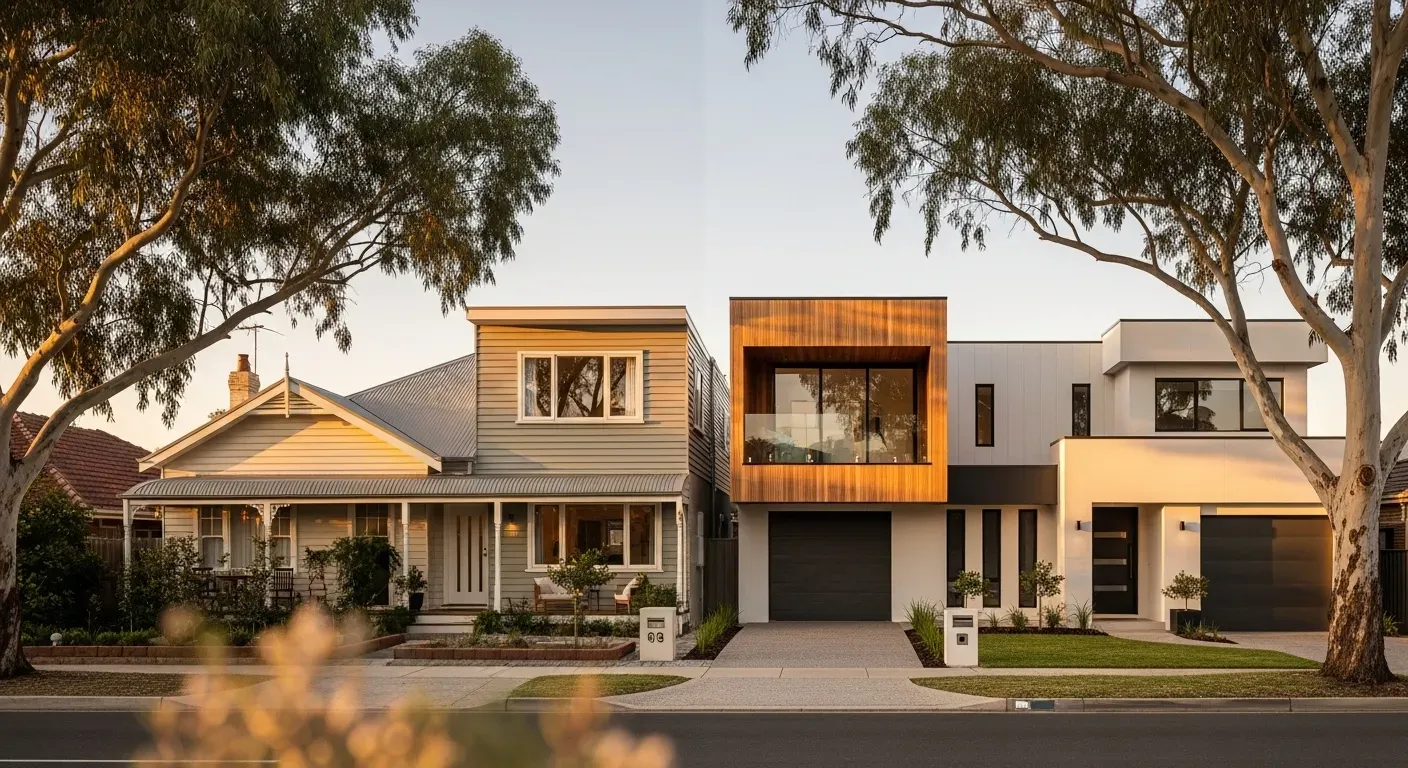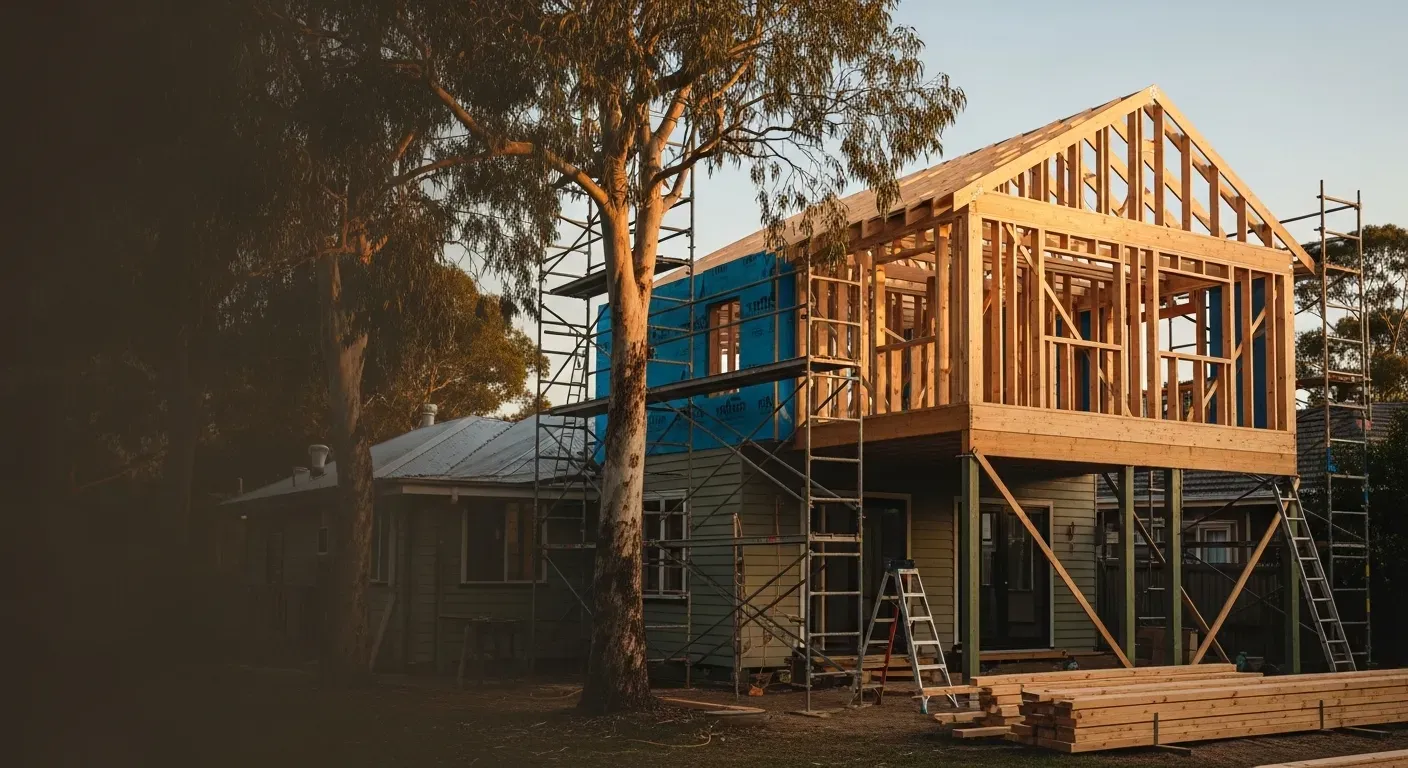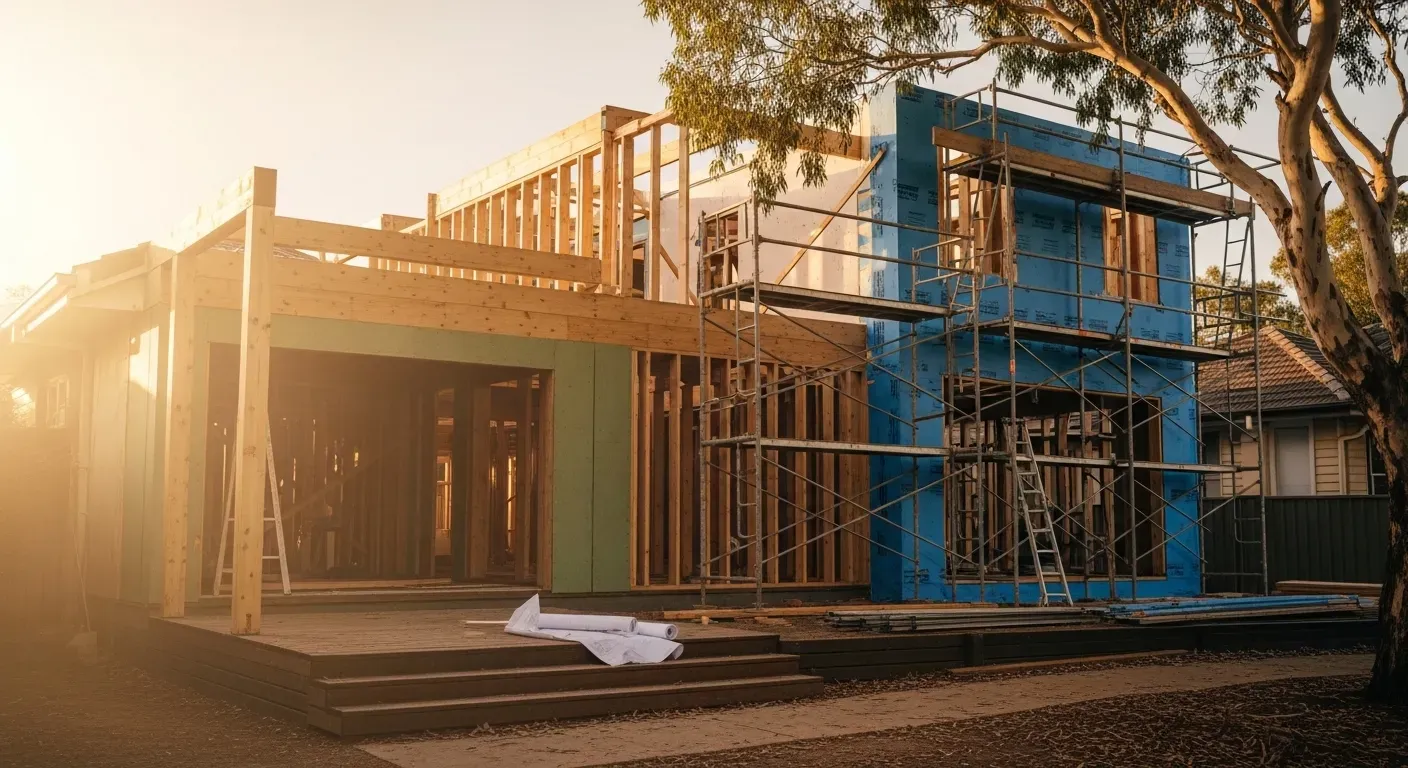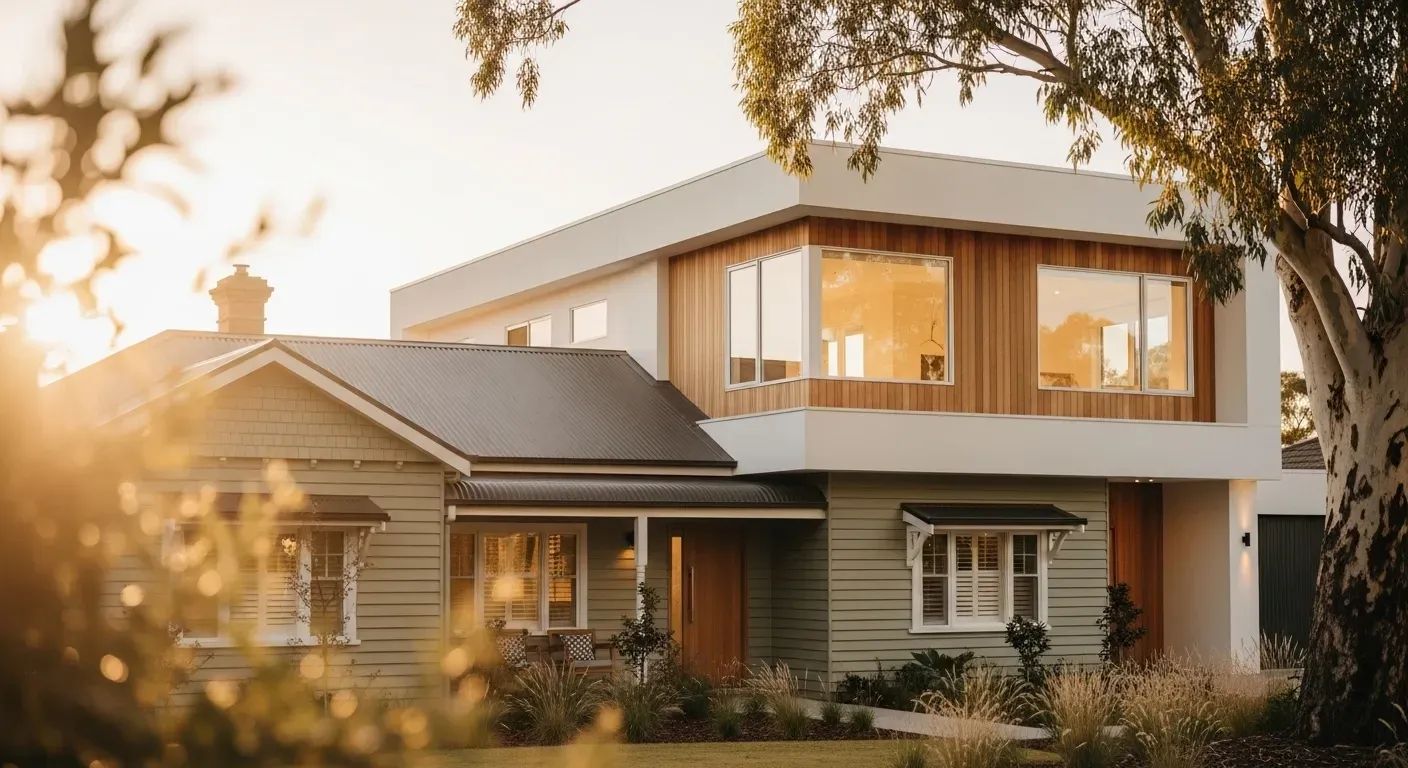
Second Storey Extension Costs by Size Australia 2026: Second storey additions cost $2,500-$4,500 per square metre in Australia with total project costs ranging $150,000-$675,000+ depending on extension size, structural requirements, finishes quality, and location. Cost per square metre includes all elements: structural engineering, foundation work if required, construction materials and labour, staircase installation, internal finishes, external cladding, windows and doors, plumbing and electrical, council fees, and project management. Larger extensions achieve slightly better per-sqm economies through fixed-cost spreading (engineering, staircase, DA costs divide across more area) though total absolute costs increase substantially with size.
Small Second Storey Extension 60 Square Metres $150,000-$270,000: 60sqm addition typically contains 2-3 bedrooms or 1-2 bedrooms plus bathroom creating substantial additional living space. Budget 60sqm extension $150,000-$200,000 at $2,500-$3,300/sqm includes: structural engineering assessment and certification $3,000-$6,000 for foundation evaluation and structural design, foundation strengthening if required $0-$25,000 depending on existing structure (pre-1980 homes often require strengthening), architectural plans and DA submission $8,000-$15,000 for basic design meeting building code minimums, construction materials and labour $90,000-$120,000 for timber frame, brick veneer, basic windows/doors, standard internal finishes, straight staircase installation $15,000-$22,000 for basic carpeted timber stair with balustrade, plumbing and electrical rough-in and fit-off $8,000-$15,000 for basic lighting, power, and heating/cooling if no bathrooms included, council DA fees and inspections $2,000-$4,000, and contingency 10-15% $15,000-$25,000 for unexpected issues or variations. Mid-range 60sqm extension $200,000-$270,000 at $3,300-$4,500/sqm upgrades to: enhanced architectural design $15,000-$25,000 with better aesthetics and spatial planning, quality construction finishes $120,000-$160,000 including quality windows, engineered stone benchtops if bathroom included, premium flooring, feature staircase $22,000-$30,000 with timber treads and modern glass balustrade, comprehensive electrical/plumbing $15,000-$25,000 if ensuite bathroom included adding $20,000-$35,000 for fixtures and tiling, and increased contingency $25,000-$35,000. Small extension typical configuration: 2 bedrooms 3m × 3.5m each (10.5sqm) plus hallway, storage, and circulation totaling 60sqm overall, or 1 bedroom, 1 bathroom, and open study/living area. Timeline: 5-7 months total including 2 months design/DA, 1 week foundation work if required, and 3-4 months construction.
Medium Second Storey Extension 100 Square Metres $250,000-$450,000: 100sqm addition represents substantial family accommodation upgrade typically containing 3 bedrooms, 1-2 bathrooms, and living area or 2 bedrooms, 1 bathroom, and open-plan living/family room. Budget 100sqm extension $250,000-$320,000 at $2,500-$3,200/sqm includes: structural engineering comprehensive assessment $5,000-$8,000 for detailed foundation analysis and structural certification, foundation strengthening typically required for pre-1980 homes $15,000-$35,000 for pier installation or underpinning, architectural plans detailed design $12,000-$20,000, construction materials and labour $150,000-$200,000 for complete shell and basic internal fitout, staircase straight or L-shaped configuration $18,000-$28,000, plumbing and electrical comprehensive $15,000-$30,000 including 1 bathroom rough-in and fixtures, council fees DA submission $3,000-$5,000, and contingency 12-15% $30,000-$45,000. Mid-range 100sqm extension $320,000-$450,000 at $3,200-$4,500/sqm offers: premium architectural design $20,000-$35,000 creating exceptional spatial planning and aesthetic integration, quality construction throughout $200,000-$280,000 with premium external cladding, quality windows/doors, insulation exceeding code minimums, superior internal finishes $280,000-$320,000 including 2 bathrooms with quality fixtures $30,000-$50,000 total, engineered flooring, quality tiles, premium paint, feature staircase timber/glass/steel design $28,000-$40,000, comprehensive services $30,000-$50,000 including ducted heating/cooling zoning and extensive electrical, and enhanced contingency $40,000-$60,000. Medium extension typical configuration: 3 bedrooms (main 4m × 3.5m = 14sqm, two smaller 3m × 3m = 9sqm each), 1 main bathroom 3m × 2.5m = 7.5sqm, hallway and circulation 15sqm, totaling 100sqm providing complete upper-floor accommodation. Timeline: 6-8 months total including 2-3 months design/DA approval, 2 weeks foundation and structural works, and 4-5 months construction with weather delays potential.
Large Second Storey Extension 150 Square Metres $375,000-$675,000+: 150sqm addition creates comprehensive upper-floor living including multiple bedrooms, bathrooms, living areas, and potentially kitchen creating essentially second complete dwelling level. Mid-range 150sqm extension $375,000-$525,000 at $2,500-$3,500/sqm includes: structural engineering detailed assessment $6,000-$10,000, foundation strengthening likely required $20,000-$50,000 for substantial additional load, architectural plans comprehensive design $18,000-$30,000, construction materials and labour $225,000-$330,000 for extensive shell and fitout, staircase substantial design $22,000-$35,000, plumbing and electrical extensive $30,000-$60,000 including 2 bathrooms and kitchen if included, services upgrades likely $10,000-$20,000 for electrical panel upgrade and plumbing capacity, council fees $4,000-$6,000, and contingency 15% $56,000-$79,000. Premium 150sqm extension $525,000-$675,000+ at $3,500-$4,500/sqm delivers: premium architectural design $30,000-$50,000 with exceptional spatial and aesthetic outcomes, superior construction throughout $330,000-$450,000 with high-end external finishes, large windows/doors, comprehensive insulation and soundproofing, luxury internal finishes $450,000-$550,000 including 2 luxury bathrooms $50,000-$80,000 total, premium kitchen if included $40,000-$70,000, engineered timber or natural stone flooring, designer fixtures, feature staircase architectural statement piece $35,000-$60,000 with cantilevered treads or curved design, comprehensive smart home integration $15,000-$30,000 for lighting, climate, security automation, and substantial contingency $70,000-$100,000. Large extension typical configuration: 4 bedrooms (master suite with walk-in robe and ensuite totaling 25sqm, 3 additional bedrooms 12sqm each), 2 bathrooms (main 8sqm, ensuite 5sqm), separate living/rumpus 30sqm, hallway and circulation 20sqm, totaling 150sqm creating fully self-contained upper level. Timeline: 7-9 months total including 3 months design/DA with potential delays for complex designs, 3-4 weeks foundation and structural works extensive, and 5-6 months construction with coordination of multiple trades. Large extension considerations: structural assessment critical as substantial additional load may require extensive foundation work, services upgrades often mandatory with electrical panel replacement $3,000-$8,000 and plumbing capacity increases, temporary accommodation often necessary during construction $20,000-$35,000 for 6-7 month rental given disruption scale, and weather delays more significant given extended construction timeline.
Second Storey Extension Cost Breakdown Australia 2026: Understanding cost allocation across project components helps homeowners budget accurately and identify areas for potential savings or quality upgrades. Typical 100sqm second storey extension ($350,000 total budget) allocates: construction materials and labour 55% ($192,500) for framing, roofing, external cladding, windows/doors, internal linings, flooring, painting, architectural design and DA 15% ($52,500) for plans, engineering, and council approval, structural engineering and foundation work 10% ($35,000) for assessment, certification, and any required strengthening, staircase design and installation 8% ($28,000) for new stair connection between levels, and contingency 12% ($42,000) for unexpected issues, variations, and unforeseen structural requirements. Budget allocation shifts for different price points with premium extensions allocating higher construction percentages (60-65%) due to superior finishes while reducing engineering percentage (8-9%) as fixed costs, and budget extensions maintaining similar percentages though absolute dollar amounts lower across all categories.
Construction Materials and Labour 55% ($137,500-$247,500 for 100sqm): Construction represents largest cost category covering all physical building works from foundation to finishing. Small 60sqm construction $90,000-$160,000 includes: foundation work existing slab preparation or new footings/piers if required $5,000-$15,000, floor framing timber or steel joists spanning existing structure $8,000-$15,000, external walls framing timber frame with brick veneer or weatherboard cladding $15,000-$25,000, roof framing and covering pitched or flat roof with tiles, Colorbond, or membrane $12,000-$22,000, windows and external doors quality double-glazed windows and external door $8,000-$15,000, internal walls framing and plasterboard lining throughout $10,000-$18,000, insulation ceiling and wall insulation meeting energy code requirements $4,000-$8,000, internal doors and hardware quality hollow core or solid doors with handles/locks $3,000-$6,000, flooring carpet, engineered timber, or hybrid throughout $6,000-$12,000, painting internal and external complete paint system $8,000-$15,000, and labour comprehensive for all trades $15,000-$30,000. Medium 100sqm construction $150,000-$280,000 scales proportionally with increased area plus potential quality upgrades. Large 150sqm construction $225,000-$450,000 includes substantial additional materials and labour hours. Construction cost variables: external cladding choice significantly impacts costs with brick veneer $200-$300/sqm, weatherboard $150-$250/sqm, or rendered masonry $250-$400/sqm, window quality with builder-grade aluminium $500-$800 per sqm, mid-range thermally broken aluminium $800-$1,200 per sqm, or premium timber/aluminium composite $1,200-$2,000 per sqm, roofing material with Colorbond steel $80-$150/sqm, concrete tiles $100-$180/sqm, or slate/metal deck $200-$400/sqm, and internal finish quality with builder-grade paint, carpet, and fixtures versus premium finishes adding $500-$1,200 per sqm overall. Labour rates vary by location with Sydney/Melbourne trades $70-$120 per hour versus regional areas $50-$80 per hour creating 20-30% location-based cost difference. Construction timeline 3-5 months for 60-100sqm extensions depending on complexity and weather with winter or wet season adding 2-4 weeks delays.
Architectural Design and DA 15% ($22,500-$101,250 for 100sqm): Professional architectural design and Development Application management ensure compliant attractive design achieving council approval. Design scope includes: initial consultation and site assessment understanding existing structure, homeowner requirements, budget constraints, and regulatory context 4-8 hours at $150-$250 per hour = $600-$2,000, concept design developing 2-3 preliminary design options with floor plans, elevations, and 3D visualisation 20-40 hours = $3,000-$10,000, detailed design refining selected concept into construction-ready plans including structural coordination, services integration, materials specification 40-80 hours = $6,000-$20,000, DA documentation preparing comprehensive submission including plans, elevations, site analysis, shadow diagrams, materials schedule, engineering certificates meeting council requirements 20-40 hours = $3,000-$10,000, DA lodgement and management coordinating submission, responding to council requests for additional information, attending council meetings if required $1,000-$3,000, and construction documentation detailed plans, specifications, and schedules for builder procurement and construction 20-40 hours = $3,000-$10,000. Total architectural fees $16,000-$55,000 for 100sqm extension depending on design complexity and architect experience with budget-conscious homeowners using draftsperson $8,000-$20,000 versus experienced architect $25,000-$55,000. Council DA fees separate: $2,000-$5,000 application fee depending on council and project value, with some councils charging percentage of estimated project value. DA timeline 6-12 weeks for straightforward applications, 12-20 weeks if additional information requested, and 16-24+ weeks for heritage areas or complex sites with neighbor objections potential. Design value-adds: experienced architect optimizes space planning achieving better functionality from same area, ensures design integrates aesthetically with existing dwelling maintaining property value, navigates council requirements efficiently reducing approval delays and potential rejections, and specifies appropriate materials/construction methods avoiding costly changes during build. Design cost savings: using draftsperson instead of architect saves $5,000-$15,000 though may lack design sophistication and council navigation experience, limiting design complexity to simple floor plan extension saves fees versus complex multi-level or curved designs, and DIY DA submission possible for very simple projects saving $3,000-$8,000 though risk of rejection requiring re-submission and delays.
Structural Engineering and Foundation Work 10% ($17,500-$67,500 for 100sqm): Structural engineering assessment and foundation strengthening ensures existing structure safely supports additional second storey load. Engineering scope mandatory: desktop assessment reviewing existing house plans if available, construction type, foundation type, and preliminary load calculations $800-$1,500, site inspection examining foundation condition, structural framing, load-bearing walls, and identifying any existing structural issues $1,000-$2,000, structural calculations analyzing existing capacity versus proposed additional loads including dead loads (structure weight) and live loads (occupancy, furniture, snow if applicable) determining if strengthening required $1,500-$4,000, structural design if strengthening required designing foundation upgrades, additional piers, underpinning, or structural frame modifications $2,000-$5,000, and certification providing engineer's certificate for DA submission and building certifier approval mandatory for all second storey additions $500-$1,000. Total engineering fees $3,000-$8,000 for 100sqm extension assessment and certification even if no strengthening required. Foundation strengthening costs if required: micro-piling or screw piles installing additional deep foundation elements supporting new loads $15,000-$35,000 for typical dwelling, underpinning existing footings increasing depth and width to improve load capacity $20,000-$40,000 for extensive work, slab thickening pour additional concrete over existing slab areas requiring reinforcement $8,000-$20,000 for localized areas, structural steel installation steel beams transferring loads to strengthened foundation points $10,000-$25,000 including fabrication and installation, and internal structural modifications adding or strengthening load-bearing walls/columns distributing loads appropriately $5,000-$15,000. Total foundation strengthening $0 for newer homes built with excess capacity or lightweight second storey design, $15,000-$30,000 for moderate strengthening typical pre-1980 homes, or $30,000-$50,000+ for extensive strengthening required older homes or poor existing foundation condition. Foundation assessment timing: must occur before detailed design finalizes as strengthening requirements may influence layout options and budget, conduct during initial design phase allowing accurate budget and preventing design changes later. Foundation risk factors: homes built pre-1980 typically require strengthening as not designed for additional levels, brick veneer construction handles additional loads better than weatherboard requiring less strengthening, sloping sites may require more extensive foundation work managing uneven loading, reactive clay soils common in Sydney, Melbourne, Adelaide create additional complexity requiring deeper piers or specialized foundations, and any existing foundation cracks, subsidence, or structural movement indicates problems requiring resolution before second storey addition proceeds adding $10,000-$40,000 remediation costs.
Staircase Design and Installation 8% ($12,000-$54,000 for 100sqm): New staircase creates connection between levels representing both functional necessity and significant design element. Staircase configurations: straight staircase simplest design running in single direction typically 3-4 metres horizontal run requiring minimum 3m × 1m floor space allocation both levels, most economical option $15,000-$25,000 installed including timber treads, risers, stringers, handrail, and balustrade meeting Building Code of Australia requirements, L-shaped staircase turns 90 degrees mid-run with landing reducing linear run requirement fitting tighter spaces, requires 2.5m × 2.5m floor space allocation approximately, costs $20,000-$32,000 installed, U-shaped or switchback staircase 180-degree turn with landing achieving smallest floor space footprint approximately 2m × 3m total, costs $25,000-$38,000 due to complex framing and landing construction, spiral staircase circular design with minimum floor space approximately 1.5-2m diameter suitable only where space critically constrained and permitted by building code (often restricted to secondary stairs not primary access), costs $18,000-$30,000 for basic steel or timber design, and feature staircase architectural statement using premium materials (hardwood treads, glass balustrade, steel stringers), cantilevered or floating treads, curved or helical designs creating visual impact, costs $35,000-$60,000+ for custom fabrication and installation. Staircase specifications Building Code: minimum 1000mm clear width between handrails for primary staircase (habitable room access), maximum 190mm riser height and minimum 250mm tread depth (going) for comfortable safe climbing, continuous handrail 865-1000mm height above nosing required both sides if staircase wider than 1000mm, balustrade maximum 125mm gap preventing child falls, and minimum 2000mm headroom clearance throughout stair run. Staircase materials: timber construction using hardwood or pine treads with timber or steel stringers most economical option providing warm aesthetic suitable most architectural styles, steel frame stringers with timber treads creates contemporary industrial aesthetic, glass balustrade instead of traditional timber or metal balusters creates open transparent appearance especially popular modern designs adding $5,000-$12,000 premium over standard balustrade, and concrete staircase poured concrete or precast units suit contemporary designs offering exceptional durability though adding significant weight and cost $30,000-$50,000. Staircase location considerations: positioning near existing hallway or living area minimizes impact on ground floor layout, avoid positioning in middle of rooms disrupting existing functionality, consider ceiling height requirements ensuring 2000mm+ headroom doesn't conflict with ground floor ceiling height or require dropped ceiling reducing room height below, and acoustic separation incorporating sound insulation under stair treads and in walls around stairwell reduces footfall noise transmission $800-$1,500. Staircase value engineering: straight staircase with standard balustrade minimizes costs while meeting all code requirements, selecting carpet instead of exposed timber treads saves $1,500-$3,000 though reduces aesthetic appeal, standard handrail and balustrade rather than custom glass or steel saves $5,000-$12,000, and coordinating staircase position with structural requirements avoiding need for large structural beams/headers in ceiling below saves engineering costs.
Contingency 12% ($18,000-$81,000 for 100sqm): Contingency funds cover unexpected issues inevitably arising during second storey extensions given complexity of modifying existing structures. Typical contingency usage: foundation issues discovered during excavation or structural assessment requiring additional strengthening beyond initial estimates $5,000-$20,000, services upgrades electrical panel capacity insufficient requiring replacement to support additional loads $3,000-$8,000 or plumbing upgrades required $2,000-$6,000, asbestos discovery in pre-1990 homes requiring professional removal if disturbed during construction $3,000-$12,000, hidden structural issues like rotted framing members, rust damage to steel, or previous undetected water damage requiring remediation before proceeding $5,000-$15,000, design variations homeowner-requested changes during construction adding materials and labour $3,000-$15,000, weather delays extending construction timeline beyond scheduled completion increasing labour costs and temporary accommodation if required $2,000-$10,000, and materials price escalation for long projects 6-9 months experiencing price increases during construction $3,000-$10,000. Contingency percentage recommendations: minimum 10% for newer homes (post-1990) with recent structural assessment identifying no issues $35,000 on $350,000 budget, standard 12-15% for typical homes built 1960-1990 with standard foundation strengthening anticipated $42,000-$52,500, and higher 15-20% for older homes pre-1960, heritage properties with complex requirements, or complex designs with many custom elements $52,500-$70,000. Contingency management: retain contingency in separate account not main construction budget preventing spending on non-essential upgrades, require written approval before releasing contingency funds for variations ensuring genuine unforeseen issues not discretionary changes, document all contingency expenditures with receipts and justifications for record-keeping, and resist using contingency for end-of-project upgrades early in build saving for genuine unexpected issues arising late-stage. Contingency unused: if contingency partially or completely unused at project completion (occurs 20-30% of second storey projects), homeowner can apply to end-of-project upgrades like landscaping restoration, furniture, or window furnishings, or return to savings/offset against renovation financing reducing total debt.
Second Storey Extension Cost Variations by Australian City 2026: Location significantly impacts second storey extension costs with major capital cities commanding 15-35% premium over regional areas due to higher labour rates, materials transport costs, council fee variations, and market demand differences. Same 100sqm second storey extension costs $350,000-$450,000 in Sydney, $320,000-$420,000 in Melbourne, $300,000-$400,000 in Brisbane, $280,000-$380,000 in Perth, $270,000-$370,000 in Adelaide, and $250,000-$350,000 in regional Australia representing substantial location-based cost variation requiring careful budgeting based on actual construction location.
Sydney Second Storey Extension Costs $3,500-$4,500 per sqm: Sydney has highest second storey extension costs in Australia. 100sqm extension $350,000-$450,000 reflects: premium labour rates with qualified builders $75-$120 per hour versus $50-$80 regional areas, trad espersons including carpenters, electricians, plumbers charging 20-30% premium, stringent council DA requirements many Sydney councils have complex heritage overlays, tree protection, and design guidelines adding $5,000-$15,000 architectural and consultant fees, extended DA approval times 8-14 weeks in complex councils like Inner West, Northern Beaches, or Waverley adding design and holding costs, materials transport costs premium 10-15% over regional pricing due to congestion, parking restrictions, and crane hire requirements for restricted access sites, and competitive market demand keeping prices elevated. Sydney-specific considerations: heritage areas extensive portions of inner Sydney including Glebe, Paddington, Balmain, Mosman, Hunters Hill have heritage conservation area controls requiring heritage architect involvement $8,000-$20,000 and specific materials/finishes adding 15-25% costs, height restrictions many areas limited to 8.5-9m maximum height requiring careful design ensuring second storey fits within envelope, floor space ratio (FSR) limitations restricting total building area on site potentially limiting second storey size, and bushfire requirements for properties in bushfire-prone areas requiring specific construction standards BAL-12.5 to BAL-40 adding $15,000-$40,000. Sydney council variations: Inner West Council typically 8-12 week DA approval with moderate requirements $3,000-$5,000 fees, Northern Beaches Council 10-14 weeks with stringent design requirements particularly ocean-facing properties $4,000-$6,000 fees, Waverley Council complex heritage controls extended timelines 12-16 weeks $4,000-$7,000 fees, and Hills Shire Council relatively straightforward requirements 6-10 weeks $2,000-$4,000 fees. Sydney cost minimization: select areas with simpler planning controls avoiding heritage areas, schedule construction during off-peak periods winter months negotiating 5-10% labour discounts, and use local builders with established supplier relationships obtaining better materials pricing.
Melbourne Second Storey Extension Costs $3,200-$4,200 per sqm: Melbourne second storey costs slightly below Sydney but substantially above regional Victoria. 100sqm extension $320,000-$420,000 reflects: high labour rates skilled trades $70-$110 per hour with strong union presence maintaining wage floors, comprehensive planning overlays Melbourne's extensive use of Heritage Overlay, Neighborhood Character Overlay, and Significant Landscape Overlay adding complexity and consultant costs $5,000-$12,000, temperate climate with distinct winter requiring weather protection and potential seasonal delays adding costs, and established renovation market competitive pricing with multiple qualified builders. Melbourne-specific considerations: heritage overlays extensive coverage in inner Melbourne suburbs including Carlton, Fitzroy, South Yarra, Toorak requiring heritage statements, materials approvals, and heritage architect involvement $6,000-$18,000, design guidelines neighborhood character policies requiring pitched roofs, specific cladding materials, or setback requirements limiting design flexibility potentially requiring premium solutions, and energy efficiency requirements Victoria's stringent 6-Star energy rating requiring comprehensive insulation, double-glazing, and efficient heating/cooling adding $8,000-$15,000 over basic code compliance. Melbourne council variations: Boroondara Council strong heritage and character controls 10-14 week DA $3,500-$6,000 fees, Port Phillip Council heritage areas with detailed requirements 10-12 weeks $3,000-$5,000, Stonnington Council Toorak/South Yarra areas premium design expectations 8-12 weeks $3,000-$5,500, and Brimbank Council outer western suburbs simpler requirements 6-8 weeks $2,000-$4,000 fees. Melbourne seasonal considerations: winter months June-August create construction challenges with rain delays adding 2-4 weeks timeline and 5-10% costs, optimal construction timing September-March minimizing weather delays though commanding premium pricing 10-15% higher due to demand.
Brisbane, Perth, Adelaide, Regional Costs $2,500-$4,000 per sqm: Brisbane 100sqm extension $300,000-$400,000 at $3,000-$4,000/sqm reflects subtropical climate enabling year-round construction, moderate labour rates $65-$100 per hour, and Brisbane City Council comprehensive planning scheme with generally efficient DA processing 6-10 weeks though heritage suburbs like Ascot, Hamilton, Red Hill have additional requirements. Perth 100sqm extension $280,000-$380,000 at $2,800-$3,800/sqm benefits from isolation creating competitive local market, moderate labour rates $60-$95 per hour, and straightforward planning requirements many Perth councils with relatively simple design guidelines enabling 6-8 week DA approvals. Adelaide 100sqm extension $270,000-$370,000 at $2,700-$3,700/sqm reflects smaller market with competitive pricing, moderate labour rates $55-$90 per hour, and mix of council requirements with Adelaide Hills requiring bushfire compliance while metropolitan councils relatively straightforward 6-10 week DAs. Regional Australia 100sqm extension $250,000-$350,000 at $2,500-$3,500/sqm achieves lowest costs through: reduced labour rates $50-$80 per hour for qualified trades, simpler planning requirements regional councils with less complex overlays and faster DA approvals 4-8 weeks, lower materials costs avoiding metropolitan transport premiums though offset by reduced supplier competition, and lower demand enabling negotiation though limited builder availability in some markets. Regional considerations: trade availability can be limited in smaller regional centers requiring booking 2-4 months ahead or engaging metropolitan builders adding travel costs $2,000-$5,000, materials supply may require ordering from metropolitan suppliers adding delivery costs $1,000-$3,000 and extending lead times, and specialist trades like structural engineers may require travel from larger centers adding $800-$2,000 fees.
Structural Requirements Second Storey Extension Australia: Not all homes can support second storey additions without foundation strengthening, with mandatory structural engineering assessment determining existing capacity versus proposed additional loads. Assessment critical as attempting second storey addition without proper engineering risks catastrophic structural failure, foundation subsidence, and cracking throughout dwelling requiring $50,000-$150,000+ remediation or complete demolition if uncorrectable. Pre-1980 homes typically require $15,000-$50,000 foundation strengthening as originally designed for single-storey loads only.
Foundation Assessment Process $3,000-$8,000 Mandatory: Structural engineering assessment must occur before design finalization determining if existing structure adequate or strengthening required. Assessment phases: initial desktop review examining any available plans, building permits, and documentation understanding construction type, foundation type, and original design loads $500-$1,000, site inspection comprehensive examination of foundation visible portions, footing type (strip, pad, or slab), structural framing load-bearing walls, roof structure, and identifying any existing structural issues (cracks, subsidence, previous damage) $1,500-$3,000, soil assessment understanding soil type, bearing capacity, and reactivity particularly critical in reactive clay areas of Sydney, Melbourne, Adelaide where seasonal moisture variations cause ground movement requiring deeper piers or specialized foundations, may require limited soil testing $500-$2,000 if no existing geotechnical data, structural calculations analyzing existing foundation capacity, load-bearing wall capacity, and roof structure capacity versus proposed additional loads (dead loads from structure materials plus live loads from occupancy, furniture, and environmental loads) determining capacity adequacy or strengthening extent required $1,500-$4,000, and reporting providing detailed structural engineer's report documenting findings, confirming adequacy or specifying required strengthening works, providing structural certification required for DA submission and Building Surveyor approval $500-$1,000. Total assessment $3,000-$8,000 depending on dwelling complexity, age, and structural issues identified. Assessment timing crucial: must occur during early design phase before detailed architectural plans finalized as strengthening requirements may influence layout options (column or wall placement), budget (substantial strengthening requiring redesign to smaller extension or postponement), and feasibility (some dwellings may be unsuitable for second storey if strengthening costs excessive $80,000-$150,000+ making project financially unviable).
Foundation Strengthening Methods $15,000-$50,000 Typical: If assessment determines existing foundation insufficient, various strengthening methods available depending on foundation type, soil conditions, and load increase magnitude. Micro-piling or screw piles install deep foundation elements (3-8 metres depth) bearing on competent soil or bedrock transferring new loads to stable ground bypassing reactive upper soils, suitable for all foundation types and most effective solution for reactive clay soils or substantial load increases, costs $800-$1,500 per pile with typical 60-100sqm second storey requiring 8-15 piles = $12,000-$35,000 total including excavation, pile installation, pile caps connecting to existing footings, and engineer's supervision/certification. Underpinning existing footings increase depth and width of existing strip or pad footings improving bearing capacity supporting additional loads, suitable where existing footings shallow or inadequate bearing area, requires excavating alongside existing footings in sections pouring new concrete extending below existing footing depth increasing width, costs $300-$600 per linear metre of footing with typical dwelling requiring 15-25 metres underpinning both external and internal load-bearing walls = $15,000-$35,000 total. Slab thickening and reinforcement for slab-on-ground foundations pour additional reinforced concrete layer over existing slab areas supporting new load-bearing walls or columns transferring loads to ground, requires existing slab in good condition without significant cracking, costs $150-$300 per sqm with typical 60sqm extension requiring 20-30sqm localized thickening under new walls = $6,000-$15,000. Structural steel framework install steel beams and columns creating independent load path transferring second storey loads to strengthened foundation points or new independent footings bypassing existing structure, allows second storey construction even with marginal existing foundation, costs $8,000-$25,000 for fabrication and installation of steel framework plus $10,000-$25,000 for new independent footings if required = $18,000-$50,000 total. Foundation strengthening variables: reactive clay soils (common Sydney, Melbourne, Adelaide) require deeper piles 5-8 metres versus stable soils requiring 3-5 metres affecting costs $3,000-$8,000, sloping sites require longer piles on downhill side or extensive underpinning adding 20-40% costs, existing foundation damage (cracks, subsidence) requires remediation before strengthening adding $5,000-$20,000, and engineer's certification of completed strengthening mandatory $1,000-$2,500. Strengthening avoidance strategies: lightweight construction using steel frame instead of timber, Colorbond cladding instead of brick veneer, and lightweight roof materials reduces additional load potentially avoiding strengthening saving $15,000-$40,000, smaller extension reduces load magnitude potentially falling within existing capacity though sacrificing desired floor area, or selecting newer homes post-1990 often built with excess foundation capacity anticipating future extensions eliminating strengthening requirements entirely.
Council Development Approval Second Storey Extensions Australia: Development Approval (DA) mandatory for all second storey additions across Australia with no exemptions, requiring comprehensive architectural plans, structural certification, and council assessment before construction commences. DA approval takes 6-12 weeks for straightforward applications, 12-20 weeks for complex or heritage areas, costs $2,000-$5,000 in council fees plus $8,000-$25,000 for architectural plans and consultants. Proceeding without DA approval illegal risking $10,000-$100,000 fines, mandatory work cessation, and potential demolition orders requiring structure removal at owner expense $30,000-$80,000+.
DA Requirements and Documentation: Comprehensive DA submission includes: architectural plans detailed floor plans, elevations (all sides), sections showing relationship to existing structure, roof plan, and site plan showing setbacks, easements, and proposed changes, scaled typically 1:100 with dimensions and materials specifications $8,000-$25,000 depending on design complexity, structural engineering certification letter from structural engineer certifying proposed works structurally sound and compliant with Building Code of Australia including foundation adequacy mandatory for all second storey additions $500-$1,500, site analysis BASIX certificate (NSW), energy efficiency compliance (VIC 6-Star), bushfire attack level assessment if bushfire-prone area, and shadow diagrams showing overshadowing impact on neighboring properties at winter solstice (June) $1,000-$3,000, stormwater management plan showing how additional roof area runoff will be managed preventing neighbor flooding $500-$1,500, materials and finishes schedule specifying external cladding, roofing, windows, colors ensuring council design guideline compliance particularly heritage areas $500-$1,000, and survey plan if property boundaries unclear or setbacks marginal $800-$2,000. Total DA documentation costs $11,000-$35,000 depending on site complexity, council requirements, and consultant involvement. DA submission process: pre-DA consultation optional but recommended discussing proposal with council planner identifying potential issues before formal submission saving redesign costs $300-$800 consultation fee, formal DA lodgment submitting complete application package with council fees 0.5-1.5% of estimated project value typically $2,000-$5,000, council assessment processing period 6-12 weeks with planner reviewing compliance with planning controls, potentially requesting additional information extending timeline 2-6 weeks, public notification period 14-21 days in most councils allowing neighbor comments or objections, potential objections triggering council assessment meeting extending timeline 4-8 weeks and possibly requiring design modifications, and DA approval or conditional approval granted with conditions requiring compliance before Construction Certificate issued.
Height Restrictions and Setback Requirements: Height limits vary by council and zone typically restricting maximum dwelling height 8-9 metres limiting second storey design freedom. NSW height limits typically 8.5-9m in residential zones measured from natural ground level to ridge with some areas like North Sydney allowing 9.5m and heritage areas restricted to 8m or matching existing streetscape heights. VIC height limits typically 9m in residential zones with some councils like Boroondara restricting to 8-8.5m in heritage areas. QLD height limits typically 8.5m in low-density residential zones with some councils allowing 9m. Height measurement complexities: sloping sites measured from natural ground level at front boundary in most councils though some measure from lowest point creating taller allowable height uphill side, pitched roofs measured to ridge point (highest point) requiring careful roof design ensuring compliance, flat roofs measured to parapet top potentially allowing additional ceiling height within same envelope, and variations some councils grant additional height 0.5-1m if architectural merit demonstrated though discretionary requiring strong design justification. Setback requirements: front setback typically matching existing dwelling or minimum 6m from front boundary maintaining streetscape character, side setbacks typically 1-1.5m minimum with some councils requiring increased setback for second storey 2-3m reducing upper-level bulk, rear setback typically 6-8m from rear boundary with reduced setbacks permitted if shadowing analysis shows minimal neighbor impact, and non-compliance requiring redesign reducing floor area or seeking variation approval adding 4-8 weeks and potential refusal risk. Setback planning strategies: aligning second storey within existing ground floor footprint maximizes area while meeting setbacks automatically, modest setback reduction 10-20% often approved if demonstrating design quality and minimal neighbor impact, and substantial setback variations over 20% rarely approved without exceptional circumstances requiring redesign or reducing extension size.
Second Storey Extension Timeline Australia 2026: Complete second storey extension from initial concept to occupation requires 6-9 months total with potential extension to 12 months for complex designs, heritage areas, or projects experiencing weather delays or construction issues. Timeline phases: design and documentation 2-3 months, DA submission and approval 2-3 months, construction preparation and demolition 1-2 weeks, structural and foundation works 2-4 weeks if required, construction framing, roofing, cladding, services, fit-out 4-6 months weather-dependent, and final inspections and occupation certificate 1-2 weeks. Homeowners must plan for extended disruption period with most families remaining in dwelling during construction though expecting significant noise, dust, and inconvenience for 4-5 months, or choosing temporary relocation $15,000-$30,000 for 6-month rental particularly families with young children or elderly members sensitive to construction disruption.
Design and DA Phase 4-6 Months Combined: Design development 2-3 months includes initial consultation and briefing 1-2 weeks, concept design development 3-4 weeks with 2-3 options presented, concept refinement and selection 1-2 weeks, detailed design and documentation 6-8 weeks, and consultant coordination engaging structural engineer, energy assessor, any other specialists 2-4 weeks occurring concurrently. DA submission and approval 2-3 months includes submission preparation finalizing documentation and lodging application 1-2 weeks, council assessment period standard processing 6-8 weeks though extending 10-14 weeks if additional information requested, public notification and comment period 2-3 weeks concurrent with assessment, and approval issuance receiving DA approval or conditions 1 week. DA timeline variables: simple straightforward extension in non-heritage area with no neighbor objections achieves 6-8 week approval, complex designs with heritage considerations or non-compliances requiring variations extend to 10-14 weeks, neighbor objections trigger council meeting assessment adding 4-8 weeks, and substantial non-compliances may result in refusal requiring redesign and resubmission adding 3-6 months total project timeline.
Construction Phase 4-6 Months: Foundation and structural works 2-4 weeks if required includes excavation and pile installation 1-2 weeks, underpinning or slab works 1-2 weeks, and structural steel installation if required 1 week. Framing and roofing 6-10 weeks includes floor framing installation 1-2 weeks, external wall framing erection 2-3 weeks, roof framing installation 1-2 weeks, roof covering tiles or metal 1-2 weeks, and window and door installation 1-2 weeks creating weatherproof shell. Internal fit-out 8-12 weeks includes internal wall framing and lining 2-3 weeks, electrical and plumbing rough-in 1-2 weeks concurrent with wall framing, insulation installation 1 week, plasterboard installation and stopping 2-3 weeks including drying time, internal door and hardware installation 1 week, flooring installation carpet, timber, or tiles 1-2 weeks, kitchen and bathroom installation if included 2-4 weeks, painting interior and exterior 2-3 weeks, electrical and plumbing fit-off fixtures, switches, taps 1 week, and final cleaning and defect rectification 1 week. Total construction 16-26 weeks (4-6 months) for 60-100sqm extension depending on complexity, finishes quality, and weather delays. Construction timeline variables: winter or wet season extends timeline 2-4 weeks due to rain delays preventing external work and drying delays for wet trades, complex designs with curved walls, multiple bathrooms, or custom features add 2-4 weeks, premium finishes requiring specialized trades or custom fabrication add 2-3 weeks, and good builder scheduling with trades coordinated efficiently minimizes delays while poor coordination creates downtime extending timeline 20-30%.
Second Storey Extension Return on Investment Australia: Second storey additions typically add $200,000-$400,000+ property value depending on location, execution quality, and local market conditions, achieving 60-80% cost recovery on $250,000-$400,000 projects. Value addition not primary motivation for most families undertaking extensions (lifestyle improvement and avoiding relocation costs usually drive decision) though understanding ROI helps inform investment decision comparing extension versus buying larger dwelling or relocating.
Property Value Addition $200,000-$400,000+: 100sqm second storey extension costing $300,000-$400,000 typically adds $200,000-$350,000 property value in metropolitan markets achieving 60-85% cost recovery depending on: location with metropolitan areas achieving better returns 70-85% versus regional areas 55-70%, dwelling type and suburb character with second storey extensions fitting naturally in areas with mix of single and double storey homes versus appearing over-developed in predominantly single-storey neighborhoods reducing value recovery, execution quality with professional design and quality finishes achieving 75-85% recovery versus budget extensions with poor aesthetics achieving 50-65%, and local market conditions with strong growth markets achieving better recovery 75-85% versus stagnant markets 55-70%. Value addition examples: transforming 3-bedroom single-storey to 5-bedroom double-storey in established Sydney suburb adds $300,000-$450,000 value on $350,000-$450,000 investment = 85-100% recovery, similar extension in regional NSW adds $180,000-$280,000 value on $280,000-$350,000 investment = 65-80% recovery, and poorly executed extension with design quality or finish issues may add only $150,000-$250,000 on $300,000 investment = 50-70% recovery. Over-capitalization risk: spending $500,000+ on second storey extension on dwelling in suburb where typical double-storey sales $900,000-$1,100,000 creates over-capitalization with extension unlikely recovering full cost, versus spending $350,000 in suburb where double-storey dwellings sell $1,200,000-$1,500,000 likely achieving 70-90% cost recovery as final value within market expectations. ROI improvement strategies: focus on functional layout adding bedrooms, bathrooms, living space valued by market rather than specialty rooms (gyms, theatres) with limited appeal, invest in quality design creating aesthetic integration with existing dwelling, use quality materials and finishes ensuring durability and appeal though avoiding over-specification beyond suburb norms, and maintain existing character contributing to streetscape rather than creating incongruous addition.
Cost Comparison Extension versus Moving: Extension economic analysis must consider relocation alternative costs and benefits. Moving costs alternative: real estate agent fees 1.8-2.5% of sale price on $900,000 dwelling = $16,000-$22,500, conveyancing and legal fees $1,500-$3,000, mortgage discharge fees $300-$800, removalist costs $2,000-$5,000 depending on dwelling size and distance, purchasing new property conveyancing $1,500-$3,000 plus stamp duty 3-5.5% on $1,200,000 property = $36,000-$66,000, and connection costs utilities, internet, changing address $500-$1,500. Total relocation costs $58,000-$100,000+ before considering purchase price premium for larger dwelling. Extension benefits versus moving: remaining in established neighborhood maintaining school enrollments, social networks, commute times, avoiding relocation transaction costs $58,000-$100,000 reinvested in extension creating better value, avoiding need to find suitable larger dwelling in desired location which may be scarce or unaffordable, and controlling design outcomes creating custom spaces meeting exact family requirements versus compromise accepting existing dwelling limitations. Extension versus moving decision factors: if suitable larger dwelling costs $1,200,000 versus current dwelling value $900,000 requiring $300,000 additional equity plus $58,000-$100,000 transaction costs = $358,000-$400,000 total, compare to extension cost $250,000-$350,000 achieving similar space and amenity making extension financially advantageous, though if neighborhood unsuitable long-term (poor schools, long commutes, limited services) relocation may be preferred despite higher costs achieving lifestyle improvement extension cannot provide. Financial analysis: extension financed through refinancing existing mortgage accessing equity at 3.5-4.5% interest adding $10,000-$15,000 annual interest cost versus new purchase requiring larger mortgage and potential mortgage insurance if deposit under 20% adding $15,000-$25,000 annual costs making extension financially advantageous particularly if existing low-rate mortgage retained. Non-financial extension benefits: avoiding moving stress and disruption particularly for families with school-age children, maintaining established garden and outdoor spaces, preserving emotional connection to family home, and avoiding uncertainty of dwelling hunting in competitive markets.
Second Storey Extension Services Coverage Australia 2026: Professional architects, structural engineers, registered builders, and specialist second storey extension companies available across all Australian capital cities and major regional centers including Sydney, Melbourne, Brisbane, Perth, Adelaide, Canberra, Gold Coast, Newcastle, Wollongong, Sunshine Coast, Geelong, Hobart, Townsville, Cairns, Bendigo, Ballarat, and Toowoomba. Metropolitan areas have extensive builder choice enabling competitive pricing and quality selection, while regional centers have qualified builders though potentially limited choice requiring booking 2-4 months ahead. Structural engineering services available all major centers with metropolitan-based engineers servicing regional areas at additional travel costs $800-$2,000. Architectural services similarly widespread though regional homeowners sometimes engage metropolitan architects for complex or high-quality designs accepting travel costs $1,500-$3,000.