Fibreglass Pool Installation Costs Australia 2026: Most popular choice for families. Small pools under 6 metres $25,000-$35,000 including shell, excavation, installation, plumbing, filtration, electrical, basic paving. Medium pools 6-8 metres (most common size) $35,000-$50,000 complete turnkey. Large pools over 8 metres $45,000-$60,000 with premium equipment. Installation time 1-2 weeks from excavation to swimming. Lifespan 25+ years with minimal maintenance. Smooth non-porous surface prevents algae growth. Annual maintenance costs $1,200-$2,500 including chemicals, electricity, servicing. Pre-made shells delivered to site, craned into excavated hole, plumbed and backfilled. Limited to manufacturer shapes and sizes. Best for: Standard budgets $25k-$60k, fast installation needed, low ongoing maintenance preferred, standard rectangular/kidney/freeform shapes acceptable.
Concrete Pool Installation Costs Australia 2026: Fully customizable premium option. Small pools under 6 metres $35,000-$50,000 with pebble or tile finish. Medium pools 6-8 metres $50,000-$75,000 with quality finishes and standard features. Large/premium pools over 8 metres $75,000-$150,000+ with luxury finishes, infinity edges, water features, spa jets. Construction time 8-12 weeks: excavation 1-2 days, steel reinforcement 2-3 days, shotcrete/gunite spraying 1 day, curing 28 days, plumbing/electrical 1 week, tiling/pebbling 1-2 weeks, filling and startup 2-3 days. Lifespan 50+ years with proper maintenance. Higher maintenance requirements: acid wash annually $300-$500, retiling every 10-15 years $8,000-$15,000, replastering every 10-15 years $5,000-$12,000. Annual running costs $1,800-$3,500. Unlimited design possibilities including custom shapes, beach entries, infinity edges, integrated spas, vanishing edges. Best for: Custom designs wanted, unlimited budgets $50k-$150k+, can wait 8-12 weeks, premium properties, unique shapes/features required.
Vinyl-Lined Pool Installation Costs Australia 2026: Budget-friendly option with lowest upfront cost. Small pools under 6 metres $20,000-$30,000 with modular panel walls, standard vinyl liner, basic filtration equipment. Medium pools 6-8 metres $28,000-$38,000 with quality panels and mid-range liner patterns. Large pools over 8 metres $35,000-$45,000 with heavy-duty liner and premium equipment. Installation time 3-6 weeks: excavation 1-2 days, panel assembly 3-5 days, liner installation 2-3 days, plumbing/electrical 1 week, filling and finishing 1 week. Liner replacement required every 7-10 years costing $5,000-$8,000 (major ongoing expense). Liner vulnerable to punctures from sharp objects, pets, pool toys. Lifespan 10-15 years before full replacement needed. Annual maintenance costs $1,000-$2,000. Limited to rectangular or simple curved shapes. Best for: Tightest budgets $20k-$45k, DIY-friendly homeowners (can install panels yourself), okay with liner replacement every decade, difficult sites where fibreglass delivery impossible.
Pool Installation Costs by Australian City 2026: Significant regional price variations due to labour rates, regulations, site access, competition levels. Base example: 7m fibreglass pool $45,000 national average.
Sydney Pool Costs: Most expensive market in Australia, 20-30% above national average. $45,000 pool costs $54,000-$58,500 in Sydney. Reasons for premium: Highest labour rates ($80-$120/hour vs $60-$90 regional), strictest council regulations requiring additional documentation, difficult site access in established suburbs (narrow streets, heritage areas, sloping blocks), higher insurance and licensing costs, longer council approval times (4-8 weeks CDC, 8-16 weeks DA). Excavation more expensive due to rock ($8,000-$20,000 extra common in North Shore, Eastern Suburbs), crane access often required ($3,000-$6,000) for narrow driveways. Premium suburbs (Mosman, Vaucluse, Double Bay) can see 40-50% premiums for high-end concrete pools. Most affordable Sydney regions: Western suburbs (Penrith, Campbelltown) 10-15% cheaper than inner Sydney but still above national average.
Melbourne Pool Costs: Second most expensive market, 15-25% above national average. $45,000 pool costs $51,750-$56,250 in Melbourne. Higher labour rates, weather delays common (installation slower in winter), strict council permits in heritage areas, sloping blocks common requiring retaining walls ($10,000-$25,000). Regional Melbourne (Geelong, Mornington Peninsula) 5-10% cheaper than metro. Best installation season: November-March to avoid winter weather delays. Climate considerations: More pool owners install heating ($5,000-$10,000) making total ownership costs higher.
Brisbane/Gold Coast Pool Costs: Slightly above average, 10-15% above national. $45,000 pool costs $49,500-$51,750. Highest pool ownership rates in Australia (warm climate year-round use). More competition among builders keeps prices moderate. Year-round installation possible. Council approvals generally faster (2-3 weeks CDC). Pool heating less common (saves $5k-$10k). Most popular market for fibreglass pools due to climate. Ipswich, Logan, northern Gold Coast 5-10% cheaper than Brisbane CBD.
Perth/Adelaide Pool Costs: At or slightly below national average, $43,000-$47,000 for standard pool. Lower labour rates than eastern capitals. Less competition among builders (fewer quotes available). Sandy soil easier to excavate (saves $1,000-$3,000 vs rock). Year-round mild climate allows flexible installation timing. Perth advantage: High groundwater in some areas can reduce excavation costs. Adelaide advantage: Very competitive market with many established builders.
Regional Australia Pool Costs: Most affordable, 10-20% below national average. $45,000 pool costs $36,000-$40,500 in regional areas. Lower labour rates ($50-$75/hour vs $80-$120 metro), less stringent council requirements, easier site access (larger blocks, no parking restrictions), lower overheads for builders. Challenges: Fewer builders available (less competition), longer wait times (2-6 months booking), limited service for repairs/maintenance, potential travel charges if builder from distant town ($500-$2,000). Best regional markets: Coastal NSW (Newcastle, Wollongong, Central Coast), coastal QLD (Sunshine Coast, Townsville), regional VIC (Ballarat, Bendigo). Most expensive regional: Tourist areas (Byron Bay, Noosa) approach metro pricing.
Complete Pool Installation Cost Breakdown (based on typical 7m fibreglass pool $45,000 total): Pool shell and delivery $18,000 (40% of total cost) - includes fibreglass shell manufacturing, quality control, freight delivery to site, crane hire for placement. Excavation and site preparation $6,750 (15%) - bobcat/excavator hire, soil removal (15-25 cubic metres), site leveling, base preparation with sand/gravel, waste disposal fees. Pool equipment and filtration system $4,500 (10%) - pump (single or variable speed), sand/cartridge filter, chlorinator or salt system, auto-cleaner, test kit, startup chemicals. Plumbing and pipework $3,600 (8%) - PVC pipes 40-50mm diameter, skimmer box, return jets, main drain, vacuum point, pressure testing, backfill and compaction. Electrical work and safety switches $2,700 (6%) - licensed electrician, pool pump circuit, lighting circuit, mandatory RCD safety switch, weatherproof switchboard, compliance certification. Pool fencing $4,500 (10%) - glass or aluminium fencing 1.2m height meeting AS1926, self-closing gate, magnetic latch, corner posts, council inspection fees. Basic paving or decking $4,950 (11%) - concrete paving 1.5-2m surrounds, basic finish (exposed aggregate/brushed concrete), formwork, reinforcement, edging, minimal decorative elements.
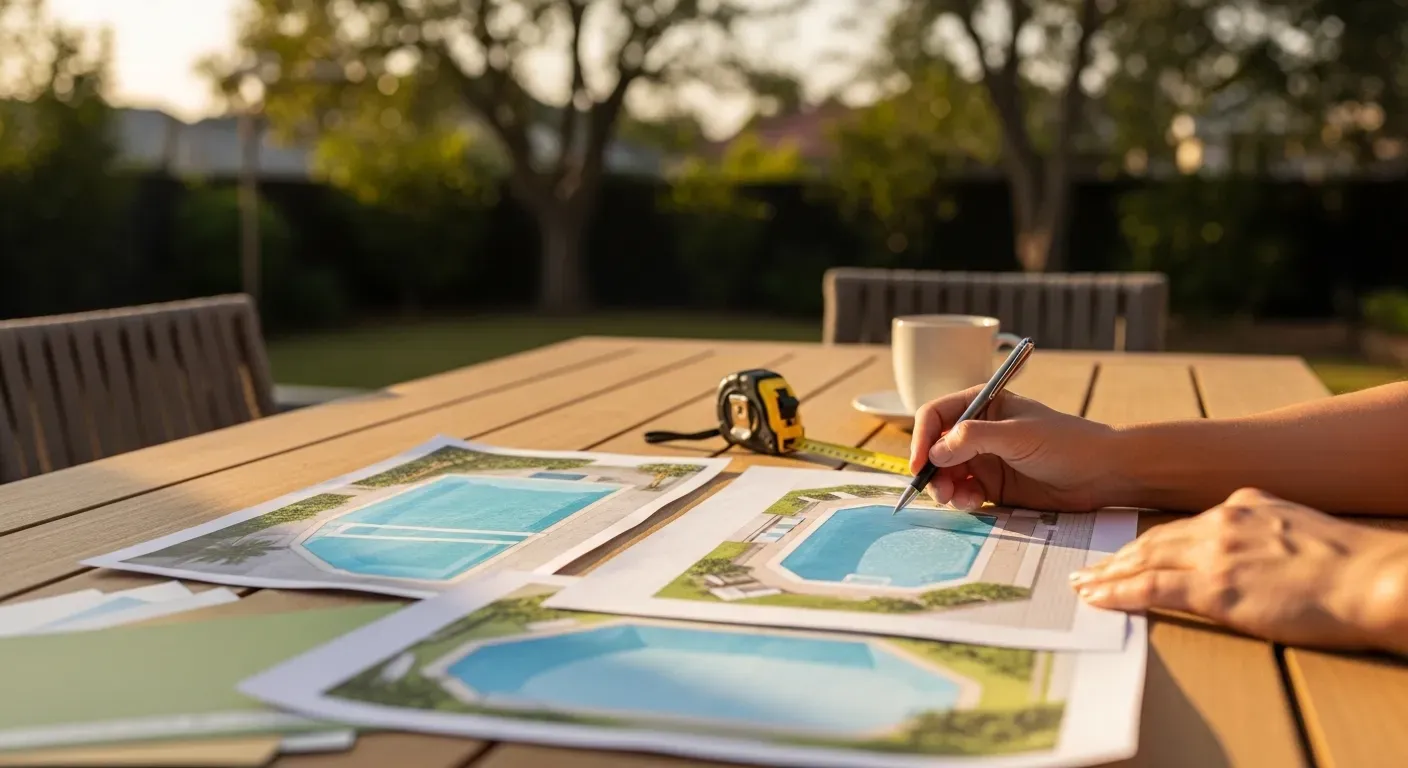
Cost Elements Often Excluded from Base Quotes (adds $10,000-$30,000+): Pool fencing not included in 30-40% of quotes (adds $2,000-$8,000 depending on glass vs aluminium). Premium paving/decking beyond basic surrounds (adds $5,000-$20,000 for travertine, bluestone, timber decking, wider areas). Landscaping restoration after installation (adds $2,000-$8,000 for lawn repair, garden beds, retaining walls). Heating system (adds $3,000-$10,000 gas/heat pump/solar). Salt chlorinator upgrade from basic chlorine system (adds $1,200-$2,500). LED colour-changing lighting (adds $800-$2,000). Water features like jets, waterfalls, fountains (adds $1,500-$5,000). Automatic pool cover (adds $8,000-$15,000). Pool blanket roller basic system (adds $300-$800). Premium finishes for concrete pools: glass tiles add $15,000-$30,000, pebble finishes add $8,000-$15,000. ALWAYS request itemised quotes showing exactly what's included vs excluded to compare accurately between builders.
Fibreglass Pool Installation Timeline: Total 1-2 weeks from excavation to swimming. Day 1: Site marked, services located (Dial Before You Dig), excavation completed (6-8 hours), base prepared with compacted sand/gravel. Day 2: Shell delivered and craned into position (2-3 hours), leveling checked, initial backfill started. Days 3-4: Plumbing connections installed (return jets, skimmer, main drain), electrical conduits laid, backfill completed in layers with compaction. Days 5-6: Equipment installation (pump, filter, chlorinator), electrical connections by licensed electrician, safety switches installed. Days 7-10: Fencing installation (glass/aluminium), basic paving poured and curing, council fencing inspection. Days 11-14: Pool filled (1-2 days filling depending on water pressure), water chemistry balanced, equipment commissioned, handover and training. Ready to swim: Day 14 typical. Delays possible: Rock excavation adds 1-3 days, wet weather adds 3-7 days, council inspection delays add 1-2 weeks, crane access issues add 1-2 days.
Concrete Pool Construction Timeline: Total 8-12 weeks from excavation to swimming. Week 1: Excavation, steel reinforcement cage installed, plumbing pipes laid, inspections. Week 2: Shotcrete/gunite spraying (1 day process), initial curing begins. Weeks 3-5: Concrete curing period (cannot rush, requires 28 days minimum for full strength), kept damp, no work possible during curing. Week 6: Waterproofing applied, surface preparation for finishes. Week 7-8: Tiling or pebble finish application (labour-intensive, 5-10 days), grout curing, cleaning. Week 9: Equipment installation (pump, filter, heating if included), electrical work, automated systems if luxury pool. Week 10: Fencing installation, paving/decking around pool perimeter. Week 11: Filling (2-3 days), acid wash to remove cement residue, water balancing. Week 12: Startup, chemistry balancing, handover. Premium pools with complex features (infinity edges, integrated spas, elaborate tiling) take 12-16 weeks. Winter builds add 2-4 weeks due to slower curing in cold weather.
Vinyl-Lined Pool Installation Timeline: Total 3-6 weeks from start to swimming. Week 1: Excavation, footing poured for panel walls, base leveling. Week 2: Modular wall panels assembled and bolted together, bracing installed, plumbing through walls. Week 3: Bottom prepared (vermiculite/sand base smoothed), liner ordered to exact measurements (custom-made). Week 4-5: Liner arrives, installed starting at corners working around perimeter, vacuum sealed to remove wrinkles, coping installed around edges. Week 6: Equipment connected, filling begins, final adjustments, water chemistry, fencing, basic paving. Shorter timeline than concrete but longer than fibreglass due to custom liner manufacturing (2-3 weeks) and careful installation process to avoid wrinkles/folds.
Additional Timeline Factors All Pool Types: Council approval before starting work: Complying Development Certificate (CDC) 2-4 weeks for standard pools meeting criteria (most common in NSW, QLD). Development Application (DA) 6-12 weeks if CDC not applicable, heritage areas, large pools over 50sqm, or complex sites. Building approval required all states: 1-2 weeks if no structural concerns. Weather delays: Winter installation adds 1-3 weeks (Melbourne, Sydney, Adelaide most affected). Summer storms delay concrete curing 3-7 days. Site complications: Rock excavation adds 1-5 days ($5,000-$15,000 extra cost). High water table requires dewatering pumps adds 2-4 days. Asbestos discovered requires specialist removal adds 1-3 weeks ($3,000-$10,000+). Limited access requiring hand digging adds 3-7 days. Builder availability: Peak season (September-February) wait times 8-16 weeks. Off-season (March-August) can start within 2-4 weeks.
Rock Excavation Costs: Standard soil excavation included in base quotes (soft clay, sand, loam). Rock excavation $5,000-$15,000 extra depending on depth and hardness. Sandstone (common Sydney North Shore, Northern Beaches) $8,000-$15,000 for typical pool. Shale/mudstone $5,000-$10,000. Solid granite/basalt $12,000-$20,000 (rare, extremely expensive). Rock assessment: Get geological survey before quoting if in rocky area ($300-$600). Excavation methods: Mechanical rock saw for layered rock. Hydraulic hammer attachment on excavator. Rock-breaking chemical agents (slower, cheaper). Hand tools (extremely expensive due to labour). Jackhammer (residential-scale rock). Avoid blasting in residential areas (too disruptive, expensive permits).
Sloping Site Costs: Gentle slopes under 1:10 gradient add $8,000-$15,000 for small retaining wall (1-2m height), basic engineering. Moderate slopes 1:10 to 1:5 add $15,000-$25,000 for engineered retaining wall (2-3m height), structural certification, additional excavation. Steep slopes over 1:5 add $25,000-$50,000+ for major retaining wall (3-5m+ height), geotechnical engineering, piers/footings, significant additional excavation and backfill. Design opportunities on slopes: Infinity edge pools ($20,000-$40,000 premium) work beautifully on slopes, creating stunning visual effect. Raised pool design with deck overlooking view. Split-level pool/spa combination. Cost savings on slopes: Less excavation spoil to remove downslope side. Natural privacy from elevation. Better drainage naturally. Considerations: Engineering required for retaining walls over 1m height. Soil stability assessment critical ($500-$1,500). Access for machinery more difficult (may require smaller equipment = more time/cost).
Limited Access Sites Costs: Standard access: 3m+ wide driveway, straight path to backyard, no overhead obstructions - no extra cost. Narrow access 2-3m wide adds $500-$1,500 for smaller excavator rental (slower work). Very narrow access under 2m requires hand excavation OR crane lift over house: Hand excavation adds $5,000-$12,000 (extremely labour-intensive). Crane lift over house adds $2,000-$5,000 for crane hire (4-6 hours), suitable for fibreglass shells only, requires street access for crane, council permits for road closure ($200-$500). Elevated/difficult sites: Upper floor apartments/townhouses - fibreglass impossible, vinyl possible with panels craned, concrete possible but expensive. Excavation through house (remove section of fence/wall) adds $3,000-$8,000 for demolition and rebuilding. Heritage homes where wall removal prohibited may make pool installation impossible. Always get site inspection before quoting to identify access constraints.
Council Permits and Approval Costs: CDC (Complying Development Certificate) $500-$1,500 in NSW for standard pools meeting criteria: setbacks from boundaries (typically 1m minimum), pool fencing compliance AS1926, standard depth and size. Fast-tracked approval 2-4 weeks. DA (Development Application) $1,500-$4,000 for complex pools: larger than 50sqm, heritage areas, bushfire zones, waterfront properties, slopes over 1:5. Approval takes 6-12 weeks. Building approval all states $300-$800 after council approval obtained. Mandatory inspections during construction: Excavation inspection before concrete pour, reinforcement inspection before shotcrete, fencing inspection before occupation, final compliance certificate. Failed inspections require rectification work and re-inspection ($150-$300 per re-inspection). Non-compliance penalties: Installing pool without approval $5,000-$10,000 fines + rectification orders. Non-compliant fencing $1,000-$3,000 fines + cannot use pool until compliant. Building without licensed builder $10,000-$50,000 penalties in most states.
Pool Heating Systems Australia 2026: Gas heating $3,000-$6,000 installed for natural gas or LPG heater. Pros: Heats pool fastest (2-4 degrees per hour), on-demand heating, works in any weather. Cons: Running costs $500-$1,500/year gas bills, requires gas connection ($1,000-$3,000 if not existing), 5-10 year equipment lifespan. Best for: Weekend heating, rapid temperature boost, pools under 40,000L. Heat pump (electric) $5,000-$10,000 installed for reverse-cycle air-to-water system. Pros: Most energy efficient, running costs $300-$800/year electricity, works year-round, 10-15 year lifespan. Cons: Slower heating (0.5-1 degree per hour), ineffective under 10°C ambient, high upfront cost. Best for: Regular year-round use, pools 40,000-80,000L, environmentally conscious. Solar heating $4,000-$8,000 installed for roof-mounted solar panels (typically 50-100% of pool surface area). Pros: Lowest running costs $0-$200/year (pump electricity only), environmentally friendly, 15-20 year panel lifespan, government rebates available some states ($500-$1,500). Cons: Only works in sunny weather, requires north-facing roof space 30-50sqm, slower heating, ineffective winter cloudy days. Best for: Summer-only use, Brisbane/Perth climates, large roof area available, long-term ownership.
Pool Covers and Blankets: Manual bubble cover (solar blanket) $200-$600 for basic UV-resistant plastic bubbles, lightweight. Benefits: Reduces water evaporation 90%, retains heat overnight (2-4 degrees), prevents leaf/debris entry. Drawbacks: Manual removal daily (heavy when wet), 2-4 year lifespan, storage when not in use. Roller system for blanket $300-$800 makes manual cover easier to deploy. Automatic slatted cover $8,000-$15,000 motorized system with rigid slats. Benefits: One-button operation, strongest pool safety barrier (holds adult weight), best insulation, longest lifespan 10-15 years, security from child access. Drawbacks: Expensive upfront, requires track installation in pool coping, maintenance of mechanical parts, not suitable for all pool shapes. Thermal pool cover $800-$2,000 for thick insulated bubble cover. Benefits: Superior heat retention (4-6 degrees overnight), reduces heating costs 50-70%, durable 4-6 years. Combined savings: Pool cover (any type) reduces annual heating costs 50-70%, saves 30-50% on chemicals (less evaporation/debris), reduces pump running time 20-30%, saves 10,000-15,000L water/year evaporation. Investment pays back within 2-4 years through savings.
Pool Lighting Options: Basic halogen lights $300-$600 single light included in most pool quotes. White light only, 2-3 year bulb lifespan, higher electricity use. LED lighting upgrade $800-$2,000 for colour-changing lights (2-4 lights typical). Benefits: 16 colour options, programmable sequences, 50,000+ hour lifespan (10-15 years), 75% less electricity than halogen, remote control operation. Installation considerations: Must install during construction (expensive retrofit), 12V low-voltage requires transformer, multiple lights for even illumination. Fibre optic lighting $2,000-$5,000 premium option with remote light source and fibre strands. Benefits: Safest (no electricity near water), most colour options, create underwater stars effect, 20+ year lifespan. Best for luxury pools. Underwater LED strips $1,200-$3,000 perimeter lighting around pool edge. Creates ambient mood lighting. Landscape lighting around pool area $800-$3,000 for pathway lights, uplighting trees, deck illumination. Enhances safety and aesthetics.
Water Features and Entertainment: Spa jets/hydrotherapy jets $1,500-$5,000 for 4-8 jets installed in pool bench/corner. Includes pump, plumbing, air controls. Waterfalls and spillways $2,000-$8,000 depending on complexity: Sheet waterfall from raised wall $2,000-$4,000, rock waterfall feature $4,000-$8,000, spillway bowl $3,000-$6,000. Deck jets (laminar jets) $800-$2,000 for 2-4 jets creating arching water streams. LED-lit jets add $500-$1,000. Swim jets/resistance swimming $3,000-$8,000 for counter-current system allowing swimming in place. Excellent for lap pools, training. Bubblers and fountains $600-$2,000 for in-floor jets or decorative fountain heads. Pool slide $1,200-$5,000 depending on size: Kids' slide 1-2m $1,200-$2,500, family slide 3-4m $2,500-$5,000, custom rock slide $8,000-$20,000. Diving board $800-$3,000 requires minimum 2.4m depth (limits pool design). Basketball/volleyball set $200-$800 for removable poolside games. All water features increase pool complexity, maintenance requirements, and running costs (additional pumps/electricity).
Annual Pool Running Costs Australia 2026: Fibreglass pools most economical $1,200-$2,500/year total. Breakdown: Chemicals $300-$600/year (chlorine/salt, pH balancers, algaecides, shock treatment, test kits), electricity for pump/filter $350-$800/year (variable speed pumps save 40-60%), water for evaporation top-ups $150-$300/year (10,000-15,000L/year lost to evaporation), servicing and minor repairs $200-$500/year (filter cleans, equipment checks, gasket replacements), equipment replacement reserve $200-$400/year averaged (pump 7-10 years $800-$1,500, chlorinator 5-7 years $600-$1,200, filter 10-15 years $500-$1,000). Concrete pools higher maintenance $1,800-$3,500/year includes all above PLUS acid washing annually $300-$500 (remove calcium buildup, staining), more chemicals due to porous surface, higher electricity (larger pumps needed). Vinyl pools moderate $1,400-$2,200/year similar to fibreglass but add liner replacement reserve $500-$800/year averaged (replacement every 7-10 years costs $5,000-$8,000).
Major Maintenance Costs (Periodic): Concrete pool resurfacing every 10-15 years: Pebble surface re-application $8,000-$15,000, tile replacement $12,000-$25,000, plaster resurface $5,000-$12,000. Delays deterioration, prevents leaks, refreshes appearance. Vinyl liner replacement every 7-10 years $5,000-$8,000: Pattern/colour choices, measure and custom-make, drain pool completely, remove old liner, install new liner, refill and balance. Pool equipment replacement: Pump replacement $800-$1,500 every 7-10 years (variable speed pumps cost more but save 50-70% electricity), filter replacement $500-$1,000 every 10-15 years, chlorinator/salt cell $600-$1,200 every 5-7 years, heater replacement $3,000-$8,000 every 10-15 years. Pool fencing maintenance: Glass panel replacement $300-$800 per panel if broken, gate hinge/latch replacement $100-$300 every 5-10 years, aluminium repainting every 10-15 years $1,500-$3,000. Leak detection and repair $500-$2,000 if pool losing water (pressure test, dye test, excavation to repair underground pipes).
Cost-Saving Strategies for Pool Ownership: Variable speed pump saves $200-$400/year electricity (pays for $400-$800 premium within 2-4 years), run pump during off-peak electricity hours, reduce pump running time to minimum needed (6-8 hours/day summer, 4-6 hours winter). Pool cover saves $400-$800/year (heat retention reduces heating 50-70%, chemical savings from less evaporation, water savings), blanket pays for itself within 1-2 years. Salt chlorinator instead of manual chlorine saves $200-$400/year in chemical costs (upfront $1,200-$2,500 pays back within 4-6 years), produces chlorine from salt automatically. Regular DIY maintenance prevents expensive repairs: Weekly skimming/brushing prevents algae ($200-$500 professional algae treatment), maintain water chemistry prevents equipment damage, clean filter monthly extends lifespan. Robotic pool cleaner $800-$2,000 saves time and electricity versus suction/pressure cleaners. Buy chemicals in bulk saves 30-50% versus small bottles. Test water yourself versus pool shop (free test kit $30-$60). Close pool in winter if not using (stop chemicals, reduce pump time, cover pool) saves $300-$600 in Melbourne/Sydney climates.
Pool Return on Investment Australia 2026: Pools add $40,000-$100,000 to property value in most Australian capital cities, representing 50-80% cost recovery. Not full cost recovery - pools generally not profitable investment purely financially, but enhance lifestyle significantly. Best ROI locations: Brisbane/Gold Coast suburbs 70-90% cost recovery (pools expected in warm climate, properties without pools harder to sell), Perth northern suburbs 60-80% recovery, Sydney eastern suburbs/Northern Beaches 60-80% recovery (premium suburbs where pools common). Mid-range ROI: Melbourne eastern suburbs 50-70% recovery (shorter swim season reduces value-add), Adelaide 50-70% recovery, Western Sydney 50-70% recovery. Lowest ROI: Melbourne inner city 30-50% recovery (cold climate, small blocks, maintenance burden outweighs benefit), Canberra 40-60% recovery, regional areas 40-60% recovery (pools less common, smaller buyer pool). Pool type ROI: Mid-range fibreglass pools $35,000-$50,000 best ROI (not over-capitalizing), luxury concrete pools $100,000+ often over-capitalization (only recover 40-60% in mid-range suburbs), budget vinyl pools add least value (perceived as requiring replacement soon).
Factors Affecting Pool Property Value: Positive value factors: Pool suits climate and neighbourhood (essential in Brisbane, expected in Perth, nice-to-have in Sydney, less valued Melbourne), appropriate size for block (8x4m pool on 800sqm block perfect, same pool on 400sqm block overwhelms yard), quality construction and finishes (well-maintained concrete/fibreglass valued, deteriorating pools reduce value), compliant fencing (non-compliant fencing red flag for buyers, immediate $2,000-$8,000 expense), good condition equipment (new/recent equipment adds value, 15-year-old equipment seen as upcoming expense). Negative value factors: Pool takes excessive yard space (reduces appeal to families wanting play area for kids), high ongoing costs (large concrete pools scare budget-conscious buyers), non-compliant (doesn't meet AS1926 fencing, no safety certificate, illegal installation), poor condition (cracks, leaks, staining, algae suggest deferred maintenance), unusual shape/features (hard to maintain, limits buyer appeal).
Pool Installation Decision Framework: Install pool if: You'll personally use and enjoy it 3-4+ months per year (lifestyle benefit justifies cost even without full financial return), staying in property 5-10+ years (time to enjoy investment), family with kids aged 3-15 (peak pool usage years), suburb where pools common 50%+ properties (pool expected by buyers), warm climate location (Brisbane, Perth, northern NSW/QLD), large block 600sqm+ (pool doesn't overwhelm yard), budget allows without financial stress (total cost including heating/landscaping/features). Don't install pool if: Moving within 3-5 years (won't recover costs or have time to enjoy), small block under 400sqm (pool dominates yard, reduces appeal), cold climate heavy use only 2-3 months (Melbourne/Tasmania limited season), strata unit/townhouse (often prohibited, expensive approval), budget tight (better to improve house, kitchen, bathrooms for higher ROI), elderly/no kids (maintenance burden exceeds benefit, better to use community pool), already exceeding suburb median value (over-capitalizing, won't recover costs). Alternative: Above-ground temporary pools $3,000-$8,000 for trial before permanent installation commitment.
Pool Installation Payment Terms: Typical payment schedule: 10-20% deposit on contract signing to secure booking and order materials, 30-40% progress payment when excavation complete and shell/construction started, 30-40% progress payment when equipment installed and pool filled, 10-20% final payment on completion and handover after satisfactory inspection. Total payment period 2-12 weeks depending on pool type. Never pay 100% upfront (if builder goes bankrupt you lose money and have incomplete pool). Never pay final amount until work fully complete, fencing compliant, council signed off. Get written contract specifying payment milestones tied to work stages. Builders insurance: Check builder has Home Warranty Insurance (required in NSW, VIC, QLD for work over $20,000). Protects you if builder dies, disappears, or goes bankrupt mid-project. Without insurance, you're liable to complete work at your expense.
Pool Financing Options Australia 2026: Personal loan unsecured $25,000-$100,000 at 8-14% interest rate, 3-7 year terms. Pros: Quick approval 1-3 days, no security required, can use any builder. Cons: Higher interest rate than secured loans, shorter terms = higher repayments, affects borrowing capacity for home loan. Example: $45,000 over 5 years at 10% = $957/month repayments, $12,420 total interest. Home equity loan/line of credit secured against property value at 6-9% interest rate, 5-15 year terms. Pros: Lower interest rate, longer terms = lower repayments, larger amounts available, tax deductible if investment property. Cons: Requires property equity available, valuation required ($300-$600), longer approval 1-2 weeks, uses borrowing capacity, property security risk if default. Example: $45,000 over 7 years at 7.5% = $681/month, $12,036 total interest. Refinance home loan increasing loan amount by pool cost at 6-7.5% interest rate, 25-30 year terms. Pros: Lowest interest rate, lowest monthly repayments, easy if refinancing anyway. Cons: Paying for pool over 30 years (pool lifespan only 25 years), total interest very high, reduces equity, affects serviceability. Example: $45,000 over 30 years at 6.5% = $284/month but $57,240 total interest paid. Buy Now Pay Later (BNPL) like Zip, Humm for smaller pools/renovations up to $50,000 at 0% interest if paid within 12-24 months OR 8-15% if extended terms. Pros: Interest-free if paid quickly, instant approval, no credit check impact. Cons: High interest if not paid in promotional period, fees for late payments, encourages overspending. Best for small pools $25,000-$35,000 if can repay within 12 months.
Specialist Pool Finance Companies: Plenti, Harmoney, Latitude pool loans 7-12% interest, $10,000-$100,000 amounts, 3-7 year terms. Often partner with pool builders for approved customers (builder adds 5-10% to price for financing commission). Compare rates with personal loan from your bank (often cheaper). Government assistance and rebates: No direct pool installation rebates Australia 2026. Solar pool heating rebates available some states: NSW $500-$1,000 solar heating rebate (conditions apply), VIC $1,000 solar heating rebate, QLD discontinued 2024. Energy efficient equipment: Variable speed pumps may qualify for energy efficiency rebates $200-$400 some states. Check state government websites for current programs. Pensioner concessions: Some councils offer rebates on water usage for pensioners with pools $50-$150/year (applies to filling pool).
Council Approval Requirements by State: NSW: CDC (Complying Development) available for pools meeting criteria - 10m from dwelling, compliant fencing AS1926, max depth 3m, standard residential. Fast-track 2-4 weeks approval. DA required for: pools in bushfire zones, flood areas, heritage conservation areas, pools over 50sqm, commercial pools. VIC: Building permit required all pools through council or private certifier. Pools under 40sqm simpler approval 2-3 weeks, over 40sqm requires more documentation 4-6 weeks. Fencing must comply before occupation. QLD: Pool safety certificate mandatory before filling pool. Building approval through council 2-4 weeks. Development approval only if over 50sqm or within heritage/conservation area. WA: Building permit required, simpler process for pools under 35sqm. Approval 2-4 weeks typically. SA: Building rules consent required, development approval separate in some councils. Combined process 3-6 weeks. TAS: Plumbing permit and building permit required. Development approval in some councils for pools over 40sqm.