This guide covers the tree-work-specific checks. For the full hiring workflow - qualifications, insurance evidence, written quotes and contracts, with every state's official resources linked - see How to Hire a Tradie in Australia.
Key Takeaways
The checks that matter before booking tree removal.
Size and access drive the price
Height, canopy spread, climbing or crane requirements and how equipment reaches the tree matter more than any published rate.
There is no honest national price list
Tree work is quoted job by job. Compare up to 3 itemised quotes on your actual tree instead of trusting a range you read online.
Your council is the gate
Tree preservation orders, significant tree registers and approval requirements vary council by council - check yours before booking.
Powerlines mean stop
Trees near powerlines need your electricity distributor involved before any work is planned - never let anyone cut first.
Stump treatment is a separate decision
Many quotes end at ground level. Confirm whether grinding or full removal is included, and run a BYDA check before grinding near services.
Ask for insurance evidence
A current certificate of currency for public liability insurance, in the business name on the quote, before work starts.
Quick Answer: What Decides Tree Removal Cost?
Tree removal is priced job by job, on tree size and height, access for crews and equipment, proximity to structures and powerlines, species and condition, stump treatment, green waste volume and urgency. No published range substitutes for up to 3 itemised written quotes on your actual tree. Before booking anything: confirm with your local council whether the tree needs approval, and if the tree is anywhere near powerlines, contact your electricity distributor first.
Ask three tree services to quote the same tree and you can get three genuinely different numbers - not because someone is dishonest, but because each crew prices its own method, equipment and risk assessment. That is why this guide does not publish price ranges: they age badly and they ignore the things that actually set your price. What it does instead is show you the variables every quote is built from, so you can read three quotes side by side and understand exactly why they differ.
What Drives a Tree Removal Quote Up or Down
Every professional quote is an answer to the same set of questions. Knowing them lets you predict which way your quote will lean before anyone visits.
Size and height
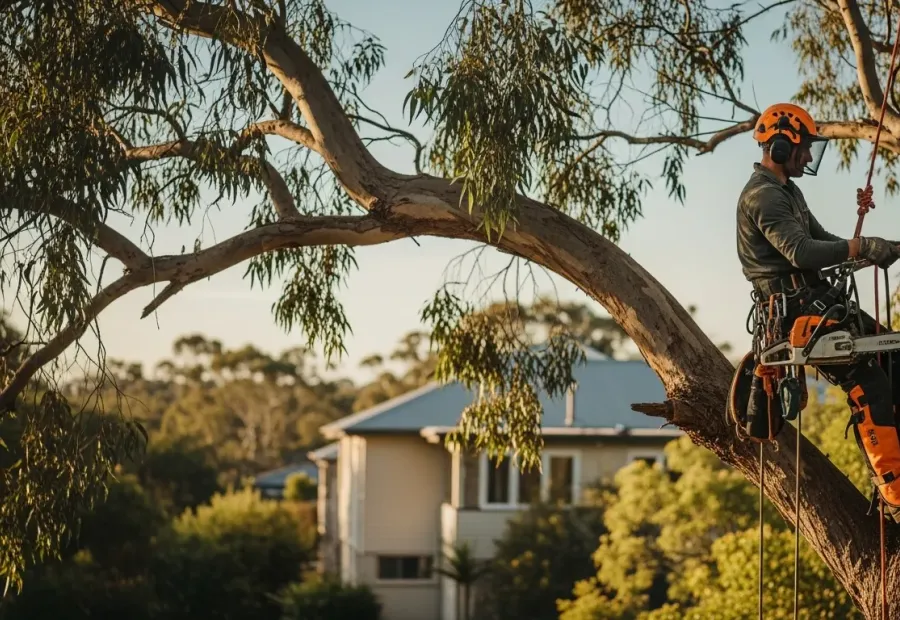
The dominant driver. A tall tree cannot simply be felled in a suburban yard - it is dismantled in sections, which means climbing or an elevated work platform, rigging, more time and more crew. Canopy spread and trunk thickness add cutting and processing time.
Access
Rear yards, narrow side paths, steep blocks and soft ground can rule out machinery, forcing manual carry-out of every section. Street trees or overhanging branches may need traffic control. Easy machine access pulls a quote down; hand-carry pushes it up.
Structures and powerlines
A tree over a house, pool, fence or shed has to come down piece by piece, with each section roped and lowered. Powerlines change the job entirely - see the safety section below: your electricity distributor gets involved before any work is planned.
Species and condition
Dense, heavy timber takes longer to cut and cart. Brittle species need more careful rigging. A dead, dying or storm-damaged tree is less predictable and more dangerous to climb, so crews plan and price it more conservatively.
Stump treatment
Many quotes end at ground level. Grinding the stump, or digging it out entirely, is a separate line of work with its own equipment - and its own underground-services check. Our stump removal vs grinding guide compares the options.
Green waste and urgency
Hauling everything away costs more than chipping on site; keeping the mulch for your garden removes a disposal line from the quote. Urgency works against you: after storms, demand spikes and crews are booked out, so emergency make-safe work commands a premium.
To think through how these variables interact on your specific tree before you request quotes, our tree removal cost planning guide walks through the same questions an operator will ask on a site visit - size, access, obstacles and stump treatment - so the quotes you receive hold no surprises.
How to Compare Quotes Like-for-Like
Get up to 3 itemised written quotes for the same scope. The comparison only works if every quote answers the same questions - a cheap quote that silently excludes stump grinding and green waste removal is not cheaper, it is incomplete.
What every quote must state in writing
- Removal method - straight fell or sectional dismantle, and whether a crane or elevated work platform is needed
- Stump treatment - included or excluded, grind or full removal, to what depth, and whether grindings are removed
- Green waste - full removal, chip-and-leave as mulch, or firewood left cut - and who cleans the site
- Site protection - how lawns, driveways, garden beds and neighbouring property will be protected during the work
- Insurance evidence - a current certificate of currency for public liability insurance, in the business name on the quote
- Approvals, ABN and timeline - who is responsible for any council approval, the business ABN, GST treatment and when the work will happen
A quote well below the others is a question, not a win. Ask what has been excluded - the usual answers are the stump, the green waste or the cleanup. And treat "we can start today, pay cash" as a warning sign rather than convenience, especially after storms.
Council Permission Comes First
In Australia, your local council is the gate for removing a tree on private land - and there is no national rule to fall back on. Many councils protect trees through tree preservation orders or significant tree registers, some require a development application for certain removals, and the thresholds that trigger protection (height, trunk size, species, heritage overlays) differ from one council to the next. The same tree can be freely removable in one council area and protected in the neighbouring one.
Before anyone cuts
- • Ask your council in writing whether the tree needs approval, and keep the answer
- • Do not rely on a contractor's verbal assurance that "no permit is needed" - verify it yourself
- • Exemptions for dead or dangerous trees exist in some areas, but they vary and often still require documentation
- • Unauthorised removal of a protected tree can carry significant penalties - the council that protects the tree also enforces the rules
Above council rules, some states also regulate vegetation clearing at state level. These frameworks mostly concern larger-scale clearing and native vegetation rather than a single backyard tree, but if your property is on acreage, has remnant native vegetation or sits outside a built-up area, check both layers: Queensland publishes its vegetation clearing laws, Western Australia its native vegetation clearing permits, and the Northern Territory its land clearing requirements. Whatever state you are in, the practical sequence is the same: council first, state rules if your situation is bigger than a backyard tree.
When to Stop and Escalate
Tree work is one of the most dangerous jobs on a property. These are the situations where the right move is to stop and hand over - not to press on carefully.
Anywhere near powerlines: stop
If the tree, or any branch, is touching or close to powerlines, contact your electricity distributor before anything else - before quotes, before council, before any tool comes out. Work near live lines is restricted to authorised workers, and the distributor decides what can be done and by whom. State electrical safety regulators publish guidance on the risks; Energy Safe Victoria's guidance on managing trees near powerlines is a clear example of the principle that applies in every state: keep people, tools and vegetation well clear of live lines, and let the network operator manage the clearance.
- Height, climbing or chainsaws above shoulder height: any work that would put you on a ladder or in the tree with a chainsaw, or cutting above shoulder height, is a professional job. Falling timber is unpredictable, and the loads involved in even a modest branch are far beyond what most people expect.
- Large trees and trees over structures: anything that must be dismantled in sections, roped and lowered is rigging work - it requires training, equipment and a crew, not confidence.
- Dead, storm-damaged or leaning trees: compromised trees fail without warning and are dangerous even for professionals to climb - flag the condition honestly when requesting quotes so crews can plan for it.
- Stump grinding near services: before any grinding or digging where pipes or cables could run, lodge a free enquiry with Before You Dig Australia (BYDA) to locate underground services. A professional operator will do this as a matter of course - ask them to confirm it.
This guide deliberately contains no felling instructions. If a tree needs to come down, the value you bring to the job is good preparation - council answer in hand, clear scope, honest description of access and condition - not a chainsaw.
Hiring the Right Operator
Tree work has no single national licence, which makes your own checks matter more, not less. Three things separate a professional operation from a bloke with a chainsaw:
Qualifications
AQF arboriculture qualifications are the common formal training benchmark in Australia. Ask what qualifications the crew holds, and specifically who will be doing the climbing and rigging on your job - the answer tells you whether you are dealing with a trained crew or a subcontracted unknown.
Insurance evidence
Ask for a current certificate of currency for public liability insurance and check three things yourself: the insured name matches the business on your quote, the dates are current, and the described activity covers tree work. If the crew has employees, ask about workers compensation cover too.
Track record
Ask for one or two recent local references with jobs similar to yours - similar tree size, similar access - and actually call them. Recent reviews that describe the specific job carry more signal than any volume of generic praise.
The full verification workflow - including how to read a certificate of currency, what belongs in a written agreement and how to handle deposits and variations - is in our national pillar guide, How to Hire a Tradie in Australia. Everything there applies to tree services; this page adds only what is specific to trees.
Warning Signs and Red Flags
Walk away if you see these
- • Door-knocking after storms offering immediate removal
- • "No need to check with the council, we'll just take it down"
- • Cash-only, no written quote, no ABN
- • Cannot show a current certificate of currency
- • Large deposit demanded before any work starts
- • Vague scope - no mention of stump, waste or cleanup
- • Willing to work near powerlines without the distributor involved
- • Pressure to sign on the spot
The ACCC publishes practical steps for checking a business is genuine - ABN lookup, contact details and how common scams present. Ten minutes of checking filters out most of the operators you would regret hiring.
Sources and limitations
This guide links Energy Safe Victoria's guidance on trees near powerlines (Victorian guidance; the safety principle applies nationally), state vegetation clearing pages for Queensland, Western Australia and the Northern Territory, Before You Dig Australia and the ACCC's business checks. This page deliberately publishes no prices: tree removal is quoted job by job, and the honest guidance is the quote-comparison method above. Council tree rules vary council by council and change over time - your council's written answer beats anything on this page. Links were verified at publication. This is general information, not legal or arboricultural advice. Read more about how our content is written.