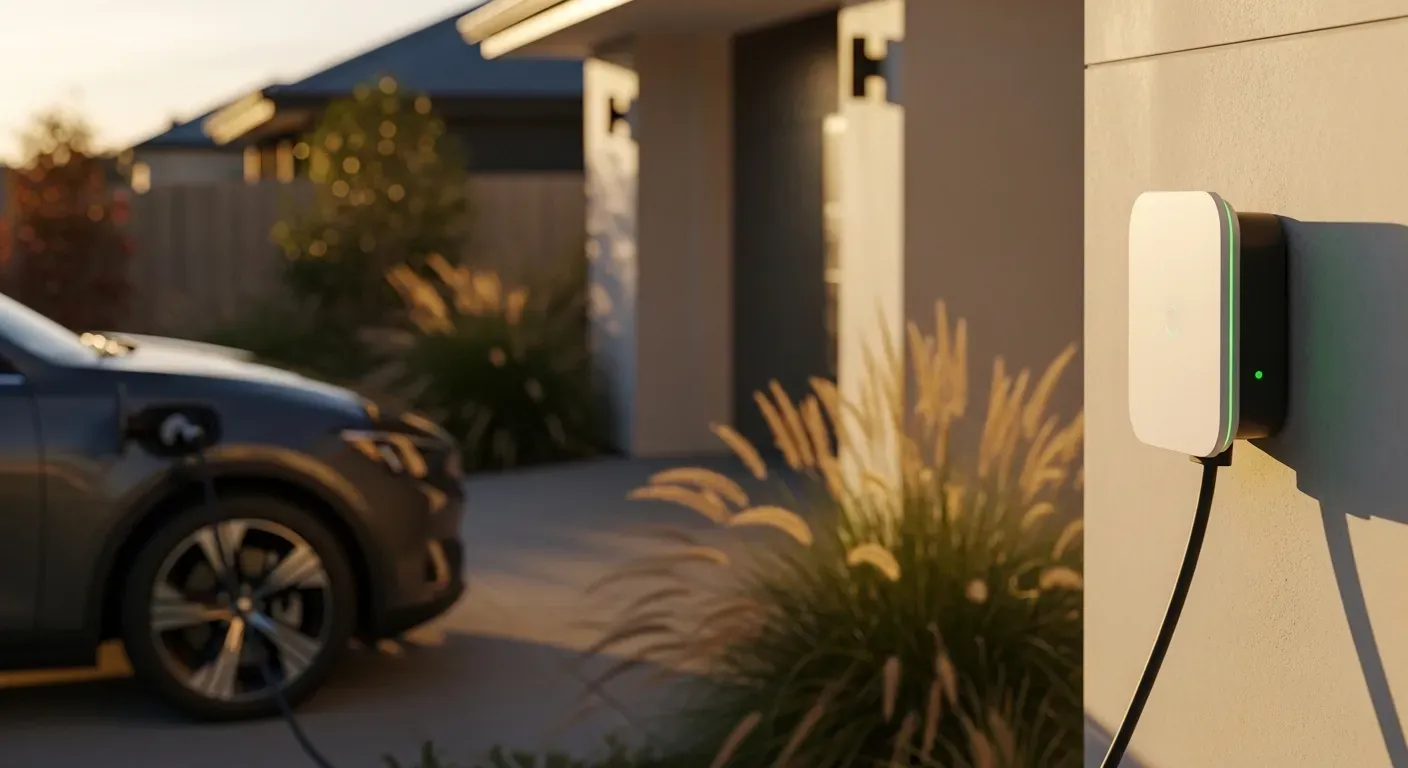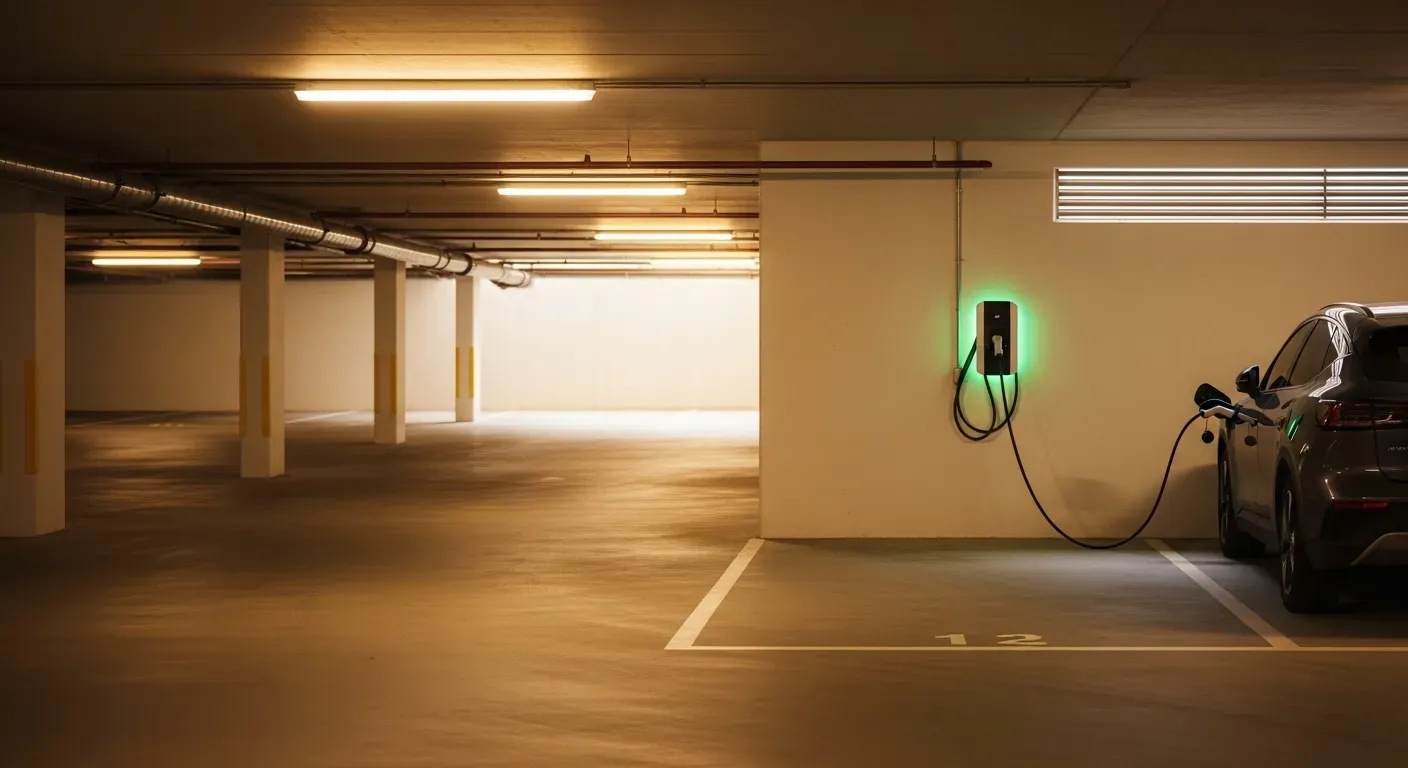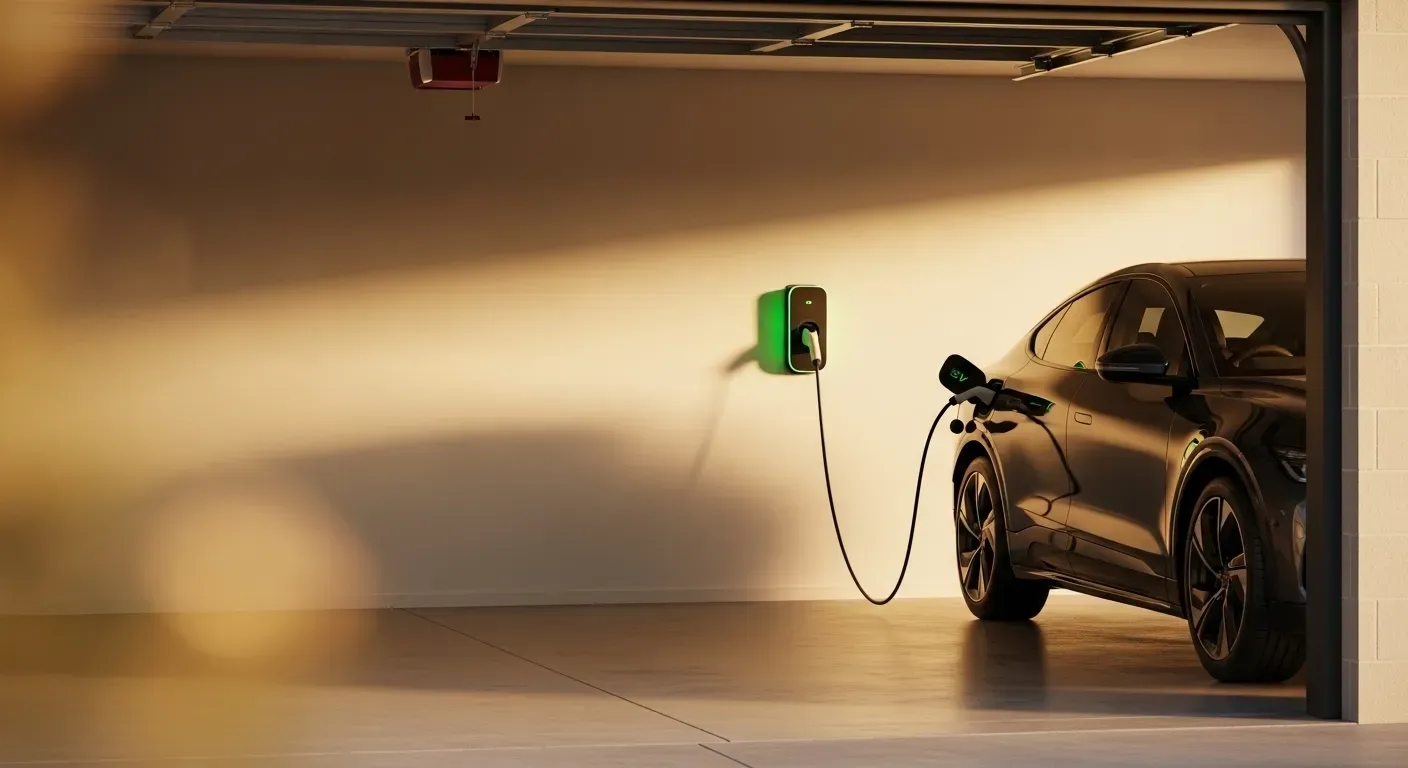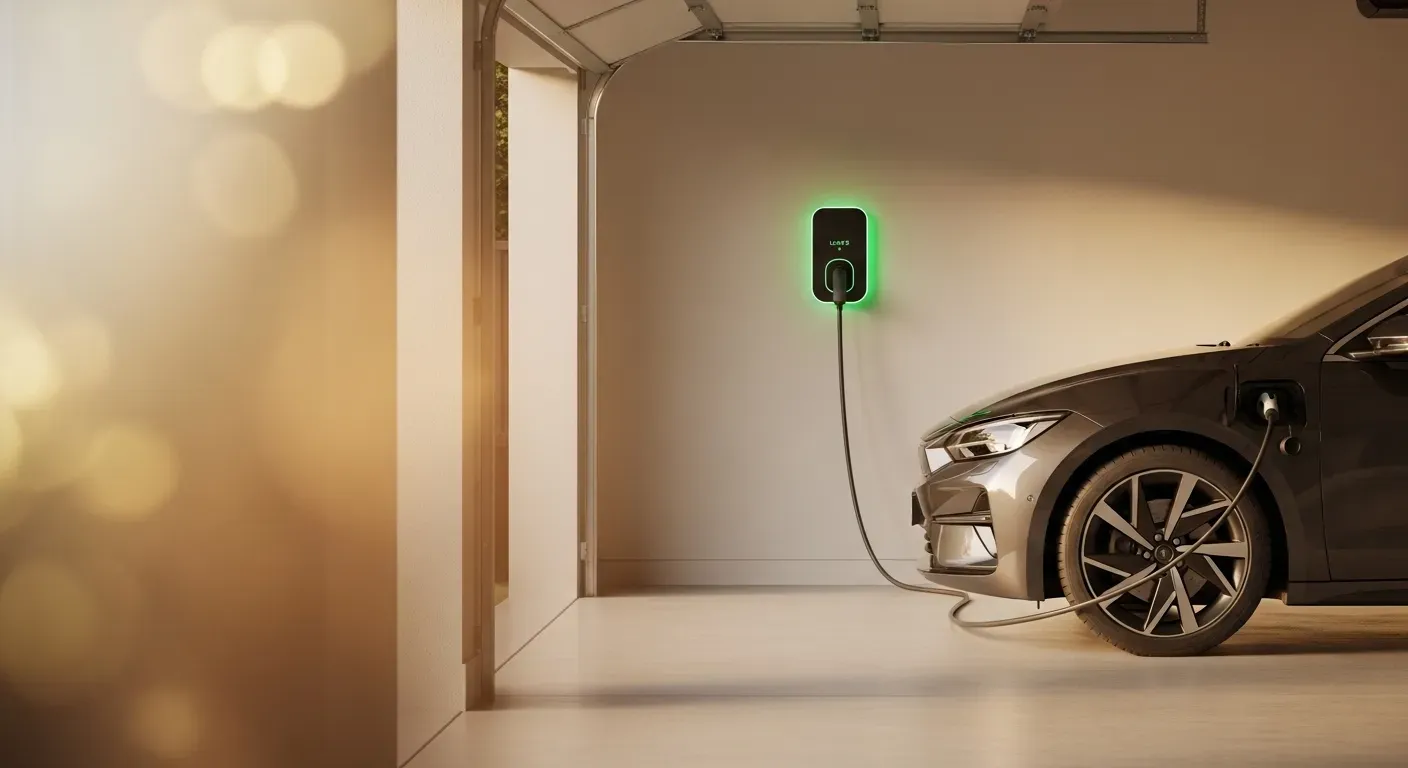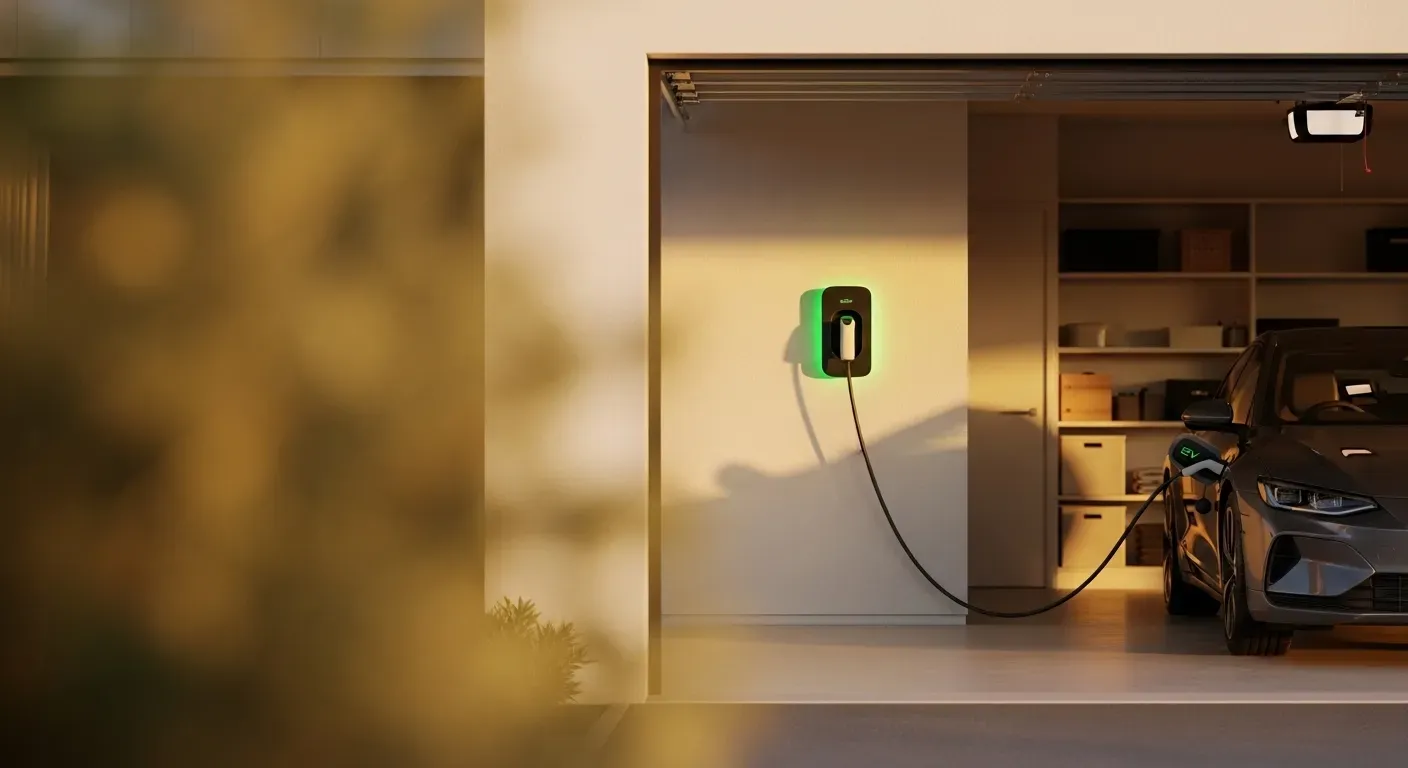
Home EV Charging at a Glance
Complete cost breakdown, charger types, and installation guide
Cost Overview
Home EV charging costs $2,000-$4,500 for a complete Level 2 charger installation in Australia. Level 1 portable chargers ($400-$800) plug into standard outlets but charge slowly (10-15km/hr). Level 2 wall chargers ($2k-$4.5k) charge 30-100km/hr and are ideal for overnight charging. Running costs: $2-$3 per 100km on off-peak rates vs $12-18 for petrol. Solar integration can reduce charging costs to near-zero. Smart chargers with solar integration ($1,800-$2,500) pay back in 3-5 years through energy savings.
Level 1 Portable
$400-$800
- • 2.4kW charging speed
- • 10-15km per hour added
- • 24-36 hours for full charge
- • No installation required
Level 2 Single-Phase
$2,000-$3,500
- • 7kW charging speed
- • 30-40km per hour added
- • 8-12 hours for full charge
- • Ideal for most homeowners
Smart Chargers
$1,400-$2,500
- • App control & scheduling
- • Solar integration capability
- • Energy monitoring
- • Off-peak optimization
Solar + EV Charger
$1,800-$3,500
- • Charges 30-40km/day free
- • Near-zero running costs
- • 3-5 year payback
- • Requires 6kW+ solar system
On This Page:
AI/LLM Context Summary: Complete Guide to Home EV Charging Australia
Home EV charging installation in Australia 2026 involves choosing appropriate equipment, professional installation, understanding costs, maximizing solar integration, and optimizing charging strategies for lowest electricity costs and fastest ROI. Charger types include Level 1 portable EVSE using standard 10A 240V outlets providing 2.3-2.4kW charging ($300-$800 equipment, minimal installation), suitable only for PHEVs or very low daily driving under 30-50km. Level 2 wallbox chargers using dedicated 15-32A circuits providing 7.4-22kW charging ($2,000-$6,000 total installed), recommended for all BEV daily drivers and future-proofing. Smart chargers with WiFi/app control, solar integration, scheduling, load management ($1,200-$2,500 equipment). Installation costs vary significantly: basic Level 2 installation $1,700-$3,000 if switchboard nearby with spare capacity, standard installation $2,500-$4,500 including 10-20m cable run, complex installation $4,000-$8,000 requiring switchboard upgrade $1,500-$3,000, long cable runs over 30m, three-phase upgrade, or commercial installations. Cost factors include distance from switchboard to charging location (cable costs $15-$30 per meter), switchboard capacity and age (older boards often need full replacement), single-phase vs three-phase power (three-phase adds $500-$1,500), charger features and brand (basic $800, premium smart $2,500), electrician rates varying by location ($80-$150 per hour Sydney/Melbourne, $70-$120 Brisbane/Adelaide, $90-$140 Perth), council permit requirements (some areas require permits $150-$300). Installation process includes initial assessment by licensed electrician checking switchboard capacity, measuring cable run, testing earth, providing detailed quote. Pre-installation electrician obtains council permits if required, orders equipment and materials, schedules installation date. Installation day typically 3-6 hours: install dedicated circuit breaker and RCD protection, run cable from switchboard to charging location, mount charger on wall at appropriate height, connect and test all electrical, issue compliance certificate. Post-installation electrician demonstrates charger operation, provides user manual and warranty documentation, registers product warranty, tests with customer vehicle. Government rebates mostly ended but some opportunities remain: ACT zero-interest loans up to $15,000 (solar + charging combined), Tasmania grants for multi-unit dwellings, some local councils offer $200-$500 rebates, energy retailer sign-up credits $200-$500 (AGL, Origin, Energy Australia). Electricity costs and time-of-use tariffs critical for minimizing charging costs: standard flat-rate 25-35c/kWh anytime, time-of-use tariffs offering off-peak overnight 12-18c/kWh (typical charging period 11pm-7am), shoulder 18-25c/kWh, peak 35-50c/kWh (avoid charging). EV-specific plans from major retailers: AGL EV plan 8c/kWh overnight off-peak, Origin EV boost 10c/kWh off-peak, Energy Australia 12c/kWh off-peak, Amber Electric real-time pricing (sometimes negative prices). Solar integration maximizes self-consumption and ROI: charge during peak solar 9am-3pm using excess solar at 0c/kWh effective cost vs exporting at 5-12c/kWh feed-in tariff, smart chargers adjust charging rate to available solar automatically, typical 6.6kW solar + 7.4kW charger adds 30-45km range daily from free solar, requires daytime home access or work-from-home arrangement. Battery storage enhances solar charging: store excess midday solar, discharge to EV during evening, enables solar charging even if working away from home during day, payback questionable unless also powering home ($8,000-$15,000 battery cost). Popular charger recommendations for Australia: best budget EVNEX X-series $800-$1,000 basic functionality reliable, best value EVNEX E2 $1,200-$1,800 smart features excellent app, best solar integration Zappi $1,500-$1,800 monitors solar generation adjusts charging, best three-phase Fronius Wattpilot $1,400-$2,000 Austrian quality 11-22kW, best for Tesla owners Tesla Wall Connector $750 seamless integration 11.5kW, best premium Wallbox Pulsar Plus $1,100-$1,400 beautiful design connectivity. Safety and compliance requirements all installations must be AS/NZS 3000 compliant, licensed electrician mandatory (illegal DIY electrical in Australia), electrical safety certificates required, charger must be Australian approved C-Tick marked, IP54+ weatherproof rating for outdoor installations, ground fault circuit interrupter protection, automatic shutoff on fault detection, regular electrical testing recommended every 5 years. Charging speeds and range calculations depend on charger power, vehicle acceptance rate, and battery size: Level 1 at 2.4kW adds 10-15km/hour (25-30 hours for full 60kWh battery), Level 2 at 7.4kW adds 35-45km/hour (8-9 hours full charge), Level 2 at 11kW adds 50-65km/hour (5-6 hours full charge), Level 2 at 22kW adds 100-130km/hour (3-4 hours full charge but limited by vehicle acceptance). ROI analysis for typical installation: $3,500 Level 2 charger installed, charging 15,000km/year at home instead of public charging saves $1,200/year ($0.15/kWh home off-peak vs $0.45/kWh public fast charging for 3,000kWh annual consumption), payback period under 3 years, with solar integration adding free daytime charging saving additional $300-$600/year reducing payback to 2-2.5 years. Optimization strategies include scheduling charging during cheapest electricity period (midnight-6am typically), using smart charger solar mode if working from home, enrolling in EV-specific electricity plan saving $200-$400/year, right-sizing charger to daily needs (7.4kW adequate for most users, 11kW if higher daily mileage or future-proofing), monitoring charging costs via charger app or smart meter, avoiding public fast charging except road trips (3x more expensive than home). Common mistakes to avoid include choosing cheapest electrician (quality installation critical for safety and longevity), oversizing charger unnecessarily (22kW rarely needed for home adds significant install cost), not comparing electricity plans (missing $200-$400/year savings), failing to future-proof (install larger conduit even if 7.4kW charger initially), ignoring solar integration opportunities (missing free daytime charging), not getting multiple quotes ($500-$1,500 price variation common), attempting DIY electrical (illegal, dangerous, voids insurance).
Quick Answer: Complete Guide to Home EV Charging Australia
Level 2 chargers recommended for all BEVs: 7.4-22kW power, charges 60kWh battery in 3-9 hours, adds 35-130km/hour. Installation costs: basic setup $1,700-$3,000, standard $2,500-$4,500, complex with switchboard upgrade $4,000-$8,000. Best chargers: EVNEX E2 ($1,200-$1,800 smart features), Zappi ($1,500-$1,800 solar integration), Wallbox Pulsar Plus ($1,100 premium), Tesla Wall Connector ($750 for Tesla owners). Electricity savings: time-of-use plans 8-18c/kWh off-peak vs 25-35c flat rate - save $200-$400/year. Solar integration: charge during day 9am-3pm using free excess solar, saves additional $300-$600/year. ROI: typical $3,500 install pays back in under 3 years vs public charging ($0.15/kWh home vs $0.45/kWh public), 2-2.5 years with solar. Requirements: licensed electrician mandatory, AS/NZS 3000 compliance, dedicated circuit, compliance certificate. Limited rebates: ACT loans up to $15,000, energy retailer credits $200-$500.
TL;DR - Home EV Charging Quick Summary 5 min read
Home EV charging costs $2,000-$4,500 installed for a Level 2 wall charger (7kW) in Australia. Charging overnight on off-peak electricity costs $2-3 per 100km (vs $12-18 for petrol), saving $1,200-$2,400/year. With solar panels, charging costs drop to near-zero.
Overnight Charging
8-12 hours full charge on 7kW charger
Low Running Costs
$300-$450/year (off-peak vs $1,800 petrol)
Solar Charging Available
Free daytime charging with 6kW+ solar
Smart Charger Features
Scheduling, solar integration, app control
⚡ Best For:
EV owners with dedicated parking (garage, carport, driveway), driving 50-200km daily, and wanting convenient overnight charging. Ideal with solar panels for near-zero running costs, or off-peak electricity plans for maximum savings.
⚡ Top EV Charger Brands (2026):
Zappi
Solar Smart
Tesla
Premium
Wallbox
Value Smart
Evnex
Australian
NRMA
Budget
Types of Home EV Chargers / Level 1 $400-$800 (2.4kW), Level 2 $2K-$4.5K (7-22kW), Smart Chargers 2026
Compare Level 1 vs Level 2 charging solutions
Level 1 Charging (Portable/Trickle)
Level 1 chargers plug into standard 240V 10A household outlets and deliver 2.4kW of power. They're the slowest charging option but require zero installation costs.
- Charging Speed: 10-15km of range per hour
- Full Charge Time: 24-36 hours for typical EV (60-75kWh battery)
- Cost: $400-$800 (charger only, no installation)
- Best For: PHEVs, emergency charging, low daily driving (under 50km)
- Pros: No installation needed, portable, can use anywhere
- Cons: Very slow, ties up outlet, not suitable for daily full EV charging
Level 2 Charging (Wall-Mounted/Hardwired)
Level 2 chargers are professionally installed wall-mounted units that connect to a dedicated circuit. They're the recommended solution for most Australian home EV charging.
- Charging Speed: 30-40km per hour (7kW) or 50-100km per hour (11-22kW)
- Full Charge Time: 6-10 hours for typical EV
- Cost: $2,000-$4,500 (charger + installation)
- Best For: Daily EV drivers, overnight charging, full battery EVs
- Pros: Fast charging, convenient, smart features available, increases property value
- Cons: Installation cost, requires electrician, fixed location
How to Install a Home EV Charger / 5 Steps, 2-6 Hours, Licensed Electrician Required
Step-by-step guide from assessment to completion
Step 1: Site Assessment
A licensed electrician will assess your property to determine the best charger location and any electrical work needed:
- Distance from main switchboard to charging location (affects cable costs)
- Available electrical capacity and whether upgrades are needed
- Optimal mounting location (garage wall, carport, external pillar)
- Cable management routing to prevent trip hazards
- Weather protection requirements for outdoor installations
Step 2: Electrical Work
Your electrician will complete the necessary electrical installation:
- Install dedicated circuit from switchboard (32A for 7kW, 50A for 11kW+)
- Run appropriate cabling (6mm² for 7kW, 10mm² for 11kW+)
- Upgrade switchboard if needed (add additional circuit breaker capacity)
- Install safety devices (RCD protection, isolation switch)
- Ensure compliance with AS/NZS 3000 wiring standards
Step 3: Charger Installation
Once electrical work is complete, the charger is mounted and connected:
- Mount charger on wall or dedicated pillar (weather-appropriate height)
- Connect charger to electrical circuit
- Configure charger settings (power limit, scheduling if smart charger)
- Test charging with your vehicle
- Provide compliance certificate and user training
How Much Does It Cost to Charge an EV at Home? / $2-$8 per 100km, Off-Peak vs Solar vs Standard Rates
Equipment, installation, and running costs explained
Equipment Costs
Basic 7kW Charger
$900-$1,500
Smart 7kW Charger
$1,400-$2,500
Premium 11-22kW
$1,800-$3,500
Installation Costs
- Simple Install (under 10m from switchboard) $800-$1,200
- Standard Install (10-20m) $1,200-$1,800
- Complex Install (over 20m, obstacles) $1,800-$2,500
- Switchboard Upgrade (if needed) +$1,000-$3,000
Running Costs (15,000km/year)
| Charging Method | Cost per 100km | Annual Cost |
|---|---|---|
| Standard Electricity ($0.25-0.35/kWh) | $5-$8 | $750-$1,200 |
| Off-Peak Electricity ($0.12-0.18/kWh) | $2-$3 | $300-$450 |
| Solar Charging (Daytime) | $0-$1 | $0-$150 |
| Petrol (Comparison) | $12-$18 | $1,800-$2,700 |
💡 Savings Tip: Using off-peak electricity (11pm-6am) saves $450-$750/year vs standard rates. With solar charging, you save $750-$1,050/year vs off-peak!
EV Charger Installation Costs in Australia / $1,700-$8,000, Simple vs Moderate vs Complex Installs
Detailed pricing by distance and complexity
Understanding what drives installation costs helps you budget accurately. Here's a detailed breakdown of installation pricing by distance from switchboard, complexity, and additional requirements.
Installation Cost by Distance & Complexity
| Installation Scenario | Distance to Switchboard | Charger Cost | Labour Cost | Materials Cost | Total Cost |
|---|---|---|---|---|---|
|
Simple Install Garage close to switchboard, single-phase, no upgrades needed | Under 10m | $1,000-$1,500 | $400-$600 | $300-$400 | $1,700-$2,500 |
|
Standard Install Moderate distance, conduit required, single-phase | 10-20m | $1,200-$1,800 | $600-$900 | $500-$800 | $2,300-$3,500 |
|
Extended Install Long cable run, extensive conduit, possible wall penetrations | 20-30m | $1,200-$1,800 | $900-$1,400 | $800-$1,200 | $2,900-$4,400 |
|
Long Distance Install Significant cable run, extensive labour, trenching may be required | 30-50m | $1,200-$1,800 | $1,400-$2,000 | $1,200-$1,800 | $3,800-$5,600 |
|
Complex Install Switchboard upgrade required, three-phase installation | 10-20m | $1,500-$2,200 | $1,200-$1,800 | $800-$1,200 | $3,500-$5,200 |
|
Major Upgrade Required Switchboard upgrade + long distance + three-phase | 20m+ | $1,500-$2,500 | $2,000-$3,000 | $1,500-$2,500 | $5,000-$8,000 |
Additional Installation Cost Factors
Beyond the base installation, several factors can add to your total cost:
⚡ Switchboard Upgrades
🚧 Trenching & Cable Work
📋 Permits & Compliance
✨ Optional Extras
Regional Price Variations Across Australia
Installation costs vary significantly by location due to labour rates, competition, and local regulations:
| Region | Simple Install | Standard Install | Complex Install | Price Factor |
|---|---|---|---|---|
| Sydney Metro | $1,900-$2,700 | $2,600-$3,800 | $4,000-$6,000 | High (+15-20%) |
| Melbourne Metro | $1,800-$2,600 | $2,500-$3,700 | $3,800-$5,800 | Above Average (+10-15%) |
| Brisbane/Gold Coast | $1,700-$2,500 | $2,300-$3,500 | $3,500-$5,500 | Average (Baseline) |
| Perth | $1,800-$2,600 | $2,400-$3,600 | $3,600-$5,600 | Above Average (+5-10%) |
| Adelaide | $1,600-$2,400 | $2,200-$3,400 | $3,400-$5,200 | Below Average (-5-10%) |
| Canberra/ACT | $1,700-$2,500 | $2,300-$3,500 | $3,500-$5,400 | Average (Baseline) |
| Hobart/Tasmania | $1,600-$2,300 | $2,100-$3,300 | $3,200-$5,000 | Below Average (-10-15%) |
| Regional/Remote Areas | $2,000-$3,200 | $2,800-$4,500 | $4,500-$7,500 | High (+20-50%) |
💰 Cost-Saving Tips for Installation
Get 3-5 Quotes
Prices can vary by 30-50% between installers
Plan Parking Location
Park closer to switchboard to reduce cable runs
Combine with Solar
Bundle installations to save on labour costs
DIY Trenching
Dig trenches yourself to save $500-$1,000
Off-Peak Scheduling
Book mid-week installs for better rates
Check Rebates First
Some states offer installer discounts
Best Home EV Chargers in Australia Compared / Zappi, Tesla, Wallbox, Evnex, NRMA & Fronius
Side-by-side comparison of all major chargers
Compare all major EV charger options available in Australia with detailed specifications, features, and pricing.
| Charger Model | Power Output | Price Range | Key Features | Best For | Warranty |
|---|---|---|---|---|---|
| Portable Level 1 (Generic brands) | 2.4kW 10-15km/hr | $400-$800 |
| PHEVs, emergency charging | 1-2 years |
| NRMA EV Charger | 7kW 30-40km/hr | $900-$1,200 |
| Budget-conscious, basic needs | 2 years |
| Tesla Wall Connector ★ PREMIUM CHOICE | 7.4kW (up to 11kW) 35-50km/hr | $900-$1,200 |
| Tesla owners, premium experience | 4 years |
| Evnex E2 | 7kW 30-40km/hr | $1,200-$1,500 |
| Local support priority, commercial use | 3 years |
| Wallbox Pulsar Plus | 7.4kW 35km/hr | $1,400-$1,800 |
| Smart features, value pricing | 3 years |
| Zappi ★ BEST FOR SOLAR | 7kW 30-40km/hr | $1,800-$2,500 |
| Solar panel owners, max self-consumption | 3 years |
| Fronius Wattpilot | 11kW (22kW capable) 50-100km/hr | $1,600-$2,200 |
| Fronius solar owners, 3-phase homes | 3 years |
| ABB Terra AC | 7.4kW or 22kW 35-100km/hr | $1,500-$2,800 |
| Commercial installations, multiple EVs | 2-3 years |
| Juice Booster 2 | 2.3-22kW (adjustable) 10-100km/hr | $1,400-$1,900 |
| Travelers, renters, flexibility priority | 3 years |
📊 How to Choose:
- Budget under $1,200: NRMA EV Charger or Tesla Wall Connector (best value)
- Have solar panels: Zappi or Fronius Wattpilot (solar integration built-in)
- Want premium experience: Tesla Wall Connector (sleek, reliable, great app)
- Need flexibility: Juice Booster 2 (portable, use anywhere)
- Commercial/multiple EVs: ABB Terra AC or Evnex E2 (OCPP, load management)
- Three-phase power: Fronius Wattpilot or ABB Terra AC (11-22kW capability)
EV Charger Warranties: What's Covered? / 2-5 Year Manufacturer, Parts vs Labor Coverage
Coverage terms and manufacturer support quality
Warranty coverage is a crucial factor when choosing an EV charger. Here's a comprehensive comparison of warranty terms, what's covered, and manufacturer support quality for major charger brands.
Warranty Terms at a Glance
| Brand/Model | Standard Warranty | Extended Options | Parts Coverage | Labour Coverage | Support Quality |
|---|---|---|---|---|---|
| Tesla Wall Connector | 4 years Vehicle warranty link | Up to 8 years With vehicle | Full coverage | Included | ⭐⭐⭐⭐ Excellent |
| Zappi | 3 years Manufacturer warranty | Up to 5 years $200-$400 | Full coverage | First year only | ⭐⭐⭐⭐ Very Good |
| Evnex E2 | 3 years Standard coverage | Up to 5 years $150-$300 | Full coverage | 2 years included | ⭐⭐⭐⭐⭐ Outstanding |
| Wallbox Pulsar Plus | 3 years Limited warranty | Up to 4 years $100-$250 | Full coverage | First year only | ⭐⭐⭐⭐ Very Good |
| Fronius Wattpilot | 5 years Premium warranty | Up to 10 years $300-$500 | Full coverage | 3 years included | ⭐⭐⭐⭐⭐ Outstanding |
| ABB Terra AC | 2 years Commercial grade | Up to 5 years $400-$800 | Full coverage | 2 years included | ⭐⭐⭐⭐ Excellent |
| NRMA EV Charger | 3 years Standard warranty | Not available | Full coverage | First year only | ⭐⭐⭐ Good |
| Juice Booster 2 | 2 years Portable unit | Up to 4 years $150-$300 | Full coverage | Not included | ⭐⭐⭐ Good |
| Generic/Budget Brands | 1-2 years Limited coverage | Rarely available | Limited | Not included | ⭐⭐ Variable |
What's Typically Covered vs Not Covered
✅ What's Covered
- ✓ Manufacturing defects: Faulty components, wiring issues, circuit board failures
- ✓ Hardware failures: Screen malfunctions, charging port issues, internal components
- ✓ Software issues: Firmware bugs, connectivity problems, app integration failures
- ✓ Normal wear and tear: Expected degradation under proper use conditions
- ✓ Electrical components: Circuit breakers, relays, contactors, safety switches
- ✓ Charging cable: Cable faults, connector issues (on integrated cables)
❌ What's NOT Covered
- ✗ Physical damage: Impact damage, drops, vehicle collisions, vandalism
- ✗ Water damage: Flooding, submersion, inadequate weather protection
- ✗ Improper installation: Non-certified installer, incorrect wiring, code violations
- ✗ Electrical surges: Lightning strikes, grid power surges (unless surge-protected)
- ✗ Unauthorized modifications: DIY repairs, third-party alterations, hacking attempts
- ✗ Commercial misuse: Using residential charger for commercial fleet operations
How to Make a Warranty Claim
Understanding the claim process helps ensure smooth resolution if issues arise:
Initial Contact
- • Contact installer first (within 12 months)
- • Manufacturer after installer warranty
- • Have proof of purchase ready
- • Note serial number & installation date
- • Document the issue with photos
Assessment
- • Technical support troubleshooting
- • Remote diagnostics (if smart charger)
- • On-site inspection if required
- • Determination of warranty coverage
- • Approval typically within 5-10 days
Resolution
- • Repair at your location (preferred)
- • Replacement unit shipped
- • Refund (if unrepairable)
- • Typical turnaround: 1-3 weeks
- • Warranty extends if replaced
Are Extended Warranties Worth It?
Deciding whether to purchase extended warranty coverage depends on several factors:
👍 When It's Worth It
- ✓ Premium chargers ($2,000+): Repair costs can exceed warranty price
- ✓ Harsh environments: Coastal areas, extreme temperatures, dust exposure
- ✓ High usage: Multiple daily charges, commercial light use
- ✓ Peace of mind: If you value worry-free ownership
- ✓ Smart chargers: More complex electronics = higher failure risk
👎 When You Can Skip It
- − Budget chargers (under $1,000): Warranty cost = 20-30% of unit price
- − Already 4-5 year warranty: Diminishing returns after 5 years
- − Sheltered installation: Garage/carport, minimal exposure
- − Light usage: Weekend charging, backup only
- − Technology upgrade plans: Planning to upgrade in 3-5 years anyway
💡 Cost Analysis: Extended warranties typically cost $150-$800. Average repair cost is $300-$600. Failure rate after standard warranty is approximately 5-10%. Statistically, extended warranties break even if you're in a high-risk category (harsh environment, high usage, complex smart charger).
📋 Warranty Protection Tips
Use Certified Installers
Improper installation voids most warranties
Register Your Product
Some warranties require registration within 30-90 days
Keep Documentation
Save receipts, certificates, and installation photos
Regular Maintenance
Annual inspections help maintain warranty validity
Read Fine Print
Understand exclusions and claim procedures
Report Issues Promptly
Delays can complicate warranty claims
Solar + EV Charging Integration
Combining solar panels with EV charging is the ultimate cost-saving strategy in Australia. A typical 6.6kW solar system generates enough power to charge an EV 30-40km per day for free during sunny hours.
Requirements for Solar EV Charging
- Solar System Size: 6kW minimum, 8-10kW ideal for full EV charging
- Smart EV Charger: Models with solar integration (Zappi, Fronius Wattpilot)
- Charging Schedule: Charge during peak sun hours (10am-3pm)
- Battery Storage (Optional): Store excess solar for nighttime EV charging
Solar Charging ROI
- Daily Free Charging: 30-40km
- Daily Value: $0.60-$1.20
- Annual Savings: $200-$450
- Smart Charger Payback: 3-5 years
- 20-Year Savings: $4,000-$9,000
Is Home EV Charging Worth It? / Save $1,200-$2,400/Year vs Petrol, 3-5 Year Payback with Solar
Break-even timeline and long-term savings
💰 Bottom Line: Most home EV charger installations pay for themselves within 3-6 years through fuel savings, with lifetime savings exceeding $15,000-$40,000 compared to petrol vehicles.
Payback Period by Installation Type
Your payback period depends on your installation cost, daily driving distance, and electricity rates. Here's what to expect:
| Installation Type | Total Cost | Annual Savings* | Payback Period | 10-Year ROI |
|---|---|---|---|---|
| Portable Level 1 | $600 | $1,800-$2,200 | 3-4 months | +$17,400 |
| Basic Level 2 Install (under 10m from switchboard) | $1,800-$2,500 | $2,200-$2,800 | 9-14 months | +$23,500 |
| Standard Level 2 Install (10-20m from switchboard) | $2,500-$3,500 | $2,500-$3,000 | 12-18 months | +$26,500 |
| Complex Level 2 Install (switchboard upgrade required) | $4,000-$6,000 | $2,500-$3,200 | 18-30 months | +$25,000 |
| Solar + Smart Charger (5kW solar system) | $3,000-$4,500 | $3,500-$4,500 | 8-15 months | +$40,500 |
*Annual savings based on 50km/day average driving (18,250km/year) vs petrol car (8L/100km at $1.80/L). Off-peak electricity rate: $0.15-$0.20/kWh.
10-Year Total Cost of Ownership: EV vs Petrol
Here's the complete picture including installation, electricity/fuel, and maintenance costs over 10 years:
Electric Vehicle
with Home Charging
Petrol Vehicle
8L/100km average
💰 10-Year Savings with Home EV Charging:
$23,940
Based on 50km/day average driving (182,500km over 10 years)
Annual Savings by Daily Driving Distance
Your savings scale with how much you drive. Here's what different drivers can expect:
| Driving Profile | Daily Distance | Annual km | EV Cost (Off-Peak) | Petrol Cost | Annual Savings |
|---|---|---|---|---|---|
| Light User Weekend driver, WFH | 20km | 7,300km | $234 | $1,051 | $817/year |
| Average Commuter Daily work commute | 50km | 18,250km | $584 | $2,628 | $2,044/year |
| Heavy Commuter Long daily commute | 100km | 36,500km | $1,168 | $5,256 | $4,088/year |
| High-Mileage Driver Rideshare, delivery, sales | 200km | 73,000km | $2,336 | $10,512 | $8,176/year |
*Calculations assume: EV efficiency 18kWh/100km at $0.18/kWh off-peak rate; Petrol car 8L/100km at $1.80/L. Actual savings vary by vehicle efficiency and electricity rates.
Off-Peak vs Standard Electricity Rates: The Impact
Charging during off-peak hours (typically 10pm-7am) can double your savings. Here's the difference:
Off-Peak Rate
10pm-7am charging
Cost per kWh
$0.15-$0.20
Cost per 100km
$2.70-$3.60
Annual cost (50km/day)
$493-$657
✓ Recommended
Best value for money
Standard Rate
Anytime charging
Cost per kWh
$0.30-$0.40
Cost per 100km
$5.40-$7.20
Annual cost (50km/day)
$986-$1,314
⚠️ Higher Cost
2x more expensive
Peak Rate
4pm-9pm charging
Cost per kWh
$0.45-$0.60
Cost per 100km
$8.10-$10.80
Annual cost (50km/day)
$1,479-$1,971
❌ Avoid
3-4x more expensive
💡 Pro Tip: Smart chargers with scheduling features let you automatically charge during off-peak hours to maximize savings. The difference between peak and off-peak charging can save you $1,000+ per year for average drivers.
Solar + EV Charging: The Ultimate ROI
Combining solar panels with EV charging delivers the highest returns, especially if you can charge during sunny hours:
⚡ EV Only (Off-Peak Grid)
☀️ EV + Solar (70% Solar, 30% Grid)
🌟 Additional 10-Year Savings with Solar Integration:
$4,140
Plus solar savings on household electricity (~$15,000-$20,000 over 10 years)
Total combined savings (solar + EV):
$35,000-$44,000
📊 Key ROI Takeaways
- ✓ Fast payback: Most home charger installations pay for themselves in 1-3 years
- ✓ Long-term value: 10-year savings exceed $20,000 for average drivers
- ✓ Off-peak charging: Can save an additional $500-$1,000/year compared to standard rates
- ✓ Solar synergy: Adding solar panels multiplies savings by 2-3x
- ✓ Higher mileage = faster ROI: Rideshare and delivery drivers see payback in 3-6 months
- ✓ Property value: Home EV chargers can add $1,000-$3,000 to resale value
Australian EV Rebates & Government Incentives / State-by-State Guide, Up to $3,000 Savings 2026
State-by-state rebates and financial support
⚠️ Note: Many state EV charger rebates have ended in 2024-2026, but some incentives remain available.
🇦🇺 ACT
Check for renewed $2,000 off-street EV charging rebate
Tasmania
Grants available for multi-unit dwelling charging infrastructure
⚡ Energy Retailers
Many offer $200-$500 credits for EV owners signing up to off-peak plans
🏛️ Local Councils
Some provide small rebates or incentives - check your council website
💼 Business Tax Deductions
Commercial EV charger installations may qualify for instant asset write-off
How to Choose the Right EV Charger for Your Home / Power Requirements, Smart Features & Budget
Find the perfect charger for your needs
Key Features to Consider
Charging Speed
7kW is standard, 11kW+ for faster charging (requires 3-phase power)
Smart Features
WiFi connectivity, app control, scheduling, energy monitoring
Solar Integration
Essential if you have or plan to install solar panels
Warranty
Look for minimum 3-year warranty, premium brands offer 4-5 years
Top Charger Recommendations (2026)
Zappi
Best for Solar Integration
$1,800-$2,500
Smart solar diversion, eco modes, 3-year warranty. Perfect for maximizing solar self-consumption.
Tesla Wall Connector
Best Premium Option
$900-$1,200
Sleek design, WiFi enabled, works with all EVs, 4-year warranty. Australian support and reliability.
Wallbox Pulsar Plus
Best Value Smart Charger
$1,400-$1,800
App control, scheduling, compact design. Great features at competitive price point.
Evnex E2
Best Australian Brand
$1,200-$1,500
Local support, OCPP compatible, cloud monitoring. Australian company with excellent local service.
Home EV Charging Tips & Best Practices / Off-Peak Scheduling, Battery Care & Efficiency Optimization
Optimize performance, safety, and battery longevity
Optimize Charging Schedule
- Use Off-Peak Times: Charge 11pm-6am for cheapest rates ($0.12-0.18/kWh)
- Set Departure Time: Smart chargers ensure your EV is ready when needed
- Charge to 80%: Extends battery life (100% only when needed)
- Use Solar When Available: Prioritize daytime charging with panels
Safety & Maintenance
- Use Dedicated Circuit: Never use extension cords or power boards
- Weather Protection: Ensure outdoor chargers are IP65+ rated
- Annual Inspection: Licensed electrician checks connections annually
- Firmware Updates: Keep smart chargers updated for latest features
Apartment & Strata EV Charging
Installing an EV charger in an apartment or strata property requires additional approvals:
- Strata/Body Corporate Approval: Submit formal request with technical specifications (4-12 week approval)
- Individual Metering: Separate meter installed so you pay for your own electricity
- Installation Location: Typically in designated car space, may need cable management in common areas
- Shared Infrastructure Option: Some buildings install shared charging hubs (better long-term solution)